
Open excavation is a commonly used method in construction and civil engineering projects, where the ground is removed to create a space for a building, road, or other structure. One key factor in open excavation is the critical depth, which refers to the maximum depth that can be excavated without additional support or reinforcement. Understanding critical depth is crucial for ensuring the stability and safety of open excavations, as exceeding this limit can lead to collapses and potentially dangerous situations. In this article, we will take an in-depth look at critical depth, its importance in open excavation, and how it can be calculated and managed to ensure a successful and safe construction project.
Table of Contents
How to determine the Critical Depth in Open Excavation?
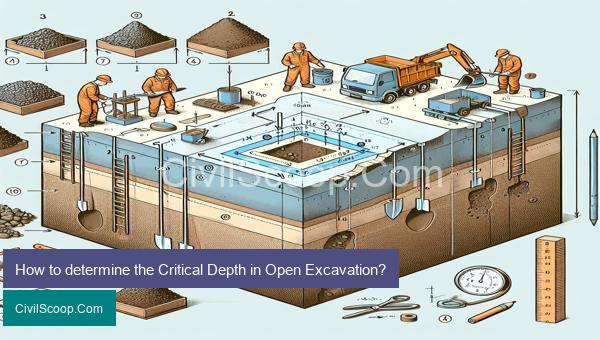
Critical depth in open excavation is the depth at which excavation turns from open cut to a deeper excavation method, such as tunneling or shaft sinking. The determination of critical depth is crucial for safe and efficient construction operations in civil engineering projects. Failure to accurately determine the critical depth can lead to unstable excavations, safety hazards, and project delays. In this article, we will discuss the factors that affect critical depth and the methods to determine it in open excavation.
Factors Affecting Critical Depth:
1. Soil Properties: The type and properties of the soil play a significant role in determining the critical depth. Soft, loose soils are more likely to collapse at shallow depths, while stiff, cohesive soils can support deeper excavations.
2. Water Table: The depth of the water table also affects critical depth. Excavations near the water table are more susceptible to instability and require additional support.
3. Slope Stability: The stability of the slope is another crucial factor in critical depth determination. If the slope is steep, the excavation may require additional support at shallower depths.
4. Groundwater Pressure: The water pressure exerted by the groundwater can increase with depth and contribute to instability. This factor becomes more critical in excavations near rivers, lakes, or the sea.
Methods to determine Critical Depth:
1. Empirical Methods: These methods use past experience and data from similar projects to determine the critical depth. This method is useful for preliminary estimates, but the accuracy may vary depending on the site conditions.
2. Analytical Methods: Several analytical methods based on engineering principles, such as soil mechanics and foundations, can determine the critical depth. This method provides more accurate results as it takes into account the specific characteristics of the site soil.
3. Numerical Methods: With advancements in technology, numerical methods have become popular for critical depth determination. These methods use computer programs to model the soil and excavation conditions and provide precise results.
Whichever method is used to determine the critical depth, it is necessary to conduct a thorough site investigation. This includes soil tests, groundwater tests, and slope stability analysis to obtain accurate data for the calculations.
Critical Depth Calculations:
The critical depth can be calculated using various formulas and equations, depending on the chosen method. For example, in empirical methods, the critical depth is estimated by multiplying the excavation width by a factor that is specific to the type of soil. In analytical methods, the calculations are based on factors such as soil strength, water table depth, and slope stability.
In numerical methods, the critical depth is determined by analyzing the excavation in a 3D model and considering various factors, such as soil type, groundwater pressure, and excavation depth. The results from the model provide a critical depth value that is specific to the project site.
Conclusion:
Determination of critical depth is a crucial aspect of open excavation in civil engineering projects. It requires careful analysis of various factors that can affect the excavation stability. By using appropriate methods and conducting a detailed site investigation, engineers can accurately determine the critical depth and ensure safe and efficient construction operations. Any changes in the site conditions during excavation should also be continuously monitored, and the critical depth recalculated if necessary to maintain the safety and stability of the excavation.
Critical Depth in Open Excavation

Critical depth in open excavation refers to the depth at which the pressure of the soil above the excavation equals the pressure of the water at the same depth. This critical depth is an important factor in the design and planning of open excavations, as it affects the stability of the excavation and the safety of workers.
When excavating an open pit, trench, or foundation, the soil around the excavation is subjected to lateral pressure due to its weight. This pressure increases with depth as the weight of the soil above increases. At the same time, if there is any water present at the bottom of the excavation, it also exerts an upward pressure on the soil. This is known as hydrostatic pressure.
The critical depth occurs at the point where the lateral pressure of the soil equals the hydrostatic pressure of the water. At this depth, the forces acting on the sides of the excavation are in equilibrium, and the pressure exerted by the soil and the water is equal. This is also known as the neutral point.
At this critical depth, the soil is said to be at its most critical state, as any disturbance or change in the balance of forces can lead to instability and collapse of the excavation. This is why it is crucial to determine the critical depth in open excavations during the design stage.
Several factors affect the critical depth, including the type and properties of the soil, groundwater conditions, and the presence of any surcharge loads. Different soil types have different unit weights, which directly impact the lateral pressure they exert. Similarly, the presence of groundwater can change the hydrostatic pressure, depending on the level of the water table. Surcharge loads, such as buildings or heavy structures, can also increase the lateral pressure and alter the critical depth.
The critical depth is often determined through calculations and is also verified in the field during excavation. The stability of an open excavation can be ensured by either keeping the depth of the excavation below the critical depth or by taking necessary measures, such as installing support systems, to counteract the increased lateral pressure.
In conclusion, critical depth is a critical factor in the design of open excavations, and it is necessary to determine it accurately to ensure the safety and stability of the excavation. Failure to consider the critical depth can lead to potential hazards and risks during excavation work. Therefore, it is essential to analyze and plan for it during the design stage to prevent any adverse consequences.
Determination of Stability number (Ns)

Determination of Stability number (Ns) is a method used in the field of civil engineering to determine the stability of a slope or an embankment. It is an essential factor in designing safe and stable structures, especially in areas where landslides and slope failures are common.
The stability number, also known as the factor of safety, is a ratio of the available shear strength of the soil to the shear stress acting on it. It is a critical parameter that indicates the level of stability of a slope or embankment. A higher Ns value indicates better stability, while a lower value indicates potential instability.
The process of determining the Stability number involves several steps, as described below:
1. Identification of Soil Properties: The first step in determining Ns is to identify the soil properties such as grain size, moisture content, and density. This information is essential in calculating the shear strength of the soil.
2. Calculation of Shear Strength: The next step is to calculate the shear strength of the soil. This can be done using various methods such as Mohr-Coulomb criterion, the Bishop-Skempton method, or the Janbu method. The selection of the method depends on the type of soil and the availability of data.
3. Determination of Driving Forces: The driving forces acting on the slope or embankment must be determined. These can include the weight of the soil, surcharge loads, and any external forces such as water pressure.
4. Calculation of Shear Stress: The shear stress acting on the soil is calculated based on the forces acting on the slope or embankment.
5. Calculation of the Stability Number: The stability number (Ns) is calculated by dividing the shear strength by the shear stress acting on the soil. Mathematically, it can be represented as Ns = ì/τ, where ì represents the shear strength and τ represents the shear stress.
6. Analysis and Comparison: The calculated Ns value is then compared with the required Ns value, which is determined based on the type of structure and the level of safety desired. If the calculated Ns is higher than the required value, the slope or embankment is considered stable. However, if the calculated Ns is lower than the required value, it indicates the potential for instability, and further analysis and design modifications are necessary.
The determination of Stability number is a critical step in the design of structures to ensure their safety and longevity. It takes into account various factors such as soil properties, external forces, and shear strength of the soil, providing a comprehensive evaluation of the stability of a slope or embankment. This method is useful for engineers in the field of civil engineering to design stable structures and prevent landslides and slope failures, thus ensuring the safety of people and infrastructure.
Determination of Critical Depth in Open Excavation

Determination of critical depth in open excavation is an important process in the design and construction of civil engineering projects that involve excavation of earth materials. It is the depth at which the stability of the excavation is at its minimum and any additional excavation beyond this depth could lead to failure or collapse of the excavation.
The critical depth in open excavation is determined by conducting a stability analysis of the excavated slope. The stability analysis is based on the principles of soil mechanics and involves determining the equilibrium of forces acting on the soil mass.
The first step in determining the critical depth is to collect soil samples from the excavation site and conduct laboratory tests to determine the physical and mechanical properties of the soil. This includes determining the soil type, its strength, and its maximum dry density. This information is crucial in determining the stability of the slope.
The next step is to conduct a visual inspection of the excavation site to identify any potential hazards such as changes in soil type, presence of water, and the presence of existing structures or nearby structures. These factors can significantly affect the stability of the slope.
The stability analysis is then carried out using various methods such as limit equilibrium analysis, shear strength analysis, and finite element analysis. These methods consider the weight of the soil, the angle of the slope, the type of soil, and the presence of any external or internal forces acting on the slope. The analysis is carried out for different depths of the excavation until the critical depth is determined.
Once the critical depth is identified, the design of the excavation is modified to ensure that the excavation does not exceed this depth. This can be achieved by using slope stabilization techniques such as benching, reinforcement with retaining walls, or using soil improvement methods.
It is important to note that the critical depth may change during the construction process due to changes in soil conditions or other factors. Hence, it is crucial to continually monitor and assess the stability of the excavation throughout the construction process to ensure safety.
In conclusion, determination of critical depth in open excavation is a critical aspect of the design and construction of civil engineering projects. It ensures the stability and safety of the excavation, thereby preventing any potential hazards that could arise from instability. A thorough understanding of the soil properties and a detailed stability analysis is essential in determining the critical depth and ensuring the success of the excavation project.
Safe Heights for Open Excavation

Ensuring safe heights for open excavations is crucial in the construction industry to prevent accidents and ensure the safety of workers and the general public. Open excavations are common in construction projects, especially for foundations, underground utilities, and tunnels. This article will discuss safe heights for open excavations and important considerations to prevent hazards and accidents.
What is an open excavation?
An open excavation is a temporary opening made in the earth’s surface to enable access to underground structures or installations. It involves the removal of earth and other materials to create a space for construction, maintenance, or repair purposes. Open excavations can be of various depths and sizes, depending on the project’s requirements.
Importance of safe heights for open excavations
Open excavations involve significant risks, including cave-ins, falls, and equipment accidents. These hazards pose a threat to workers’ lives and the surrounding structures and property. Therefore, maintaining safe heights for open excavations is crucial to mitigating these risks and ensuring the safety of workers and the public.
Factors to consider for safe heights in open excavations
1. Types of soil: The type of soil at the excavation site is a significant factor in determining safe excavation heights. For instance, cohesive soils such as clay and silt are more stable and can accommodate deeper excavations compared to loose and sandy soils.
2. Slope stability: The slope’s stability is another critical factor to consider when determining excavation heights. Excavation slopes should be designed and maintained to prevent collapse of the walls, which can be hazardous to workers and the public.
3. Groundwater level: The water table’s location can significantly impact safe excavation heights. When the excavation depth is below the water table, there is a risk of instability, which can lead to cave-ins and flooding.
4. Adjacent structures: The proximity of adjacent structures to the excavation site should be considered to avoid potential damages. If the excavation is too deep or too close to the structures, it can affect their stability and cause structural failure.
5. Environmental factors: Environmental conditions such as heavy rainfall, extreme temperatures, or wind can also affect safe excavation heights. These factors can weaken the soil and make the excavation more vulnerable to collapses.
Recommended safe heights for open excavations
Various guidelines and standards recommend minimum safe heights for open excavations, including the Occupational Safety and Health Administration (OSHA) and American Society of Civil Engineers (ASCE). These guidelines suggest that for excavations up to 20 feet deep, the sides should be sloped at a ratio of 1:1 (vertical height to horizontal width) or have a bench width of at least 72 inches. For excavations deeper than 20 feet, shoring or other protective measures should be used.
Additionally, the use of protective systems such as trench boxes, shoring, and sloping techniques can increase the safe height for open excavations. These systems can provide additional support and prevent cave-ins, making the excavation safer for workers.
In conclusion, maintaining safe heights for open excavations is necessary to prevent accidents and protect workers and the public. The factors mentioned above should be carefully considered when determining excavation heights, and protective measures should be implemented to ensure a safe working environment. Construction projects should also have a competent person on-site to assess the excavation and make any necessary changes to ensure safety.
Conclusion
In conclusion, understanding critical depth is essential for successful open excavation projects. It allows engineers and contractors to carefully plan and execute their excavations, ensuring structural stability and safety. By considering factors such as soil properties, groundwater level, and slope stability, the critical depth can be determined and appropriate measures can be taken to mitigate risks and prevent failures. It is crucial to follow proper excavation practices and continuously monitor critical depths to prevent potential hazards and ensure the success of the project. With the knowledge and application of critical depth, open excavation can be carried out efficiently, saving time, money, and ultimately, lives.