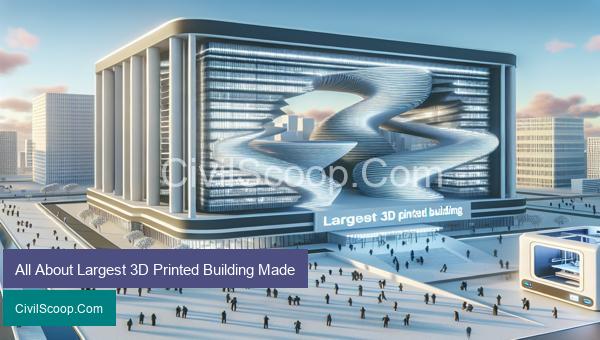
The world of 3D printing continues to push boundaries and break records, and the latest feat is a testament to its limitless potential. In recent years, the construction industry has turned to 3D printing as a way to revolutionize the way buildings are designed and built. And now, the largest 3D printed building has been made, showcasing the remarkable capabilities of this technology. In this article, we’ll delve into all the details of this groundbreaking achievement, from the inspiration behind it to the challenges faced during the process. Get ready to be amazed by the wonders of 3D printing in construction.
Table of Contents
Largest 3D Printed Building Made with Real Concrete
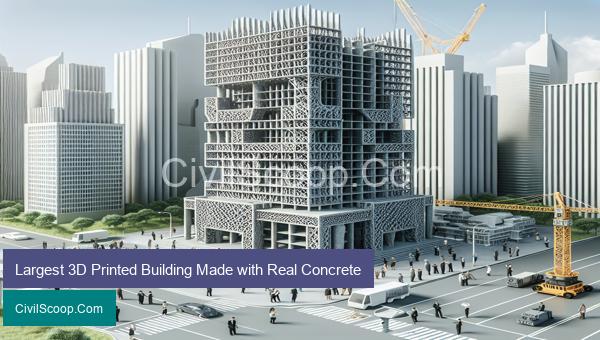
In recent years, 3D printing technology has been taking the construction industry by storm. While 3D printing has been used in housing projects, the largest 3D printed building made with real concrete was unveiled in Dubai, UAE in 2018.
Known as the “Office of the Future”, this two-story building spans a total area of 2,689 square feet and was constructed using the largest 3D printer in the world. The printer, known as the “Inventor”, measures at 120 feet long, 40 feet wide and 20 feet tall.
The Office of the Future was designed by Gensler, a global architecture and design firm, and was built in collaboration with Dubai Future Foundation, Dubai Municipality, and WinSun Global. The project aimed to showcase the potential of 3D printing technology in the construction industry and promote sustainable and innovative building solutions.
The 3D printing process involved printing layers of a special concrete mixture, made of cement, gypsum, and fibers, layer by layer using the Inventor printer. The layers were then reinforced with steel bars and insulation was added for thermal resistance. The entire printing process took only 17 days, causing a significant reduction in overall construction time compared to traditional methods.
The Office of the Future features a curved, organic design that is both aesthetically appealing and structurally sound. The building boasts several sustainable features, such as rooftop solar panels, LED lighting, and a water recycling system, making it one of the first smart buildings in Dubai.
Apart from its sustainability, the Office of the Future also boasts impressive structural strength. The 3D printed concrete walls are up to 10 times stronger than traditional concrete, making the building more resistant to seismic activity and extreme weather conditions.
This groundbreaking project has paved the way for a new era of construction methods and has opened up endless possibilities for architects and engineers. With 3D printing, buildings can be constructed with more complexity and intricacy, without compromising on strength and efficiency.
In addition, 3D printing technology has the potential to significantly reduce construction costs, as it requires lower labor and materials. This can be a game-changer for the construction industry, especially in developing countries where affordable housing is a major concern.
In conclusion, the largest 3D printed building made with real concrete is a testament to the advancements in technology and the endless possibilities it offers for the future of construction. This project has laid the foundation for more sustainable, efficient, and innovative building solutions to be explored and implemented in the coming years.
Conclusion
In conclusion, the creation of the largest 3D printed building marks a significant milestone in the field of construction and technology. This breakthrough not only showcases the potential of 3D printing in creating large-scale structures, but also highlights the endless possibilities and advancements that can be achieved in the future. From reducing construction time and costs, to offering custom design options, 3D printing has the potential to revolutionize the way buildings are constructed. As we continue to witness the continuous growth and innovation in this field, it is exciting to imagine what the future holds for 3D printing in the construction industry. Undoubtedly, the largest 3D printed building is just the beginning of a new era in architecture and engineering.