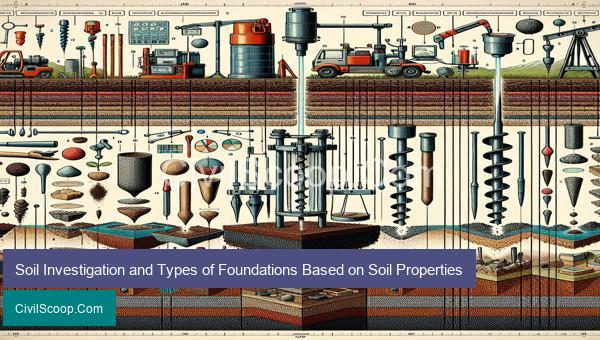
Soil plays a crucial role in the construction of any building, as the foundation of a structure relies on its ability to support the weight of the entire edifice. Therefore, it is essential to conduct a thorough soil investigation before beginning any construction project. Soil investigation involves analyzing the physical, chemical, and engineering properties of the soil to determine its suitability for building purposes. Based on the results of the investigation, appropriate types of foundations can be selected to ensure the stability and durability of the structure. In this article, we will delve into the significance of soil investigation and explore the types of foundations that are best suited for different soil properties.
Table of Contents
Types of Soil Investigations for Foundation Selection
Soil investigations are an essential part of the foundation selection process in civil engineering. The soil properties of a site play a crucial role in determining the type and design of the foundation that can support the proposed structure. The goal of soil investigation is to collect and analyze data about the soil profile and determine its characteristics to make informed decisions for the foundation design.
Here are the different types of soil investigations that are commonly used for foundation selection:
1. Desk Study:
A desk study is the first step in the soil investigation process. It involves reviewing the available geological maps, soil surveys, and other documentation related to the site. This initial study provides valuable information on the soil profile, topography, and potential hazards that may affect the foundation design.
2. Visual Inspection:
Visual inspection involves a site walkover to observe the soil profile, vegetation, and other factors that may affect the foundation design. The color, texture, and composition of the soil can give an indication of its strength and ability to support a structure.
3. Field Tests:
Field tests involve conducting various in-situ tests to determine the properties of the soil. These tests can include Standard Penetration Test (SPT), Cone Penetration Test (CPT), Plate Load Test, and others. These tests help in determining the shear strength, bearing capacity, compressibility, and other important parameters of the soil.
4. Laboratory Tests:
Laboratory tests are performed on soil samples collected from the site to further understand its properties. These tests include soil classification tests, such as Atterberg limits, grain size distribution, and moisture content, as well as tests for determining the soil’s consolidation and shear strength characteristics.
5. Geophysical Investigations:
Geophysical investigations involve using various techniques, such as ground-penetrating radar, seismic refraction, and electrical resistivity, to gather information about the subsurface soil layers. These methods are useful in identifying the depth, thickness, and stratigraphy of the soil, which can aid in determining the most suitable foundation type.
6. Permeability Tests:
Permeability tests are conducted to measure the rate at which water can flow through the soil. This test is crucial in determining the soil’s ability to drain and its suitability for different types of foundations.
7. Dynamic Load Tests:
Dynamic load tests, such as the Standard Penetration Test (SPT) and Dynamic Cone Penetration Test (DCPT), are performed to measure the soil’s resistance to dynamic loading. These tests are essential for the design of foundations for structures that are subjected to repeated or dynamic loading, such as bridges or high-rise buildings.
In conclusion, there are various types of soil investigations that are conducted to gather information about the soil profile and its properties. The results of these investigations play a vital role in selecting the most suitable foundation type for a structure, ensuring its stability and longevity. It is essential to conduct a thorough soil investigation to avoid potential foundation failures and costly repairs in the future.
Soil Classifications for Foundation Selection
Soil classifications are an essential component in the selection of appropriate foundation types for civil engineering projects. Foundations play a crucial role in providing stability and support to structures built on soil, and the type of soil present at a construction site can greatly impact the selection and design of a foundation.
Soil classification is the process of grouping soils based on their physical and engineering properties. It involves studying the soil’s composition, structure, water content, and strength characteristics to determine its suitability for supporting a structure. There are various classification systems used by civil engineers, but the most commonly used classification for foundation selection is the Unified Soil Classification System (USCS).
The USCS classifies soils into two broad categories: coarse-grained soils and fine-grained soils. Coarse-grained soils refer to soils with particles larger than 0.075 mm, such as sand and gravel, while fine-grained soils are those with particles smaller than 0.075 mm, such as clay and silt. The basis for this classification is the size distribution of the soil particles, which greatly affects their engineering behavior.
Furthermore, the USCS further divides soils into three categories based on their composition and properties: gravels, sands, and silts/clays. Gravels are coarse-grained soils with particle sizes ranging from 4.75 mm to 80 mm, while sands have particle sizes ranging from 0.075 mm to 4.75 mm. Silts and clays, on the other hand, have particles smaller than 0.075 mm and are often referred to as fine-grained soils.
Each of these soil types has unique properties that determine its behavior under load and its suitability for foundation design. For example, gravel soils are known to have high bearing capacity and low compressibility, making them suitable for shallow foundations. On the other hand, fine-grained soils have low bearing capacity and high compressibility, making them better suited for deep foundations.
Apart from the USCS system, there are also other classification systems used for specific foundation types, such as the AASHTO soil classification system, which is used for highway pavement design. This system classifies soils based on their particle size distribution, plasticity index, and liquid limit.
In addition to soil types, the classification of soil also takes into account other factors, such as soil moisture content, degree of compaction, and the presence of organic materials. These factors can greatly influence the stability and strength of the soil and ultimately affect the selection of an appropriate foundation type.
In conclusion, soil classification is a crucial step in foundation selection for civil engineering projects. It provides engineers with valuable information about the soil’s properties, behavior, and suitability for supporting a structure. By understanding the soil classification system and its implications, engineers can make informed decisions when designing foundations, ensuring the safety and stability of structures.
Compaction of Soil for Foundation Selection
Compaction of soil is a crucial step in the process of selecting a suitable foundation for any construction project. It is the process of increasing the density of soil by removing air voids and achieving a more stable and structurally sound base for the foundation. The compaction process involves the application of mechanical energy to the soil, which reduces its volume and increases its density.
The purpose of soil compaction is to improve the load-bearing capacity of the soil, which is essential for the safe and stable construction of any structure. Without proper compaction, the soil may settle and cause structural damage to the foundation, leading to costly repairs or even total failure of the structure.
Soil compaction is particularly crucial in areas with poor soil quality or high water table. In such conditions, the soil has a low bearing capacity, which can affect the stability of the foundation. Therefore, it is essential to compact the soil to increase its strength and stiffness, making it more capable of supporting the structure above.
There are various methods of soil compaction used in the construction industry. The most common methods include:
1. Mechanical compaction - This method involves the use of heavy machinery such as rollers, compactors, and vibrators to compress the soil. The equipment is passed over the surface in different directions until the desired level of compaction is achieved.
2. Vibratory compaction - This method uses a vibrating plate or roller to compact the soil. The vibrations penetrate deep into the soil, disrupting the air voids, and increasing its density.
3. Dynamic compaction - This method involves dropping heavy weights from a considerable height onto the soil surface. The impact of the weight creates compaction and densifies the soil.
4. Moisture control - Moisture content is a critical factor in soil compaction. The optimum moisture content depends on the type of soil and the compaction method used. Too much or too little moisture can hinder the compaction process or result in poor compaction.
The degree of compaction required for a foundation depends on the type of structure, the weight of the structure, and the soil conditions. The soil must be compacted to a level that can support the expected loads without significant settlement.
In conclusion, compaction of soil is an essential step in foundation selection. It is a cost-effective way of ensuring the stability and durability of the structure. Proper compaction of the soil is crucial to prevent structural failure, reduce the risk of settling, and increase the overall strength of the foundation. Therefore, it is essential to have an experienced engineer assess the soil and determine the appropriate level of compaction required for the specific project.
Types of Foundations Based on Soil Investigation
Foundations are an essential part of any structural design, providing support and stability to the entire structure. Their design and construction depend on several factors, including the type of soil on which they will be built. Soil investigation, also known as geotechnical investigation, is the process of studying the properties and characteristics of the soil to determine its stability and load-bearing capacity. Based on the findings of this investigation, different types of foundations are designed and constructed. In this article, we will discuss the various types of foundations based on soil investigation.
1. Shallow Foundations
Shallow foundations are generally used when the soil near the surface has adequate bearing capacity to support the weight of the structure. This type of foundation is suitable for buildings with light loads and stable soil conditions. Shallow foundations include strip foundations, pad foundations, and raft foundations. Strip foundations are continuous footings that run along the length of the wall, while pad foundations are isolated footings that support individual columns. Raft foundations cover the entire area under the structure, distributing the load evenly.
2. Deep Foundations
Deep foundations are used when the soil near the surface is weak or unstable, and cannot support the weight of the structure. In such cases, foundations are extended to deeper layers of soil with higher bearing capacity. They include pile foundations, drilled shafts, and caissons. Pile foundations are long, slender columns made of concrete or steel that are driven deep into the ground and then filled with concrete. Drilled shafts are deep, cylindrical holes filled with concrete and often reinforced with steel. Caissons are similar to drilled shafts, but they are larger and are used in areas with high water tables.
3. Isolated Foundations
Isolated foundations are used to support individual columns or walls. They are usually square or rectangular in shape and are used when the loads are light, and the soil is stable. Isolated foundations include pad foundations, strap footings, and combined footings. Strap footings are used when the columns are closely spaced, and the soil has varying bearing capacity. Combined footings are used to support two or more columns located close together.
4. Combined Footings
Combined footings are used when two or more columns are located close together, and soil conditions do not allow for individual foundations. These types of foundations are usually rectangular or trapezoidal in shape and are designed to distribute the load evenly between the columns. They are often used for larger or irregularly shaped structures.
5. Mat Foundations
Mat foundations, also known as raft foundations, are used to distribute the weight of the structure over a large area of soil. They are often used for structures that require a high degree of stability, such as high-rise buildings. Mat foundations are suitable for areas with highly compressible or soft soils, as they provide a larger bearing area and reduce the differential settlement.
6. Floating Foundations
Floating foundations are used in areas with soft or unstable soil conditions that cannot support the weight of the structure. They are usually made of lightweight materials such as polystyrene, and they ‘float’ on the soil, reducing the weight on the foundation. Floating foundations are commonly used in coastal areas where the soil is weak or in areas where the water table is high.
In conclusion, the type of foundation selected for a structure is dependent on the soil conditions and the results of the soil investigation. It is crucial to understand the properties and characteristics of the soil before deciding on the type of foundation
General Summary of Soil Investigation and Types of Foundation
Soil investigation is an essential process in civil engineering that involves studying the characteristics and properties of soil at a site. It helps in determining the suitability of the soil for supporting the proposed structure and selecting the appropriate type of foundation. The main objective of soil investigation is to assess the strength, compressibility, and stability of the soil to ensure the safety and stability of the structure.
General Summary of Soil Investigation:
Soil investigation typically consists of two main phases – a desk study and a field investigation. In the initial stage, a desk study is conducted by reviewing available site information such as geological maps, topographic maps, and past soil investigation reports. This provides an understanding of the geological and environmental conditions of the site.
The field investigation involves collecting samples of the soil and conducting various tests to determine its characteristics. The soil samples are collected from different depths using various methods such as auger boring, test pits, and drilling. The collected soil samples are then analyzed in a laboratory to determine their geotechnical properties like grain size, moisture content, density, and strength.
Based on the results of the soil investigation, a geotechnical report is prepared that provides a detailed analysis of the soil characteristics and recommendations for the foundation design.
Types of Foundation:
The type of foundation chosen for a structure depends on various factors, such as the soil conditions, type of structure, and the load it needs to support. Some common types of foundations are:
1. Shallow foundation: This type of foundation is suitable for structures that have relatively light loads and are constructed on stable soil. Shallow foundations include spread footings, strip footings, and raft foundations.
2. Deep foundation: This type of foundation is used for structures that require support from deeper, more stable layers of soil. Deep foundations can be piles, caissons, or drilled shafts.
3. Raft foundation: Also known as a mat foundation, it is a type of shallow foundation that covers the entire area beneath the structure, providing a uniform support. It is often used for large and heavy structures, such as high-rise buildings.
4. Pile foundation: Pile foundation is a type of deep foundation that involves driving the pile into the ground to transfer the load of the structure through the soft surface soil to a more competent layer, such as rock or stiff clay.
5. Caisson foundation: A caisson is a large, watertight chamber that is sunk into the ground and filled with concrete to form a foundation. It is used in areas with soft and unstable soil.
6. Drilled shaft foundation: It is a deep foundation that involves drilling a cylindrical hole in the ground and then filling it with concrete. Drilled shafts are used to support high-rise buildings and heavy structures.
In conclusion, soil investigation is a crucial step in the construction process, and the type of foundation selected must be based on the results of the investigation. A proper understanding of the soil conditions and selection of an appropriate foundation type is crucial for ensuring the long-term stability and safety of any structure.
Conclusion
In conclusion, soil investigation is a crucial step in the foundation design process. It helps to determine the properties and characteristics of the soil, and therefore, the appropriate type of foundation to be used. There are various methods of soil investigation, including boring, sampling, and testing, which provide valuable information for engineers to make accurate and informed decisions. The type of foundation chosen based on soil properties greatly impacts the stability and durability of a structure. It is essential to consider the load-bearing capacity, settlement, and moisture content of the soil to ensure a strong and stable foundation. By understanding the types of soil and their properties, engineers can design foundations that can withstand the forces acting upon them and provide a solid base for any construction project. Thus, soil investigation