
Constructing residential buildings with maximum two storeys requires careful planning and execution, starting from the foundations. The foundations of a building play a crucial role in ensuring its stability, durability, and safety. One of the primary components of the foundation is the construct footing, which serves as the connecting element between the building and the ground. In this article, we will delve into the details of construct footing for residential buildings with a maximum of two storeys, exploring its types, materials, and considerations for proper installation. Understanding the basics of construct footing will aid in creating a sturdy and secure foundation for your residential building.
Table of Contents
How to Construct Footing for Residential Buildings with Maximum Two storeys?

Constructing the footing of a residential building is a crucial step in the construction process. It is responsible for transferring the load of the building to the soil underneath, providing a strong and stable foundation. The footing also plays a major role in ensuring the safety and stability of the building, especially in areas prone to earthquakes. In this article, we will discuss the process of constructing a footing for a residential building with a maximum of two storeys.
1. Site Preparation:
Before starting the construction of the footing, the site must be prepared properly. The area where the footing will be laid should be cleared of any debris, vegetation, and loose soil. The ground should be compacted and leveled to provide a stable base for the footing.
2. Soil Investigation:
A soil investigation should be conducted to determine the type of soil at the construction site. The bearing capacity and soil properties play a vital role in determining the type and size of the footing. A geotechnical engineer can perform the soil investigation and provide recommendations for the type of footing suitable for the site.
3. Design:
Based on the soil investigation, the structural engineer will design the footing. The design takes into consideration the load of the building, soil characteristics, and local building codes. This stage is crucial as it ensures that the footing is strong enough to support the weight of the building and distribute it evenly to the soil.
4. Excavation:
Excavation is the process of digging a trench in the ground for the footing. The depth and width of the trench will depend on the design of the footing. Generally, for a two-storey residential building, the depth of the footing should be at least 1.5 meters to 2 meters. The width of the trench should be at least equal to the width of the footing.
5. Formwork:
Once the trench is excavated, formwork is installed to hold the concrete in place. The formwork can be made of either wood or steel. It should be sturdy enough to withstand the weight of the concrete. The formwork should also be checked for levelness and alignment to ensure that the footing will be of the correct dimensions.
6. Reinforcement:
Steel reinforcement bars, also known as rebars, are placed inside the formwork before pouring the concrete. The rebars add strength and stability to the footing. They are placed in a grid pattern as per the design and securely tied together.
7. Pouring the Concrete:
Once the formwork and reinforcement are in place, concrete is poured into the trench. The concrete should be of high quality and have the right mix of cement, sand, and aggregates. The concrete should also be properly compacted to remove any air pockets.
8. Curing:
After the concrete is poured, it needs to be cured properly. Curing is the process of keeping the concrete moist for a specific period of time to allow it to harden and gain strength. The curing process is essential for the longevity of the footing.
9. Backfilling:
After the footing is cured, the formwork is removed, and the trench is backfilled with soil. The backfill should be compacted and leveled to provide a stable base for the construction of the walls.
In conclusion, constructing a footing for a residential building with a maximum of two storeys is a critical step in the construction process. It requires proper planning, design, and execution to ensure a strong and stable foundation for the building. It is crucial to follow
Footing Width for Residential Buildings with Maximum Two storeys

Footing width is an important aspect of the foundation design for residential buildings with maximum two storeys. It refers to the width of the base of the foundation that provides the necessary support for the building. The footing width plays a crucial role in distributing the weight of the building and its occupants to the underlying soil, ensuring stability and preventing settlement.
The design of the footing width for residential buildings varies depending on factors such as the type of soil, loads from the structure, and the local building codes. In this article, we will discuss the general guidelines for footing width for residential buildings with maximum two storeys.
1. Soil Type and Bearing Capacity: The type of soil on which the building will be constructed is a significant factor in determining the footing width. Different types of soil have varying bearing capacities, which is the ability of the soil to support the weight of the building. For example, cohesive soils such as clay and silt have a lower bearing capacity compared to granular soils like sand and gravel. A higher bearing capacity soil may require a narrower footing width, while a lower bearing capacity soil will need a wider footing width to spread the load.
2. Building Loads: The design of the footing width also considers the structure’s loads, including the weight of the building, live loads (e.g. furniture, people), and any additional loads such as heavy equipment or snow in colder climates. These loads are calculated by the structural engineer to determine the required width of the footing.
3. Local Building Codes: Each country has its set of building codes and standards that must be followed when designing residential buildings. These codes specify the minimum footing width required based on the soil type, loadings and site conditions. It is essential to check the local building codes and consult with the authorities for any specific requirements when determining the footing width for a residential building.
4. Frost Depth: In colder climates, the depth at which the ground freezes (frost depth) must be considered when designing the footing width. Footings should be placed below the frost depth to prevent the footing from moving due to changes in soil volume during freezing and thawing. Inadequate footing depth can lead to foundation settlement, cracks, and other structural issues over time.
5. Building Dimensions: The dimensions of the building also play a role in determining the footing width. The larger the building, the wider the footing will need to be to support its weight. The number of storeys in the building is also a significant factor. For a two-storey residential building, the footing width will be wider than a single-storey building to support the additional weight and increased load.
In conclusion, footing width for residential buildings with maximum two storeys is determined by several factors, including soil type and bearing capacity, building loads, local building codes, frost depth, and building dimensions. It is crucial to consult a structural engineer to design the appropriate footing width for a safe and stable structure. Properly designed footings will ensure the structural integrity of the building and provide a stable foundation for a long-lasting residential structure.
Footing Thickness for Residential Buildings with Maximum Two storeys

Footing thickness is an important aspect of designing a residential building, especially for buildings with a maximum of two storeys. Footings are the structural elements that support the weight of the building and transfer it to the underlying soil.
In residential buildings with two storeys, the footing thickness generally varies from 10 to 12 inches (25 to 30 cm). However, the exact thickness may vary depending on several factors such as the type of soil, load-bearing capacity, and the type of foundation used.
The first step in determining the footing thickness for a residential building is to conduct a soil investigation. This involves analyzing the soil type, its bearing capacity, and any potential issues such as expansive soils. The bearing capacity of the soil is a crucial factor in determining the size and depth of the footing.
Another important factor to consider is the type of foundation used for the building. There are three main types of foundations: shallow, deep, and mat foundation. Shallow foundations, also known as spread footings, are generally used for residential buildings with two storeys. These types of foundations require a thicker footing compared to deep or mat foundations. This is because they spread the building load over a larger area to reduce the stress on the soil.
Moreover, the type of construction material used for the building also impacts the footing thickness. For example, if the building is constructed with lightweight materials such as wood, the footing thickness can be reduced. However, if the building is constructed with heavy materials such as concrete, the footing thickness needs to be increased to accommodate the additional load.
In addition to the above factors, local building codes and regulations must also be considered while determining the footing thickness. These codes and regulations vary from region to region and must be followed to ensure the safety and stability of the building.
In conclusion, the footing thickness for a two-storey residential building may vary depending on factors such as soil type, load-bearing capacity, type of foundation, and local building codes. It is essential to conduct proper soil investigations and follow building codes to determine the appropriate footing thickness for a safe and stable residential building.
Keyways for Residential Buildings with Maximum Two storeys

Keyways, also known as expansion joints, are important elements in the construction of residential buildings with a maximum of two storeys. They are designed to allow for the natural movements of structures due to various factors such as temperature changes, settling, and wind loads.
Keyways are essentially gaps or spaces that are left between different parts of the building, such as walls, floors, and roofs. These spaces are filled with flexible materials, such as rubber or foam, to accommodate movement and prevent damage to the structure.
In residential buildings, keyways can be found in several areas, including wall-to-floor connections, wall-to-roof connections, and around doors and windows. They are also commonly used in concrete slabs, such as in basements, to prevent cracking due to shrinkage.
The primary purpose of keyways is to reduce stresses in the building caused by movement. As a building naturally shifts and settles over time, keyways provide a buffer zone, reducing the risk of cracks and damage. This is particularly important in areas with high seismic activity, as keyways can help to prevent or minimize damage during earthquakes.
In addition to movement, keyways also serve as a barrier against air and water infiltration. The gap between the two parts of the building is often filled with a flexible sealant or caulk, which helps to maintain the integrity of the building envelope and prevent leaks.
When designing keyways for residential buildings, it is essential to consider the local climate and soil conditions. Temperature changes, soil movement, and high wind loads can all impact the size and placement of keyways. For example, in areas with high temperatures, wider keyways may be required to accommodate greater expansion and contraction of the building.
Another important factor to consider is the building materials used. Different materials have different rates of expansion and contraction, and this must be taken into account when determining the spacing of keyways. This is especially true in areas with extreme temperature fluctuations, where materials such as concrete can expand and contract significantly.
In conclusion, keyways play a crucial role in the construction of residential buildings with a maximum of two storeys. They allow for natural movements of the building, preventing damage and ensuring the structural integrity of the building. Proper design and placement of keyways are essential to ensure the long-term durability of the building.
Penetrations for Residential Buildings with Maximum Two storeys

Penetrations refer to any openings that are created in the building envelope or structural elements of a residential building. These openings can affect the overall strength, stability, and durability of the structure if not properly designed and installed. Residential buildings with maximum two storeys have a more simplified structural system compared to high-rise buildings, but they still require careful consideration of penetrations.
Types of Penetrations
There are several types of penetrations that may be found in a residential building, including mechanical, electrical, plumbing, and communication penetrations. These openings are necessary for the installation of utilities, such as HVAC ducts, electrical wires, plumbing pipes, and telecommunication wires. Special penetrations, such as windows and doors, are also included in the design of a residential building.
Critical Points
The location and size of penetrations are critical to the structural integrity of a residential building. They must be designed to avoid structural members, such as load-bearing walls, beams, and columns, to ensure the structural integrity is not compromised. For example, mechanical penetrations must be placed above or below load-bearing walls and not through them.
Waterproofing is another crucial aspect to consider for penetrations in residential buildings. The building envelope must be properly sealed around penetrations to prevent water from entering the building and causing potential damage. This is especially important for penetrations through exterior walls and roofs, as they are more vulnerable to water infiltration.
Fire Protection is also a significant concern when it comes to penetrations. Special fire-rated assemblies may be required for penetrations passing through fire-rated walls or floors to maintain their fire resistance rating. These assemblies must be installed according to the building code and tested to ensure their effectiveness.
Design and Installation
The design and installation of penetrations in residential buildings must comply with local building codes and standards. The size, location, and fire rating of each penetration must be carefully planned and coordinated with the rest of the building design. Structural engineers must work closely with other design professionals to ensure that the penetrations do not compromise the structural integrity of the building.
Proper installation of penetrations is essential to prevent any potential leaks, fire hazards, or structural issues. Contractors must follow the approved design and installation methods to ensure the integrity of the building is not compromised. Regular inspections must be conducted to identify any installation errors and address them before they become bigger problems.
Conclusion
In conclusion, penetrations in residential buildings with maximum two storeys must be carefully designed and installed to ensure the overall integrity of the structure. They require close coordination between design professionals and proper installation techniques to prevent any potential issues. Failure to properly design and install penetrations can result in structural defects, water infiltration, and fire hazards, ultimately leading to costly repairs and compromising the safety of the building.
Excavation for Residential Buildings with Maximum Two storeys

Excavation is a crucial step in the construction process of any residential building, especially for those with maximum two storeys. It involves the removal of soil, rocks, and other materials from the site in order to create a suitable foundation for the building. This process is essential to ensure the stability, durability, and safety of the structure.
Here are the key aspects of excavation for residential buildings with maximum two storeys:
1. Soil Investigation and Analysis:
Before any excavation work can begin, a detailed site analysis and soil investigation must be conducted to determine the type and composition of soil present. This will help in understanding the strength, stability, and load-bearing capacity of the soil and plan the excavation accordingly.
2. Marking and Layout:
The next step is to mark and layout the exact location and dimensions of the building on the site. This will serve as a guide for the excavation process and ensure that the building is aligned correctly.
3. Excavation Techniques:
Various excavation techniques such as open cut, basement, and trench methods can be used for residential buildings with maximum two storeys. The most suitable technique depends on the type of soil, site conditions, and building design.
4. Safety Measures:
Excavation work can be hazardous, and it is crucial to implement safety measures to protect workers and the surrounding areas. These may include proper shoring and retaining walls to prevent cave-ins, barricades around the excavation site, and regular inspections by qualified engineers.
5. Slope Stability:
For buildings with a maximum of two storeys, the building footprint is smaller, and the depth of excavation may not be significant. However, it is still essential to ensure the slope stability of the excavation walls to prevent any soil erosion and structural damage.
6. Dewatering:
In areas with high groundwater levels, dewatering is necessary to lower the water table and create a dry and stable working environment. This can be done using pumps, wells, or by installing a drainage system around the excavation area.
7. Backfilling and Compaction:
Once the foundation has been completed, the excavation needs to be backfilled and compacted to create a solid and stable base for the building. The backfill material should be of the same quality as the excavated soil and compacted in layers to avoid any settlement issues in the future.
In conclusion, excavation is a critical step in the construction of residential buildings with maximum two storeys. It must be done with caution and by following proper techniques and safety measures to ensure the safety and stability of the structure. Hiring experienced and qualified contractors is also essential for a successful and efficient excavation process.
Form Types for Residential Buildings with Maximum Two storeys
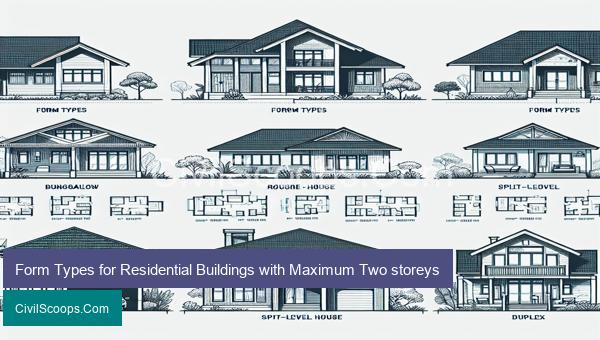
There are several types of forms used in the construction of residential buildings with a maximum of two storeys. These forms are essential for shaping and supporting the concrete during the construction process. The type of form used will depend on the design, size, and complexity of the building.
1. Plywood Forms
Plywood forms are the most commonly used type of form in residential building construction. They consist of a frame made of timber or steel and are covered with plywood sheets. The plywood is strong, lightweight, and easy to handle, making it ideal for smaller residential projects. Plywood forms are typically reusable and can be used multiple times, making them cost-effective.
2. Insulating Concrete Forms (ICF)
Insulating concrete forms are a relatively new type of form that is gaining popularity in residential construction. They are made of high-density foam, which is stacked together to form the walls of a building. Once the foam is in place, concrete is poured in between to create a solid structure. These forms provide excellent insulation and soundproofing, making them a popular choice for residential buildings.
3. Block and Brick Forms
Block and brick forms are commonly used for the construction of two-storey residential buildings. They consist of interlocking concrete blocks or bricks that are stacked together and filled with concrete. These forms provide excellent strength and durability, making them suitable for buildings in areas prone to natural disasters.
4. Steel Forms
Steel forms are used for larger and more complex residential buildings. They consist of steel frames that are covered with plywood or steel sheets. Steel forms are highly durable and can be used multiple times, making them a cost-effective option for large projects. They also provide smooth finishes and can be easily adjusted for different shapes and sizes.
5. Slip Forms
Slip forms are a type of formwork that is used for taller residential buildings with a limited footprint. They consist of a moving platform that supports the concrete while it sets. As the concrete is poured, the platform moves up, allowing the form to take the shape of the building’s exterior. Slip forms are commonly used for construction of high-rise buildings.
6. Tunnel Forms
Tunnel forms are similar to slip forms, but they are used for buildings with smaller footprints. They are a continuous formwork system that is constructed on the site horizontally, then lifted and filled with concrete to create the walls and floors in one continuous process. Tunnel forms are efficient and cost-effective for buildings with a repetitive floor plan.
In conclusion, the form type used in the construction of residential buildings with a maximum of two storeys will depend on the project’s specific requirements. These forms are an essential component of the construction process and must be carefully selected based on factors such as cost, durability, and ease of use. It is crucial to use the proper form type to ensure the construction process is efficient and the end result is a strong and durable residential building.
Reinforcement for Residential Buildings with Maximum Two storeys

Reinforcement is an essential aspect of residential building construction, ensuring the structural integrity and stability of the building. In this article, we will discuss the use of reinforcement in residential buildings with a maximum of two stories.
The purpose of reinforcement in a building is to resist the tensile and compressive forces that may occur due to various loads such as dead, live, wind, or seismic loads. Without proper reinforcement, a building can become weak, leading to cracks, deformations, and even collapse.
In two-story residential buildings, the reinforcement is mostly used in the foundation, columns, beams, and slabs. Let’s delve into the details of each of these structural elements.
Foundation:
The foundation is the base of any building, and it carries the entire load of the structure. In a two-story residential building, the foundation is usually a combination of spread footings and continuous footings. It is essential to provide proper reinforcement in these footings to ensure their stability and prevent any settlement. The typical reinforcement used in footings includes steel bars in the form of mesh or individual bars.
Columns:
Columns are vertical structural elements that transfer the load from the beams and slabs to the foundation. In two-story residential buildings, columns are usually made of reinforced concrete (RC) and are designed to withstand both compressive and bending forces. The common reinforcement used in columns is a combination of vertical and horizontal steel bars. The vertical bars are used to resist the axial forces, while the horizontal bars provide resistance against bending moments.
Beams:
Beams are the horizontal members that span between columns and carry the load from the slab to the columns. In two-storey residential buildings, beams are usually made of reinforced concrete, and they are designed to resist bending forces. The reinforcement in beams includes bottom and top steel bars, which are placed parallel to the span of the beam. The bottom bars resist the tensile forces, while the top bars resist the compressive forces.
Slabs:
Slabs are the flat elements that form the floors and roofs of a building. In two-story residential buildings, slabs are usually made of RC and are designed to resist the dead and live loads. The reinforcement in slabs includes a layer of steel bars at the bottom and sometimes at the top, depending on the span and loading conditions. The bottom bars are used to resist the tensile forces caused by the flexure of the slab, while the top bars are used to control any potential cracks.
Apart from these main structural elements, reinforcement is also used in other secondary elements such as stairs, parapets, and other architectural features to enhance their strength and stability.
In conclusion, reinforcement is an integral part of a two-story residential building, providing strength, durability, and safety to its occupants. It is crucial to ensure the proper design and installation of reinforcement to prevent any structural failures. Hence, it is recommended to consult a professional civil engineer for the appropriate reinforcement design in residential buildings.
Concrete Placement for Residential Buildings with Maximum Two storeys

Concrete placement is a crucial step in the construction process of any residential building, especially for those with a maximum of two storeys. The proper placement of concrete ensures the structural stability and durability of the building. In this article, we will discuss the process of concrete placement for residential buildings with maximum two storeys.
1. Preparation of the Site:
The first step in concrete placement is preparing the site. The site should be clear of any debris, rocks, and vegetation. The ground should be compacted and leveled to provide a stable base for the concrete. The site should also be accessible for the concrete truck to deliver the concrete mix.
2. Formwork Installation:
Formwork is an essential element in concrete placement. It is the temporary structure that holds the concrete in place until it is cured. For residential buildings with a maximum of two storeys, wooden formwork is commonly used. The formwork should be properly supported and braced to prevent any movement during the pouring of concrete.
3. Rebar Placement:
Reinforcement bars, or rebar, are essential for the structural strength of the building. The rebar is placed in the formwork according to the design of the building. It is crucial to ensure that the rebar is properly tied and supported to prevent any movement during the concrete pouring.
4. Concrete Mixing:
Once the preparation of the site is complete, and the formwork and rebar are in place, the next step is to mix the concrete. Ready-mix concrete is commonly used for residential buildings. It is delivered by a concrete truck and poured directly into the formwork.
5. Concrete Pouring:
The concrete should be poured evenly into the formwork to prevent air pockets or gaps. It is essential to vibrate the concrete to remove any trapped air and to ensure proper compaction. The concrete should be poured in layers to prevent the formwork from collapsing under the weight of the concrete.
6. Finishing:
After the concrete is poured, it needs to be finished to achieve a smooth surface. This is done by using tools such as a trowel or a bull float to level and smooth the surface. At this stage, any decorative elements such as stamping or coloring can also be added.
7. Curing:
Curing is the process of maintaining the moisture in the concrete to ensure proper hydration. This is crucial for the strength and durability of the concrete. Curing can be done by spraying the surface with water or covering it with plastic sheets.
8. Removal of Formwork:
Once the concrete is cured and has reached its required strength, the formwork can be removed. This usually takes around 24-48 hours. It is important to remove the formwork carefully to avoid any damage to the concrete.
In conclusion, proper concrete placement is vital for the structural integrity of residential buildings with a maximum of two storeys. It requires careful preparation, formwork installation, rebar placement, concrete mixing, pouring, finishing, curing, and removal of formwork. It is crucial to follow these steps meticulously to ensure a strong and durable foundation for the building.
Conclusion
In conclusion, construct footing is a crucial aspect of building a residential structure with maximum two storeys. It is the foundation on which the entire building rests, providing stability and support. Without proper footing, the building is at risk of collapse, which can result in significant damage and even injuries. Therefore, it is essential to understand all about construct footing - from its types and materials to its design and construction - to ensure the structural integrity and safety of a residential building. By following the building codes and guidelines, conducting thorough soil investigations, and hiring qualified professionals, homeowners can ensure that their residential structure is built with a strong and stable foundation for many years to come. It is always better to invest time and resources in proper footing construction to avoid any costly