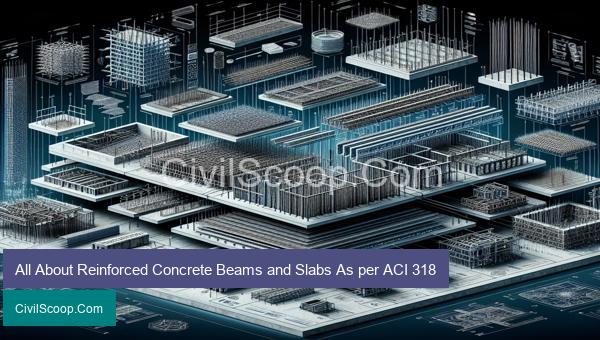
Reinforced concrete beams and slabs are widely used in the construction industry, with applications ranging from commercial buildings to bridges and highways. These structural elements are essential for providing strength, stability, and durability in various construction projects. As per the standards set by the American Concrete Institute (ACI), the design and construction of reinforced concrete beams and slabs follow a specific set of guidelines outlined in the ACI 318 code. In this article, we will delve into the key aspects of reinforced concrete beams and slabs as per ACI 318, discussing their design principles, key components, and construction techniques. By understanding the fundamentals of reinforced concrete beams and slabs as per ACI 318, we can ensure safe and efficient construction practices and
Table of Contents
Maximum Deflections of Reinforced Concrete Beams and Slabs As per ACI 318

Maximum deflection refers to the amount of deformation that a beam or slab can undergo before it becomes unstable and unable to support the intended load. As a civil engineer, it is crucial to understand the maximum deflections of reinforced concrete beams and slabs to ensure the design meets safety standards and able to resist the expected loads.
According to the American Concrete Institute (ACI) 318 code, there are specific requirements for maximum deflections of reinforced concrete beams and slabs that ensure the structural integrity of the building. These requirements take into account the effects of long-term loading, creep, and shrinkage of concrete, which can cause significant deflections over time.
For reinforced concrete beams, ACI 318 specifies that the maximum deflection should not exceed the following limits:
1. For simply supported beams: L/360 or 0.6 inches (whichever is smaller)
2. For continuous beams: L/480 or 0.5 inches (whichever is smaller)
3. For cantilever beams: L/240 or 0.75 inches (whichever is smaller)
Where L is the span length of the beam.
These limitations ensure that the beam remains within an acceptable level of deformation and does not cause any structural damage. However, for beams supporting fragile finishes like glass panels or brittle facades, smaller deflection limits may be recommended to prevent any cracking or damage.
In addition to the above, ACI 318 also states that the deflection due to live load alone should not exceed L/240 for all types of beams. This limit ensures that even under the maximum live load, the deflection of the beam stays within acceptable limits.
For reinforced concrete slabs, ACI 318 specifies that the maximum deflection should not exceed the following limits:
1. For one-way slabs: L/180 or 0.5 inches (whichever is smaller)
2. For two-way slabs: L/180 or 0.7 inches (whichever is smaller)
Where L is the shorter span length of the slab.
These limits ensure that the slab remains stable and does not crack or fail under the expected loads. It is essential to note that these limitations are for the short-term deflections and do not include any effects of long-term loading or creep.
Furthermore, ACI 318 also states that the total deflection of the slab should not exceed L/240 due to the live loads alone. This limit is crucial as it accounts for any additional loading that could occur during the service life of the building.
To ensure compliance with these deflection limitations, civil engineers must consider various factors during the design and construction stages. This includes proper selection of materials, minimum reinforcement requirements, and appropriate section sizes to resist the expected loads. Additionally, periodic maintenance and inspections are necessary to detect any deflection issues that may arise over time.
In conclusion, the maximum deflections prescribed by ACI 318 for reinforced concrete beams and slabs are vital for ensuring the structural integrity and safety of buildings. It is the responsibility of civil engineers to follow these provisions and monitor the deflections during construction and throughout the service life of the structure.
Conclusion
In conclusion, reinforced concrete beams and slabs play a crucial role in the construction industry, providing strength and durability to the overall structure. With the guidelines and design provisions set forth by ACI 318, engineers and builders can ensure safe and effective use of reinforced concrete beams and slabs in their projects. Understanding the principles and considerations of designing and constructing using reinforced concrete can lead to successful and long-lasting structures. As technology advances and research continues, the regulations and methods outlined in ACI 318 will continue to evolve, making reinforced concrete an ever more dependable and efficient building material. It is essential for all industry professionals to remain up-to-date with these standards to ensure the highest quality of construction for the future.