
Transfer of loads from slab to beams is an important aspect in the design and construction of structures. It is crucial for ensuring the stability and strength of a building, as well as minimizing potential failures and damages. In simple terms, it refers to the process of transferring the weight or load of a slab to the beams which then support the load downwards to the foundation. This is a complex process that requires careful consideration of various factors such as the type of structure, loads to be supported, and the materials used. In this article, we will delve deeper into the principles and methods involved in the transfer of loads from slab to beams, and its significance in the overall structural integrity of buildings.
Table of Contents
Understanding the Transfer of Loads from Slab to Beams

Transfer of loads from slab to beams is a crucial aspect of structural engineering, especially in the design and construction of buildings and other structures. In simple terms, it refers to the process of transferring the weight and other forces from a slabs to the supporting beams. This transfer of loads is essential for ensuring the stability, durability, and safety of the overall structure.
To understand the transfer of loads from slab to beams, it is important to first have a basic understanding of the components involved. A slab is a flat, horizontal structural element that forms the floor or roof of a building. It can be made of various materials such as concrete, steel, or timber. Beams, on the other hand, are horizontal or sloping structural members that support the weight of the slab and transfer it to the columns or walls.
Now, let’s delve deeper into the process of load transfer. The first step in understanding this process is to determine the type of load acting on the slab. There are two types of loads – dead loads and live loads. Dead loads refer to the weight of the structure itself and any permanent fixtures, while live loads refer to the weight of objects and people that the structure will support. Both these loads act on the slab and are transferred to the beams.
Once the type of load is determined, the next step is to calculate the magnitude of the load. This requires an understanding of the structural design and the materials used for the slab and beams. Typically, the structural design will specify the maximum allowable loads for the slab and beams. These loads must be distributed evenly to prevent any imbalances that could compromise the structural integrity of the building.
The actual transfer of loads from slab to beams occurs through the use of reinforcement and connections. Reinforcement is used within the slab and beams to strengthen them and prevent cracking or other forms of failure under the weight of the loads. Connections, on the other hand, are used to join the slab and beams together, ensuring that they work together to transfer the loads efficiently.
In addition to the primary loads, transfer of loads also considers secondary loads such as wind, seismic forces, and temperature changes. These loads also need to be transferred from the slabs to the beams and ultimately to the columns or walls for proper distribution and stability of the structure.
Understanding the transfer of loads from slab to beams is essential for civil engineers as it helps them design structures that can withstand the stresses and loads they will be subjected to. This also enables engineers to choose the right materials, reinforcements, and connections to ensure the safety and longevity of the structure.
In conclusion, transfer of loads from slab to beams is a critical aspect of structural engineering that helps maintain the stability and safety of buildings. It requires a thorough understanding of the forces involved and the proper use of materials and connections to ensure the efficient transfer of loads. As a civil engineer, it is essential to have a solid grasp of this fundamental concept to successfully design and construct safe and durable structures.
One-way Slab for transfer of Loads from Slab to Beams

A one-way slab is a type of concrete slab that is designed to transfer loads from the slab to the supporting beams in only one direction. The term “one-way” refers to the fact that the slab is reinforced in one direction, typically perpendicular to the supporting beams. This type of slab is commonly used in buildings, bridges, and other structures to transfer the weight of the slab to the supporting beams, which then distribute the load to the columns or walls below.
One of the basic components of a one-way slab is its reinforcement, which is typically in the form of steel bars or mesh. The reinforcement is placed in the bottom of the slab, parallel to the supporting beams, to resist tensile forces caused by the weight of the slab and any additional loads. This reinforcement is usually spaced evenly across the width of the slab to provide uniform support.
Another important aspect of a one-way slab is the thickness of the slab. The thickness is determined by the span (distance between supporting beams), the type and magnitude of loads, and the properties of the concrete used. In general, a thicker slab can support heavier loads and span longer distances without excessive deflections.
When designing a one-way slab, engineers must also consider the support conditions at the edges of the slab. The slab is usually supported by beams or walls on its sides, which provide resistance to lateral movements. The edge beams or walls must be designed to withstand the loads transferred from the slab.
To ensure the stability and strength of the one-way slab, several design principles are followed. These include the maximum span-to-depth ratio, minimum reinforcement requirements, and limits on deflection and cracking. The design of the reinforcement is based on the ultimate strength of the concrete and the load that the slab is expected to support.
In order to transfer loads effectively from the slab to the beams, a proper connection between the two is crucial. This is typically achieved through the use of stirrups, which are steel bars that run between the bottom and top reinforcement and hold them together. The stirrups increase the shear resistance of the slab and help distribute the loads efficiently to the supporting beams.
In conclusion, one-way slabs are an important structural element in the construction of buildings and other structures. They are designed to transfer loads from the slab to the supporting beams in a single direction, ensuring the stability and strength of the overall structure. The proper design and construction of one-way slabs are crucial for safe and efficient transfer of loads.
Two-way Slab for transfer of Loads from Slab to Beams
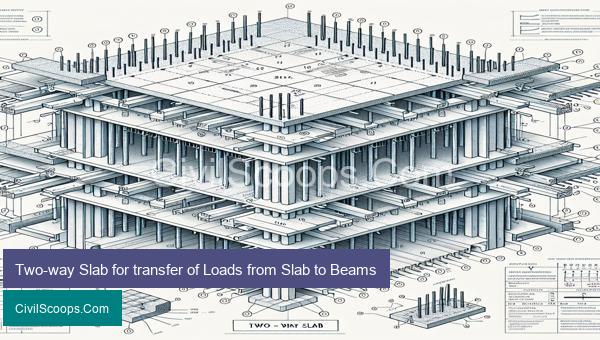
A two-way slab is a type of reinforced concrete slab that is designed to transfer loads from the slab to the beams in two directions. This type of slab is commonly used in building structures, such as residential and commercial buildings, where large spans are required.
The main feature of a two-way slab is its ability to transfer loads in two orthogonal directions, which means that it can support heavy loads without requiring as many beams or columns as a one-way slab. This makes it a more efficient and cost-effective solution for large spans.
In a two-way slab, the loads are transferred to the beams in two directions through a series of ribs or columns. These ribs or columns are placed at regular intervals throughout the slab to provide additional support and prevent the slab from sagging or cracking under heavy loads.
The design of a two-way slab is based on the principles of bending and shear. The loads acting on the slab cause it to bend, which creates tension and compression forces within the slab. These forces are then transferred to the ribs or columns, which in turn transfer them to the beams.
One of the key factors in the design of a two-way slab is the depth of the slab. A deeper slab is able to span longer distances without requiring additional reinforcement, making it a more efficient solution for larger spans. The depth of the slab is determined by factors such as the type of building, the expected loads, and the strength of the concrete.
Another important consideration in the design of a two-way slab is the spacing and size of the ribs or columns. These elements must be properly sized and spaced to ensure that they can effectively transfer the loads to the beams without excessive deflection or cracking.
In addition to transferring loads, a two-way slab also provides other benefits such as improved sound insulation and fire resistance. The ribs or columns in the slab act as barriers that reduce the transmission of sound between floors and also provide additional protection against fire.
In conclusion, a two-way slab is a versatile and efficient solution for transferring loads from a slab to beams in building structures. Its ability to span longer distances without requiring additional support makes it a popular choice for large spans and heavy loads. Proper design and construction of a two-way slab are crucial to ensure its structural integrity and performance.
Complex-geometry Slab for transfer of Loads from Slab to Beams

Complex-geometry slab is a type of concrete slab used in building construction that is designed to transfer loads from the slab to the beams. It is also known as a transfer slab or transfer plate. This type of slab is commonly used in high-rise buildings, where the loads from upper floors need to be transferred to lower floors or to lateral force resisting elements such as columns or shear walls.
The design of complex-geometry slab involves creating a series of ribs or beams within the slab itself. These ribs are strategically placed to distribute the load from the upper floor to the columns or shear walls. This type of slab typically has a larger thickness compared to conventional slabs, allowing it to carry heavier loads and span longer distances.
The most crucial aspect of designing a complex-geometry slab is the analysis of the loading conditions. The design engineer must consider the magnitude and distribution of the loads, as well as the probability of eccentric or concentrated loads, to determine the optimum spacing and dimensions of the ribs or beams within the slab. Additionally, the slab must be designed to resist bending, shear, and torsion forces.
One of the primary advantages of using complex-geometry slabs is the efficient use of space. Since the load is transferred from the upper floor to the beams within the slab, there is no need for additional beams or columns, freeing up valuable floor space. This is especially beneficial in high-rise buildings, where every square meter counts in terms of usable floor area.
Moreover, complex-geometry slabs allow for flexibility in architectural design. The ribs or beams can be placed in various patterns, allowing for larger openings and more significant spans without compromising the structural integrity of the building. This feature is particularly useful in creating open, column-free spaces.
However, the design and construction of complex-geometry slabs can be more challenging and time-consuming compared to conventional slabs. The construction process must be meticulously planned and executed to ensure the proper installation of the ribs or beams, as any errors could compromise the structural integrity of the slab.
In conclusion, complex-geometry slabs are essential elements in modern high-rise building construction. They efficiently transfer loads from the upper floors to the primary structural elements and allow for more significant flexibility and efficient use of space. While the design and construction of these slabs may be more complex, the benefits they offer make them a valuable option in building design.
Conclusion
In conclusion, the transfer of loads from slab to beams is a crucial aspect of structural engineering. It involves the proper distribution and transfer of loads to ensure the stability and safety of a structure. Various methods, such as stub girders, drop panels, and corbels, have been developed to effectively transfer loads. It is essential for structural engineers and architects to have a thorough understanding of the principles and techniques involved in load transfer to ensure the structural integrity and longevity of a building. With careful planning and design, the transfer of loads from slab to beams can effectively and efficiently support the loads placed upon a structure.