Table of Contents
All About Underground Water Sources
Underground water sources play a crucial role in sustaining life on our planet. From providing drinking water to supporting agricultural activities, these hidden reservoirs of water are essential for human existence. However, despite their importance, many people may not fully understand the complex systems and processes that make up underground water sources. In this article, we will delve into the world of underground water sources and explore what they are, how they are formed, and how they are utilized for various purposes. Join us as we unravel the mysteries of these vital natural resources and discover all there is to know about underground water sources.
What is Underground Water Sources?

Underground water sources are natural reservoirs of water that are located beneath the earth’s surface. They play a vital role in providing water for human consumption, agriculture, industrial activities, and maintaining ecological balance.
There are two main types of underground water sources: aquifers and springs. Aquifers are saturated permeable geological formations that can store and transmit significant amounts of water. They are typically made up of layers of sand, gravel, and rock, which act as natural filters and help to purify the water.
Springs, on the other hand, are natural outlets that release groundwater to the surface. They occur when the water table intersects with the surface, creating a flow of water that emerges as a stream or a pool. Springs are often found in mountainous areas or along the slopes of hills.
The primary source of underground water is precipitation, such as rain and snow, which percolates through the soil and rock layers. The rate of infiltration and the type of soil and rock present in an area determine the amount of water that can be stored underground.
Another significant source of underground water is surface water, such as rivers and lakes, which can recharge aquifers when it flows into the ground. This process, known as indirect recharge, can take years or even centuries to reach the groundwater.
The depth of underground water sources varies, depending on factors such as topography, geology, and climate. In some areas, groundwater may be just a few meters below the surface, while in others, it can be hundreds of meters deep.
Groundwater is replenished through a natural process called recharge, where water from above the ground seeps into the soil and refills the underground reservoir. However, factors such as over-pumping, pollution, and land-use changes can affect the rate of recharge and deplete underground water sources.
The use of groundwater dates back thousands of years, and it remains a crucial resource for human activities today. The water is typically extracted through wells, which are constructed by drilling or digging into the ground. The depth and type of well depend on the characteristics of the underground water source and the intended use.
In conclusion, underground water sources are vital sources of freshwater that play a significant role in sustaining life on earth. As a civil engineer, it is crucial to understand the behavior and characteristics of these sources to effectively manage and sustain the underground water supply for current and future generations. Sustainable management practices, such as proper recharge techniques, can help preserve these valuable resources for years to come.
Different Types of Underground Water Sources
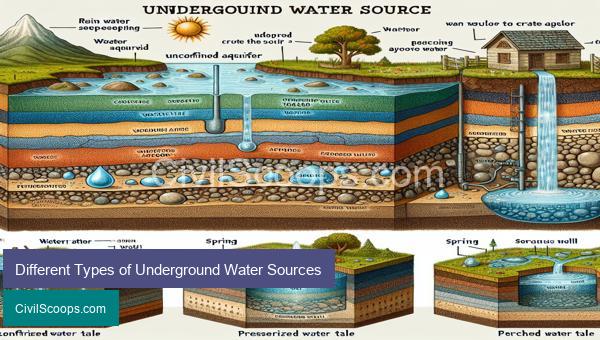
There are various types of underground water sources that are vital for sustaining life on earth. These sources provide us with clean, fresh water for drinking, irrigation, and other essential purposes. Let us take a closer look at some of the different types of underground water sources.
1. Aquifers
Aquifers are underground layers of permeable rock or soil that hold water. They are one of the most common and important sources of underground water. Aquifers can be a few meters or hundreds of meters deep and can extend for hundreds of miles. They are replenished by rainwater and surface water that percolates down into the ground. Aquifers act as natural reservoirs and provide water to wells and springs.
2. Confined Aquifers
Confined aquifers are similar to regular aquifers, but they are surrounded by layers of impermeable rock or clay, which prevents water from escaping. This results in a higher pressure within the confined aquifer, making it an important source for deep wells and pumping systems. However, excessive pumping from these aquifers can lead to a decrease in water levels and cause the rock layers to collapse, known as land subsidence.
3. Unconfined Aquifers
Unconfined aquifers are not confined by impermeable layers and can be easily accessed through wells or springs. They are replenished by surface water and precipitation, making them more susceptible to contamination from pollutants on the surface. Unconfined aquifers are often shallow, and can quickly recharge after a rainfall or snow melt.
4. Karst Aquifers
Karst aquifers are formed in soluble rocks, such as limestone, dolomite, and gypsum. These rocks are susceptible to erosion, resulting in the formation of caves, sinkholes, and underground rivers. Karst aquifers are characterized by their fast flow rates and are vital sources for spring water. However, their permeability also makes them vulnerable to pollutants, and their ability to store water is limited.
5. Fractured/Porous Rock Aquifers
These types of aquifers are found in hard, crystalline rocks such as granite, where water is stored in fractures and pores between the rocks. Fractured and porous rock aquifers can hold large amounts of water, but it can be difficult to extract as the flow rate is relatively low. These aquifers are also susceptible to pollution and can be difficult to recharge.
6. Reservoirs
Underground reservoirs, also known as subsurface reservoirs, are formed when water is stored in natural depressions or cavities below the earth’s surface. These depressions can be created by faults, caverns, or collapsed rock layers. Subsurface reservoirs are often used for water storage and supply during droughts, but they are prone to contamination and can have limited storage capacity.
7. Magma
Magma, or molten rock, can also act as an underground water source. When the magma cools and solidifies, it can trap pockets of hot, pressurized water within the solid rock. This heated water can be extracted and used for geothermal energy or hot springs. However, accessing this type of water source is challenging and typically requires specialized technology.
In conclusion, there are various types of underground water sources, each with their unique characteristics and importance. They play a crucial role in providing us with the water we need for daily activities and sustaining the environment around us. It is essential to protect and conserve these sources to ensure a steady supply
Conclusion
In conclusion, underground water sources play a vital role in sustaining human life and supporting different ecosystems. They are a valuable natural resource that needs to be carefully managed and protected. With ongoing challenges such as pollution, over-extraction, and climate change, it is important to understand the importance of maintaining a healthy balance of these water sources. By promoting sustainable practices and conservation efforts, we can ensure that future generations have access to clean and abundant underground water sources. It is important to continue researching and studying these underground water systems to better understand their complexities and find ways to protect and preserve them for the benefit of all living beings on our planet.