
Concrete is a fundamental building material that serves as the foundation for countless structures around the world. In order to ensure the safety and durability of these structures, it is crucial to maintain high-quality standards for concrete. This is where the process of concrete quality check comes into play. By thoroughly assessing the composition, strength, and other key factors of concrete, quality checks play a vital role in meeting building code requirements and ensuring the longevity of construction projects. In this article, we will delve into the various aspects of concrete quality check, its importance, and the methods used to ensure the highest standards of quality in this essential building material.
Table of Contents
What are Different Tests for Concrete Quality Check?

Concrete is one of the most widely used construction materials in the world. It is a versatile and durable material that is essential in building foundations, walls, roads, bridges, and more. The strength and quality of concrete play a crucial role in the structural integrity and longevity of a building. Thus, it is important to conduct various tests to ensure the quality of concrete before it is used in construction. Let’s take a closer look at some of the different tests for concrete quality check.
1. Slump Test
The slump test is one of the most common tests used to check the consistency and workability of concrete. It involves filling a conical-shaped mold with freshly mixed concrete and then gently removing the mold to see how much the concrete settles or “slumps.” The higher the slump, the more workable the concrete is, but excessively high slumps can indicate a lack of strength. Thus, the slump test helps determine the water-cement ratio and overall workability of concrete.
2. Compressive Strength Test
The compressive strength test is the most important test for evaluating the quality of concrete. It measures the ability of concrete to withstand crushing loads without breaking or cracking. This test is performed by casting cylindrical or cube-shaped samples of concrete, curing them, and then subjecting them to compressive loads until failure. The compressive strength is then calculated by dividing the maximum load by the cross-sectional area of the sample.
3. Water Permeability Test
Water permeability test is conducted to determine the quality of concrete’s impermeable properties. It measures the rate at which water can pass through the concrete under a specific pressure. This test is essential in evaluating the durability of concrete and its ability to resist water penetration, which can cause corrosion of reinforcement and damage to the concrete structure.
4. Rebound Hammer Test
The rebound hammer test is a non-destructive testing method used to assess the strength and uniformity of concrete. It involves hitting the surface of the concrete with a known force and measuring the rebound distance using a device called a rebound hammer. The rebound distance is then compared to a predefined chart to determine the strength of the concrete.
5. Ultrasonic Pulse Velocity Test
The ultrasonic pulse velocity (UPV) test is another non-destructive testing method used to assess the quality of concrete. It involves sending high-frequency sound waves through the concrete and measuring the time taken for them to travel through it. A healthy concrete structure will have a higher velocity, whereas defects or voids can cause a reduction in the velocity.
6. Concrete Core Test
The concrete core test is performed by drilling a cylindrical sample from a hardened concrete structure and testing it for compressive strength. This test is used when it is not possible to remove samples for the compressive strength test. It also helps assess factors like uniformity, in-place strength, and concrete curing.
In addition to these tests, visual inspection, air content test, and temperature of the concrete during placing can also be conducted to assess the quality of concrete. Properly conducting and interpreting these tests can help ensure the quality of concrete and prevent any potential construction failures. Therefore, it is crucial to conduct these tests as per standards and guidelines to ensure that the concrete used in construction meets the desired quality standards.
Tests for Concrete Quality Check

Concrete is one of the most commonly used construction materials, and it is essential to ensure that it is of high-quality to ensure the strength and durability of structures. As a civil engineer, it is imperative to conduct quality checks on concrete to ensure that it meets the required standards and specifications. There are various tests that can be performed to determine the quality of concrete. In this article, we will discuss the most commonly used tests for concrete quality check.
1. Slump Test
The slump test is the most widely used test for assessing the consistency and workability of concrete. It is a simple test that involves placing a sample of freshly mixed concrete in a slump cone and measuring the amount of settlement. The slump value is an indicator of the amount of water present in the mixture, which directly affects the workability and strength of concrete.
2. Compressive Strength Test
The compressive strength test is another crucial test for quality checking of concrete. It measures the ability of the concrete to withstand a compressive load without failing. The test involves casting cylindrical samples of concrete and subjecting them to a compressive load until they fail. The strength of the concrete is thus determined by the maximum load the sample can withstand.
3. Water Absorption Test
The water absorption test is used to determine the porosity of concrete, which is the ability of the material to absorb water. This test is essential as it indicates the durability and resistance of concrete to moisture penetration. The test involves weighing a dry concrete sample, immersing it in water for a specific period, and then reweighing it to determine the amount of water absorbed.
4. Rebound Hammer Test
The rebound hammer test is used to assess the compressive strength of concrete in situ. It involves using a device called a rebound hammer to strike the surface of the concrete and measure the rebound distance. The rebound distance is then converted to a compressive strength value using a chart. This test is useful for assessing the quality of existing concrete structures.
5. Ultrasonic Pulse Velocity Test
The ultrasonic pulse velocity test is a non-destructive test used to evaluate the quality of concrete based on its elastic properties. It involves sending a high-frequency sound wave through the concrete and measuring the time taken for the wave to travel through the material. This test is helpful in detecting voids, cracks, and other defects in concrete.
6. Chloride Content Test
The chloride content test is used to determine the amount of chloride ions present in concrete. Chloride ions can cause corrosion of steel reinforcement in concrete, leading to the deterioration of structures. This test is crucial for evaluating the durability of concrete in corrosive environments.
In addition to these tests, other quality checks for concrete include the air content test, specific gravity test, and temperature monitoring during curing. Conducting these tests ensures that the concrete used in construction meets the required standards and specifications, thus ensuring the strength, durability, and safety of structures. As a civil engineer, it is vital to carefully perform these tests and interpret the results accurately to ensure the quality of concrete in construction projects.
Quality Tests on Fresh Concrete

Quality tests on fresh concrete play a crucial role in ensuring that the concrete meets the necessary standards and specifications for its intended use. These tests help to assess the properties and characteristics of concrete during its plastic or fresh state, which is before it sets and hardens.
Some of the common quality tests conducted on fresh concrete include:
1. Slump Test:
The slump test is used to measure the workability or consistency of the fresh concrete. It involves filling a standard slump cone with three layers of concrete and then removing the cone to see how much the concrete slumps or retracts. The result of this test indicates the workability of the concrete, which is essential for proper placement and compaction.
2. Compaction Factor Test:
Similar to the slump test, the compaction factor test also measures the workability of fresh concrete. It involves filling a standard compaction factor apparatus with concrete and determining the ratio of the final volume of concrete to the initial volume. This test is preferred over the slump test for lean or low workability concrete.
3. Air Content Test:
The air content test is carried out to determine the volume of air present in the fresh concrete. This is important as the presence of excess air can reduce the strength and durability of concrete. The test is typically conducted using the pressure method, where the air content is measured by subjecting the concrete to pressure in a sealed chamber.
4. Density Test:
The density test is conducted to measure the unit weight or density of fresh concrete. It helps to ensure that the concrete is properly proportioned and contains the correct amount of aggregates and cement. The density test is carried out by filling a known volume of concrete in a container and measuring its weight.
5. Temperature Test:
The temperature test is performed to determine the temperature of fresh concrete. This is crucial as temperature can significantly affect the setting time and strength development of concrete. The test is typically carried out using a thermometer or infrared temperature gun.
6. Setting Time Test:
The setting time test is used to determine the time taken for fresh concrete to set and harden. This is important for proper handling and finishing of concrete. The test involves inserting a penetration resistance needle into the concrete at regular intervals and noting the time when the needle does not make an impression on the concrete surface.
In conclusion, quality tests on fresh concrete are essential to ensure that the concrete has the required properties for its intended use. These tests should be conducted by trained personnel using standardized procedures to obtain accurate and reliable results. Regular testing can help to identify and address any issues with the concrete, ensuring its durability and strength.
Tests on Hardened Concrete

Tests on hardened concrete are an essential part of the quality control process in construction projects. These tests are conducted to evaluate the strength, durability, and overall performance of concrete, which is used in various structural elements such as beams, columns, slabs, and foundations.
Here are some of the most commonly used tests on hardened concrete:
1. Compressive Strength Test: This test is used to determine the compressive strength of concrete, which is the maximum load that the concrete can withstand before it fails. A cube or cylinder sample is prepared from the hardened concrete and subjected to compressive force using a hydraulic machine. The results of this test help in determining the structural design of the concrete element.
2. Flexural Strength Test: This test is used to measure the flexural strength or the ability of concrete to resist bending. A beam sample is prepared from the hardened concrete and loaded in the center until it cracks or fails. The results of this test are useful in designing structural elements that are subjected to flexural forces, such as beams and slabs.
3. Ultrasonic Pulse Velocity Test (UPV): This test is used to measure the propagation of ultrasonic waves through concrete, which is an indication of the quality and uniformity of concrete. The time taken for the waves to travel through the concrete is measured, and the results are used to assess the strength and integrity of the structure.
4. Rebound Hammer Test: This test is a non-destructive method of measuring the surface hardness of concrete. A spring-loaded hammer is used to strike the surface of the concrete, and the rebound distance is measured. This test is a quick and simple way to assess the compressive strength of concrete in situ.
5. Water Absorption Test: This test is used to determine the porosity and permeability of concrete, which are critical properties for its durability. The sample is weighed and then immersed in water for a specified period, and the weight gain is recorded. A high water absorption rate indicates poor quality and durability of concrete.
6. Ultrasonic Pulse Echo Test (UPE): This test is used to detect flaws such as cracks, voids, and honeycombing in hardened concrete. A transducer sends ultrasonic waves through the concrete, and the reflected waves are analyzed to locate any defects in the concrete.
7. Carbonation Test: This test is used to evaluate the carbonation depth in concrete, which is an indication of its durability. The sample is coated with an alkaline indicator and exposed to carbon dioxide. The depth of color change indicates the extent of carbonation, and the results are used to assess the corrosion potential of steel reinforcement in concrete.
In addition to these tests, other tests like pull-out test, abrasion resistance test, and chloride permeability test are also conducted on hardened concrete to ensure its quality and durability.
In conclusion, conducting tests on hardened concrete is crucial in ensuring the strength, durability, and overall performance of concrete in construction projects. These tests help in identifying any potential issues in concrete and help in making informed decisions for its structural design and placement.
Compression Test and Slump Test for Quality Tests
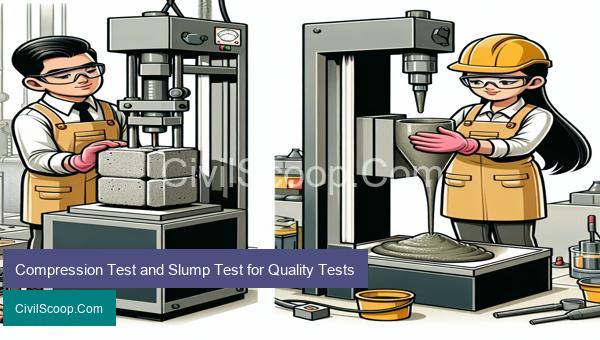
Compression Test:
Compression test is a common quality test used for determining the strength of a material by applying a compressive force on a test specimen. In civil engineering, this test is mainly performed on concrete to ensure its strength and durability.
The procedure for conducting a compression test involves taking cylindrical or cube-shaped specimens of concrete from the site and subjecting it to a compressive force using a compression testing machine. The machine exerts a gradually increasing load on the specimen until it fails. The force at which the specimen fails is recorded and compared with the design strength of the concrete.
Compression test helps to evaluate the properties of concrete and its ability to resist compression. It also helps in identifying any possible defects in the mixing, placing, and curing of concrete. Moreover, it is an essential quality control test for ensuring the overall quality of a structure, as the structural integrity and stability of a building depend on the compressive strength of its concrete elements.
Slump Test:
Slump test is another widely used quality test for determining the workability of fresh concrete. Workability refers to the ease with which concrete can be mixed, transported, placed, and compacted without segregation or bleeding. A slump test measures the consistency or fluidity of concrete, which is a critical factor in determining the quality of the concrete.
The procedure for conducting a slump test involves filling a standard slump cone with freshly mixed concrete in three layers. Each layer is compacted by a standard tamping rod in a specified manner. The cone is then lifted vertically, and the amount of slump or settlement of the concrete is measured in millimeters.
A higher slump indicates a more fluid and workable concrete, while a lower slump indicates a stiffer mix. This test helps to ensure that the concrete used on the site is workable enough to be placed and compacted effectively. It also helps to detect any possible issues with the proportioning of ingredients, grading of aggregates, or the amount of water added to the mix.
In conclusion, both compression test and slump test are essential quality tests in civil engineering that ensure the strength and workability of concrete. These tests help to determine the quality of concrete and ensure that it meets the required standards for construction projects. It is crucial to conduct these tests regularly to ensure the durability and longevity of structures.
Conclusion
In conclusion, it is crucial to conduct a thorough quality check when it comes to concrete. The strength and durability of any structure depend on the quality of the concrete used. By following the steps mentioned in this article, you can ensure that the concrete used in your construction project meets the necessary standards and specifications. Regularly checking the quality of concrete not only improves the strength and longevity of the structure but also reduces the risk of potential damages and costly repairs in the future. Remember, the key to a successful construction project is using high-quality materials, and concrete is no exception. So, make sure to prioritize quality checks for concrete in your construction process.