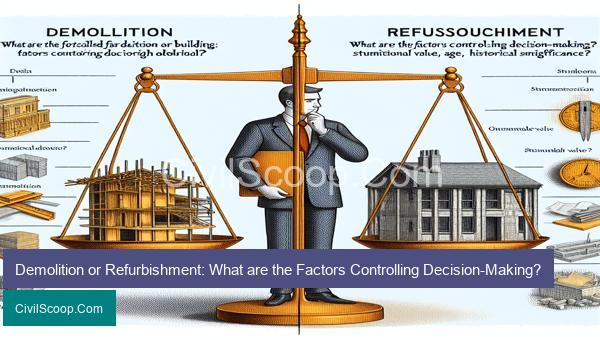
Demolition and refurbishment are two common approaches when it comes to changing or updating existing structures. Both options have their own advantages and limitations, making the decision-making process a complex and crucial one. In this article, we will explore the factors that influence the choice between demolition and refurbishment, as well as the various considerations that must be taken into account when making such a decision. From cost and environmental impact to structural integrity and desired outcomes, understanding these factors is essential for effective decision-making in demolition and refurbishment projects.
Table of Contents
Demolition or Refurbishment: What are the Factors Controlling Decision-Making?
Demolition and refurbishment are two common methods used in the construction industry to remove old or unused structures. While demolition involves completely destroying a building or structure, refurbishment involves renovating and repairing an existing structure to improve its functionality and aesthetic appeal. Both options have their own set of advantages and challenges, and the decision to choose between them is often based on several factors.
1. Age and Condition of the Structure: The age and condition of a structure are crucial factors in determining whether it should be demolished or refurbished. Older structures may have deteriorated to a point where refurbishment may not be a viable option, and complete demolition may be the only solution. On the other hand, if the structure is relatively new and is only in need of minor repairs and upgrades, refurbishment may be a more cost-effective and sustainable choice.
2. Structural Integrity: The structural integrity of a building also plays a significant role in the decision-making process. Demolition may be the preferred option if the structure has severe structural damage that cannot be repaired, as it may pose a safety risk. However, if the damage is limited to specific areas, refurbishment may be possible, as long as the overall structural integrity is not compromised.
3. Historical or Cultural Value: Some old structures may have significant historical or cultural value, which makes demolition a difficult decision. In such cases, preserving the building through refurbishment may be the preferred option to maintain its cultural and architectural heritage.
4. Future Use and Purpose: The future use of the structure is an essential factor that affects the decision between demolition and refurbishment. If the structure does not serve its intended purpose anymore, demolition may be the best option. However, if it can be repurposed and adapted to meet current needs, refurbishment may be a more suitable choice.
5. Environmental Impact: Demolition of a building can have a significant environmental impact, as it generates large amounts of waste material. Refurbishment, on the other hand, involves reusing existing materials, reducing waste, and promoting sustainable construction practices.
6. Cost: Cost is a crucial factor in any construction project, and it plays a significant role in the decision between demolition and refurbishment. Demolition typically involves higher costs due to the need for heavy machinery and disposal of waste, while refurbishment may be a more cost-effective option, depending on the extent of repairs needed.
7. Regulatory Requirements: In some cases, local authorities may have regulations or restrictions on demolition or refurbishment of buildings, especially those with historical or cultural significance. Compliance with these regulations is essential in making the decision between the two methods.
In conclusion, the decision between demolition and refurbishment depends on a combination of factors, including the age, condition, structural integrity, future use, and cultural value of the structure, as well as cost and regulatory requirements. A thorough evaluation of these factors is crucial to make an informed decision that best suits the specific project’s needs and goals.
Conclusion
In conclusion, the decision between demolition or refurbishment is not a simple one and is dependent on various factors. Both options have their own benefits and drawbacks, and it is important to carefully consider each factor before making a decision. Factors such as cost, environmental impact, historical significance, and future use of the site all play a crucial role in determining the best course of action. Ultimately, making an informed decision requires careful evaluation and consideration of each factor to ensure that the chosen approach is the most suitable and sustainable option for the given circumstances. Whether it is demolition or refurbishment, the goal should be to make a long-lasting and responsible decision that benefits both the community and the environment. Therefore, engaging in open and transparent communication and working closely with