
Cantilever beams are a fundamental structural element that can be found in numerous constructions, from buildings and bridges to furniture and machines. They are characterized by their unique ability to support heavy loads over a large span without the need for additional support columns or beams. However, without proper understanding and design, cantilever beams can fail catastrophically, resulting in costly damages and potential safety hazards. In this article, we will delve into everything you should know about cantilever beams, including their history, types, applications, design considerations, and failure mechanisms. By the end, you will have a comprehensive understanding of this crucial element and how to ensure its stability and safety in your projects.
Table of Contents
Structural Behaviour of Cantilever Beam

A cantilever beam is a type of structural element that is fixed at one end and free at the other end. It is commonly used in construction for various purposes such as bridges, balconies, and building extensions. The structural behaviour of a cantilever beam is crucial in determining its stability and load-bearing capacity.
One of the most important aspects of a cantilever beam’s behaviour is its ability to resist bending. When a load is applied to the free end of the beam, it causes the beam to bend downwards. This bending is known as deflection. The amount of deflection is directly proportional to the load applied and inversely proportional to the stiffness of the beam. This means that a stiffer beam will have less deflection for the same amount of load compared to a less stiff beam.
The resistance to bending in a cantilever beam is provided by the beam’s cross-sectional shape and material properties. Beams with rectangular cross-sections are commonly used in construction as they are easy to fabricate and provide greater resistance to bending. However, other cross-sectional shapes such as I-beams and T-beams can also be used, depending on the structural requirements.
The material properties of the beam, such as its strength and elasticity, also play a significant role in its structural behaviour. Different materials have different stiffness and yield strengths, which affect the beam’s load-bearing capacity. For instance, steel beams are stronger and stiffer than wooden beams, making them suitable for heavier loads.
Another crucial aspect of a cantilever beam’s behaviour is its ability to resist shear forces. Shear forces act parallel to the beam’s length and cause its cross-section to deform. This deformation is known as shear deformation and can result in the beam’s failure if the shear forces exceed the beam’s resistance.
To prevent shear failure in cantilever beams, additional structural elements such as shear reinforcement or stiffeners are added to increase their shear resistance. The appropriate placement and design of these elements are crucial in ensuring the overall stability and load-bearing capacity of the beam.
In addition to resisting bending and shear forces, a cantilever beam also experiences a phenomenon called stress concentration. This occurs at the point where the beam is fixed, known as the support or fixed end. The forces and moments are highest at this point, making it a potential weak spot. Proper design and strengthening of the support can help to distribute the forces and minimize stress concentration, thus increasing the beam’s overall stability.
In conclusion, the structural behaviour of a cantilever beam is determined by its ability to resist bending, shear forces, and stress concentration. The proper selection of material, cross-sectional shape, and support design is crucial in ensuring the beam’s stability and load-bearing capacity. As such, civil engineers must carefully consider these factors when designing cantilever beams for any construction project.
Shear Force (SF) and Bending Moment (BM) Diagram of Cantilever Beam
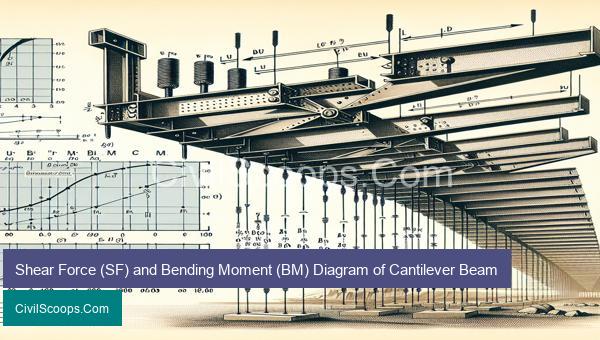
Shear Force (SF) and Bending Moment (BM) diagram are essential tools in structural analysis of a cantilever beam. They help engineers determine the internal forces and moments that act on a beam, which are crucial for designing safe and efficient structures.
A cantilever beam is a structural member that is supported at one end and left free at the other end, while subjected to external loads and forces. These beams are commonly used in bridges, buildings, and other structures.
Shear Force (SF) is the force that acts parallel to the cross-section of a beam, while Bending Moment (BM) is the algebraic sum of all the moments about a specific point on the beam. These internal forces and moments vary along the length of the beam, as a result of the external loads and reactions applied on the beam.
To plot the SF and BM diagrams of a cantilever beam, we follow a set of steps:
1. Determine the Support Reactions: The first step is to calculate the support reactions at the fixed end of the beam. These reactions are typically vertical and horizontal forces that counteract the external loads applied on the beam.
2. Determine the Point of Zero Shear: The point where the shear force changes from positive to negative (or vice versa) is known as the point of zero shear. This can be found by setting the sum of the forces to be equal to zero at a specific location on the beam.
3. Plot the SF Diagram: Using the support reactions and the point of zero shear, we can plot the SF diagram. The SF at any point along the length of the beam can be determined by adding the external loads and reactions up to that point.
4. Determine the Points of Max/Min Bending Moment: The points where the BM changes from positive to negative (or vice versa) are known as points of maximum or minimum bending moment. This can be found by setting the sum of the moments to be equal to zero at a specific location on the beam.
5. Plot the BM Diagram: Using the support reactions, the points of maximum/minimum bending moment, and the SF diagram, we can plot the BM diagram. The BM at any point along the length of the beam can be determined by adding the moments from the external loads and reactions up to that point.
6. Check for Equilibrium: Once the SF and BM diagrams are plotted, it is important to check for equilibrium at any section of the beam. This ensures that the internal forces and moments are balanced and the beam is stable.
In summary, the SF and BM diagrams of a cantilever beam are important tools for structural engineers to analyze and design efficient structures. They help in determining the internal forces and moments that are essential for safe and stable structures.
Design of Cantilever Beam
A cantilever beam is a structural element that is fixed at one end and free to pivot at the other end. It is commonly used in buildings, bridges, and other structures to support heavy loads or resist external forces. The design of cantilever beams is crucial as it ensures the structural stability and safety of the entire structure.
The design of cantilever beams involves the consideration of various factors such as load requirements, material properties, beam geometry, and support conditions. The following are the key steps involved in the design process of a cantilever beam:
1. Determine the type of load: The first step in designing a cantilever beam is to determine the type of load that the beam will be subjected to. This could be a point load, uniformly distributed load, or a combination of both. The magnitude and location of the load also need to be considered.
2. Calculate the reactions at the fixed end: The next step is to calculate the reactions at the fixed end of the beam using the equilibrium equations. This will provide the necessary support for the beam to resist the applied load.
3. Determine the maximum bending moment: Once the reactions are known, the maximum bending moment can be calculated at any point along the beam. This is the point of maximum stress and is essential in selecting the appropriate beam size and material.
4. Select the beam material: The selection of the beam material is crucial in achieving the required strength and stiffness. Commonly used materials for cantilever beams include concrete, steel, and timber. The material properties such as Young’s modulus, yield strength, and density must be considered in the design process.
5. Consider deflection and shear: In addition to bending, cantilever beams are also subjected to deflection and shear forces. The deflection of the beam must be limited to avoid any aesthetic or functional issues. The shear force, on the other hand, must be resisted by providing sufficient reinforcement or choosing a material with high shear strength.
6. Determine the size and shape of the beam: Based on the beam’s material, span, and loading conditions, the appropriate beam size and shape can be determined using standard design tables or by performing structural analysis using software.
7. Provide appropriate support: The support conditions at the fixed and free end of the beam must be carefully considered. Adequate support ensures the stability and safety of the structure.
The design of cantilever beams must also comply with the local building codes and regulations. The use of safety factors and load combinations must also be incorporated to ensure a conservative and robust design.
In conclusion, the design of cantilever beams is a complex and critical process that requires extensive knowledge of structural mechanics and materials. A well-designed cantilever beam can support heavy loads, resist external forces, and ensure the structural integrity of the entire structure.
Applications of Cantilever Beam in Construction

Cantilever beams are structural elements that are used extensively in construction due to their versatility and structural efficiency. A cantilever beam is defined as a structural member that is supported at one end and is free at the other end. The applications of cantilever beams in construction are diverse and include the following:
1) Bridges: Cantilever beams are commonly used in bridge construction, especially in the construction of suspended bridges. These beams are used to create the structure of the bridge deck, supporting the weight of the deck and the load of the traffic passing over it. The use of cantilever beams in bridge construction allows for longer spans without the need for intermediate support columns, making them a cost-effective and efficient option.
2) Balconies: Cantilever beams are used in the construction of cantilever balconies, which are projecting structures that are supported at one end and are free at the other. These beams are an integral part of the structural design of the balcony, providing support and stability to the structure. Cantilever balconies are popular in residential and commercial buildings as they add aesthetic appeal and increase usable floor space.
3) Retaining walls: Cantilever beams are commonly used in retaining walls, which are structures designed to retain soil in places where there is a significant difference in elevation. These beams are used to create a wall that is free-standing on one side and is supported by the soil on the other side. The use of cantilever beams in retaining walls allows for the construction of taller and more stable walls compared to traditional methods.
4) Overhangs: Cantilever beams are used in the construction of overhangs, which are structural elements that project beyond the main body of a building. These beams provide support to the overhang, allowing for the projection of large distances without the need for additional columns or supports. Overhangs are commonly used in commercial and residential buildings to create covered walkways, entrance canopies, and shaded outdoor spaces.
5) Signage and lighting: The use of cantilever beams in the construction of signage and lighting structures is becoming increasingly popular. These beams are used to create the structure for large, projecting signs and support lighting fixtures. Cantilever beams allow for the creation of visually appealing and impactful structures while reducing the need for ground support, making them a popular choice in urban areas with limited space.
6) Stadiums and sports complexes: The use of cantilever beams is prevalent in the construction of stadiums and sports complexes. These beams are used to create the roof structure, providing unobstructed views for spectators and eliminating the need for columns that can obstruct sightlines. The use of cantilever beams in stadium construction allows for the creation of larger and more spacious seating areas.
In conclusion, cantilever beams have a wide range of applications in construction and are essential elements in creating efficient and aesthetically pleasing structures. The use of cantilever beams allows for the construction of longer spans, increased usable space, and more visually appealing designs, making them a popular choice among engineers and architects.
Advantages of Cantilever Beams

Cantilever beams are one of the most commonly used structural elements in civil engineering. They are horizontal beams that are supported at only one end and free to load at the other end. These beams are used in a wide range of applications, from bridges and buildings to machines and electronics. There are several advantages of using cantilever beams in construction projects, some of which are discussed below.
1. Easy to design and construct: Cantilever beams are relatively simple to design and construct, making them a popular choice among engineers. They require fewer supports compared to other types of beams, which reduces construction time and costs. The simplicity of their design also makes them easy to analyze and modify if necessary.
2. Saves space: Since cantilever beams are only supported at one end, they do not require any additional vertical supports. This allows for more open space in buildings and structures, providing flexibility in design and functionality. It also makes them ideal for use in areas with limited space, such as overhangs and balconies.
3. Provides stability: Cantilever beams are inherently stable due to their structural configuration. The fixed end of the beam resists any bending moments and provides stability against lateral movements, making these beams suitable for withstanding strong winds or earthquakes. This stability is also beneficial in construction, as it minimizes the need for additional support structures.
4. Cost-effective: Due to the reduced number of supports and the simplicity of their design, cantilever beams are a cost-effective option for construction projects. They require less material and labor, resulting in lower costs compared to other types of beams. This makes them a desirable choice for small and medium-sized construction projects.
5. Versatile: Cantilever beams offer versatility in terms of design and use. They can be constructed in various lengths, and engineers can incorporate different shapes and materials to suit the specific requirements of a project. This flexibility in design allows for unique and innovative structures that are not possible with other types of beams.
6. Allows for expansion and contraction: Unlike traditional beams that are fixed on both ends, cantilever beams are free to expand and contract depending on temperature changes. This is beneficial in areas with extreme weather conditions, as the beams can accommodate thermal movement and prevent damage to the structure.
In conclusion, cantilever beams offer various advantages in terms of design, construction, and functionality in civil engineering projects. Their stability, cost-effectiveness, and versatility make them a popular choice for a wide range of applications. It is essential to consider the specific requirements and load capacities of a project before deciding on the type of beam to use.
Disadvantages of Cantilever Beams

Cantilever beams are a type of structural element commonly used in construction projects. They are designed to support a load at one end while the other end is anchored to a support structure. While they have numerous advantages, there are also some significant disadvantages of cantilever beams that should be considered before their use in a project.
1. Limited load capacity: One of the main disadvantages of cantilever beams is their limited load-carrying capacity. This is due to the fact that the load is supported on just one end of the beam. As a result, cantilever beams are not suitable for structures that require significant weight support or where heavy equipment will be located.
2. Stress concentration: Cantilever beams are prone to stress concentration at the fixed support point and at the point where the load is applied. This could lead to cracks or failure of the beam if the load is too heavy or if there are structural defects.
3. Deflection: The unsupported end of a cantilever beam is susceptible to deflection under load. This deflection can cause the beam to bend or even break if the load is too heavy. Therefore, cantilever beams are not ideal for structures that require high stiffness and rigidity.
4. Complex design: The design of cantilever beams is more complex compared to other structural elements. It requires precise calculations and careful consideration of the load, support conditions, and the properties of the materials being used. This can lead to longer design times and higher costs.
5. Cost: The construction of cantilever beams can be expensive. This is due to the complexity of their design, the need for specialized materials, and the additional support structures that may be required to offset the load and stress concentration.
6. Limited applications: Cantilever beams have limited applications in structural engineering. They are mainly used for small-scale projects such as creating balconies, awnings, and bridges. They are not suitable for large-scale structures where greater load capacity and stability are required.
7. Maintenance: Due to the complexity of their design, cantilever beams may require more frequent maintenance compared to other structural elements. This can add to the overall cost of the project.
In conclusion, while cantilever beams have numerous advantages, it is essential to consider their limitations and potential disadvantages before deciding to use them in a construction project. Their load-carrying capacity, stress concentration, and complex design can pose significant challenges and increase costs if not properly addressed.
Conclusion
In conclusion, understanding the basics and key points about cantilever beams is crucial for engineers, architects, and anyone working with structural designs. From the definition and types of cantilever beams to their advantages and disadvantages, it is essential to have a comprehensive knowledge of these structural elements to ensure safe and efficient designs. Additionally, familiarizing oneself with the different factors that affect cantilever beams, such as load distributions, material properties, and support conditions, can help in making informed decisions for a successful project. With proper understanding and implementation of cantilever beams, we can continue to create innovative and sustainable structures in our modern world. As technology and designs evolve, it is essential to continuously educate ourselves about cantilever beams and their applications to