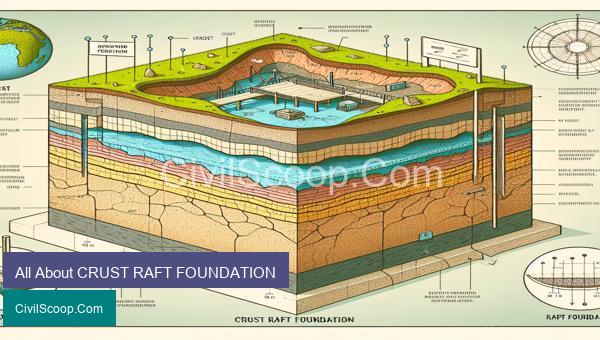
Crust raft foundation is a relatively new and innovative type of foundation used in the construction industry. Inspired by traditional raft foundations, crust raft foundation has evolved to provide a more efficient and cost-effective solution for building on challenging ground conditions. This article will delve into the intricacies of crust raft foundation, including its design, construction process, advantages, and applications. Join us as we explore the world of crust raft foundation and discover why it’s becoming a preferred choice for many construction projects.
Table of Contents
CRUST RAFT FOUNDATION
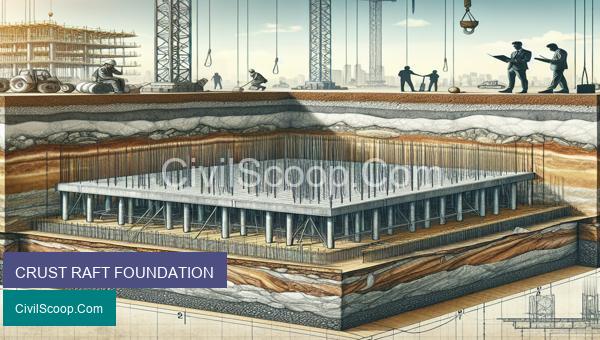
A crust raft foundation is a type of deep foundation that is commonly used in the construction of buildings and structures that are located in areas with weak or uneven soil conditions. It is a combination of a raft foundation and a pile foundation, which provides a cost-effective solution for constructing buildings on soft soils.
The concept of a crust raft foundation originated in Scandinavia in the early 20th century and has since been widely adopted in different parts of the world, especially in areas with thick soft clay deposits. This type of foundation is also known as floating foundation or mat foundation.
Crust raft foundations are specially designed to transfer the loads from the superstructure to a thick layer of soil, known as the crust layer, which has the required load-bearing capacity to support the building. The crust layer is usually located at a depth of 3 to 5 meters below the ground surface. It consists of dense, consolidated soil or rock that can withstand the weight of the building and distribute the load to the surrounding soil.
The construction of a crust raft foundation involves excavating the top layer of soft soil and replacing it with a layer of compacted gravel or sand, known as a mattress layer. This layer serves as a stable base for the crust layer above it. The crust layer is then constructed with reinforced concrete beams or slabs, which are interconnected to form a rigid platform that can support the building’s load. The thickness and reinforcement of the crust layer depend on the design requirements and the soil conditions.
One of the key advantages of a crust raft foundation is its ability to distribute the loads of the building evenly on the crust layer, which helps to minimize any differential settlement. Differential settlement is a common issue in buildings constructed on soft soils, where one part of the building sinks more than the other, leading to structural damage. The use of a crust raft foundation helps to mitigate this issue and ensures the stability of the building.
Another advantage of a crust raft foundation is its cost-effectiveness. As the foundation is spread over a large area, it reduces the need for deep foundation elements such as piles, which can be expensive and time-consuming to install. Additionally, the construction of a crust raft foundation is relatively easier and quicker compared to other deep foundation systems, making it a popular choice for large-scale construction projects.
However, the design and construction of a crust raft foundation require detailed geotechnical investigations, soil analysis, and structural design to ensure its stability and load-bearing capacity. Any errors or miscalculation in the design can lead to serious consequences, including structural failure.
In conclusion, crust raft foundation is a practical and economical foundation system for buildings constructed on soft soils. Its ability to distribute loads evenly and minimize differential settlements makes it a preferred choice for civil engineers in areas with challenging soil conditions. With proper design and construction, a crust raft foundation can provide a solid foundation for buildings, ensuring their stability and longevity.
Conclusion
In conclusion, crust raft foundation is a type of foundation that is widely used in the construction industry due to its numerous benefits. It provides a stable and strong base for buildings, distributing the load evenly to the underlying soil. The design and construction of a crust raft foundation require careful consideration of soil properties and building loads, as well as regular maintenance for optimal performance. This type of foundation is suitable for various soil conditions and can be adapted for different building types. With proper planning and execution, crust raft foundation can provide a reliable and durable foundation for all types of structures. It is an essential aspect of modern construction and will continue to play a crucial role in building strong and sustainable structures.