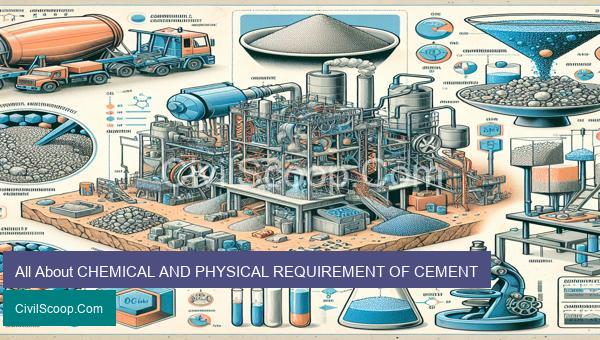
Cement is a crucial material in construction, used to bind various components together to create strong and durable structures. It is made up of a combination of chemical and physical properties that determine its quality and performance. Understanding the chemical and physical requirements of cement is essential for ensuring its effectiveness in construction projects. In this article, we will delve deeper into the composition and characteristics of cement, exploring the key factors that influence its strength, workability, and durability. By gaining a comprehensive understanding of these requirements, professionals in the construction industry can make informed decisions when selecting the right type of cement for their specific project needs.
Table of Contents
CHEMICAL AND PHYSICAL REQUIREMENT OF CEMENT
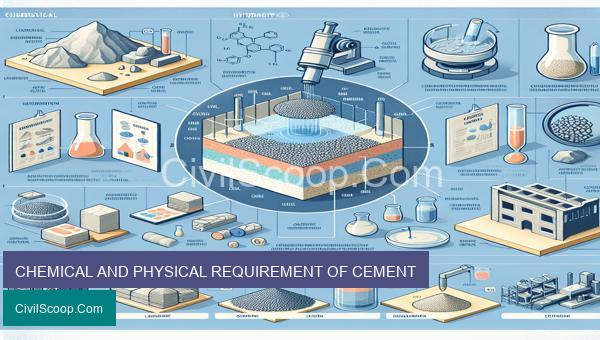
Cement is a vital material in the construction industry, widely used in the production of concrete and mortar. It is a fine powder made from a combination of minerals such as calcium, silicon, aluminum, iron, and other ingredients. The quality of cement is crucial for the strength and durability of the structures where it is used. Hence, the chemical and physical requirements of cement play a significant role in determining its overall performance. In this article, we will discuss the key chemical and physical requirements of cement.
Chemical Requirements:
1. Lime Saturation Factor (LSF): LSF is a measure of the ratio of lime (CaO) to other major oxides in cement, such as silica (SiO2), alumina (Al2O3), and iron oxide (Fe2O3). It is used to indicate the degree of cement’s quality and also affects its setting time. Ideally, LSF should be between 0.92 and 1.02 for ordinary Portland cement (OPC). A lower LSF indicates an excess of free lime, leading to slower setting and poor strength, while a higher LSF can cause rapid setting and cracking.
2. Fineness: Fineness refers to the particle size of cement and is measured by the surface area per unit weight. A finer cement has more surface area, which results in better water retention and improves the strength of concrete. The fineness of cement is determined by the sieving method and reported as either specific surface area or particle size. Generally, the specific surface area of OPC should be between 300 to 350 m2/kg.
3. Tricalcium silicate (C3S) and Dicalcium silicate (C2S) content: These two compounds are responsible for the early strength of cement. C3S reacts faster, giving high early strength, while C2S contributes to long-term strength development. OPC should contain at least 50% C3S and 25% C2S for optimum strength development.
4. Alumina (Al2O3) and Iron oxide (Fe2O3) content: These compounds contribute to the strength and durability of cement. They control the rate of cement’s setting and also reduce its solubility. A higher content of these compounds can lead to slower setting and may cause the formation of cracks.
Physical Requirements:
1. Setting time: The setting time of cement is the time taken for the material to change from a plastic to a rigid state. It is divided into initial setting time and final setting time. The initial setting time should be at least 45 minutes, while the final setting time should not exceed 10 hours for OPC.
2. Soundness: Soundness is the ability of cement to retain its volume after it hardens. The initial volume of cement paste should not change more than 10mm when immersed in water for 24 hours. Excessive expansion of cement can cause cracks and damage to structures.
3. Compressive strength: The compressive strength of cement measures its resistance to crushing under a specific load. It is the most crucial mechanical property of cement and is affected by factors such as fineness, chemical composition, and curing conditions. OPC should have a compressive strength of at least 52 MPa after 28 days of curing.
4. Specific gravity: The specific gravity of cement is the ratio of its mass to the mass of an equal volume of water. Generally, the specific
Conclusion
In conclusion, understanding the chemical and physical requirements of cement is crucial for any construction project. The properties of cement, such as setting time, strength, and workability, are directly influenced by its chemical and physical composition. It is essential to use high-quality cement that meets the necessary standards and follows proper storage and handling protocols. By adhering to the required specifications and guidelines, we can ensure the durability and strength of structures built with cement. As the demand for construction materials continues to rise, it is more important than ever to have a comprehensive understanding of the chemical and physical requirements of cement to ensure safe, reliable, and long-lasting buildings. Knowledge of these requirements also allows for innovative developments and improvements in the construction industry, leading to more efficient and