Bending is a fundamental mechanical property that can be observed in various structures and materials. It is the result of external forces acting on an object, causing it to deform and change shape. The study of these forces and their effects on an object is known as statics of bending. This discipline is essential in understanding the behavior and strength of different structures, from bridges and buildings to everyday objects such as chairs and utensils. In this article, we will explore the basics of statics of bending, including its principles, calculations, and real-world applications. Whether you are a student of engineering or simply curious about the mechanics of everyday objects, this article will provide a comprehensive overview of all things related to statics of bending.
Table of Contents
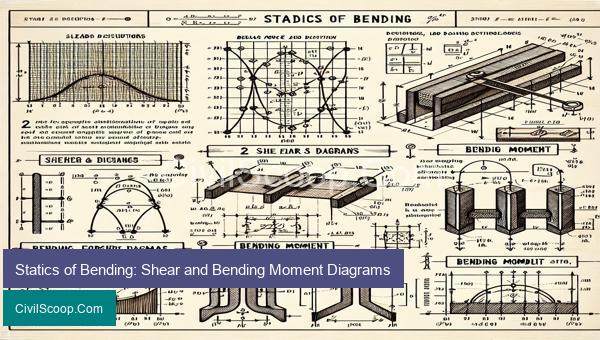
Statics of Bending: Shear and Bending Moment Diagrams
Statics of bending is a fundamental concept in the field of civil engineering. It deals with the behavior of beams and other structural members under the application of external loads. The analysis of bending is an essential part of structural design as it helps determine the stress and deformation of a structure.
Shear and bending moment are two important forces that act on a beam subjected to external loads. These forces are critical in understanding the behavior of a beam and designing a safe and stable structure.
Shear is a force that acts perpendicular to the longitudinal axis of a beam at a particular section. It is caused by the vertical loads that are applied on the beam, such as the weight of the structure or any live loads. Shear forces can cause a beam to fail by sliding or tearing apart.
On the other hand, bending is a force that causes a beam to deform or bend. It is due to the moments created by the external loads on the beam. Bending can cause a beam to fail by excessive deflection or even fracture.
To analyze the behavior of a beam under the influence of shear and bending forces, engineers often use shear and bending moment diagrams. These diagrams provide a graphical representation of the distribution of shear and bending moment along the length of the beam.
Shear diagrams are typically represented by a line or curve that shows the magnitude of the shear force at every point along the beam. For a simply supported beam, the shear force is zero at the ends and reaches its maximum value at the center. The shape of the shear diagram depends on the type and magnitude of the load applied on the beam.
Bending moment diagrams, on the other hand, represent the variation of bending moment along the length of a beam. They are typically represented by a line or curve that shows the magnitude of the bending moment at every point. The bending moment is maximum at the ends of a simply supported beam and zero at the center.
These diagrams are useful tools for engineers in designing and analyzing beams. By observing the shape and magnitude of the shear and bending moment diagrams, engineers can identify critical points in a beam that require additional reinforcement to resist excessive loading.
In conclusion, understanding the concepts of shear and bending moment diagrams is crucial for predicting and preventing structural failures. By using these diagrams, engineers can design safe and stable structures that can withstand external loads and keep people and properties safe.
Conclusion
In conclusion, understanding the statics of bending is crucial for engineers, architects, and anyone involved in the design and construction of structures. By applying the principles of statics, they can ensure the structural integrity and stability of their designs. However, it is also important to consider factors such as material properties, load distribution, and safety factors when analyzing bending forces. With proper knowledge and application of statics, structures can be built to withstand the forces of bending and last for years to come. It is a fundamental concept that plays a vital role in the field of engineering and continues to be studied and improved upon. By continuously learning and applying the principles of statics of bending, we can create safe and reliable structures for the future.