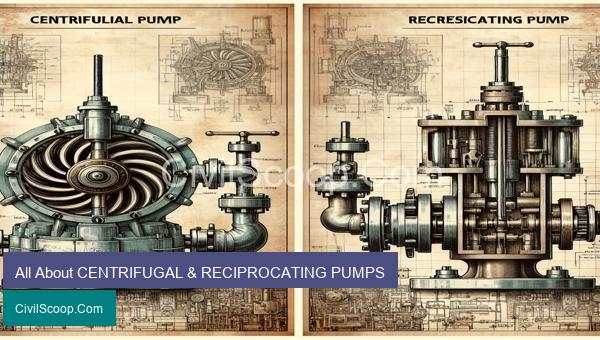
Centrifugal and reciprocating pumps are two of the most commonly used pumps in various industries such as oil and gas, agriculture, mining, and many more. These pumps play a vital role in the transportation and circulation of fluids, making them essential for many industrial processes. Understanding the differences, advantages, and applications of centrifugal and reciprocating pumps is crucial for choosing the right pump for a specific task. In this article, we will delve into the world of centrifugal and reciprocating pumps, exploring their basic principles, functionality, and important applications. Whether you are a professional in the field or simply curious about these powerful machines, this article will provide you with all the information you need to know about these essential pumps.
Table of Contents
COMPARISON BETWEEN CENTRIFUGAL & RECIPROCATING PUMPS:
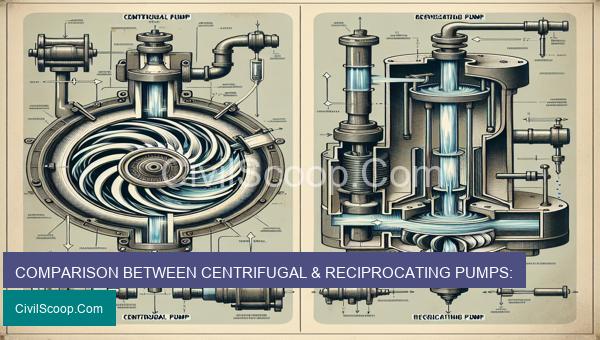
Centrifugal and reciprocating pumps are two commonly used types of pumps in various industries and applications. Both these pumps have their own advantages and limitations, and the choice between them depends on the specific requirements of the project. In this article, we will compare centrifugal pumps and reciprocating pumps based on various parameters.
1. Principle of Operation
Centrifugal pumps work on the principle of centrifugal force, where a rotating impeller creates a centrifugal force that pushes the fluid towards the outer edges of the impeller, increasing its velocity and creating a low-pressure zone at the center. This low-pressure zone allows the fluid to be drawn into the pump through the inlet and then gets pushed out through the outlet due to the centrifugal force. On the other hand, reciprocating pumps use a piston or plunger to create a vacuum to draw in the fluid through the inlet and then use the reciprocating motion of the piston or plunger to push the fluid out through the outlet.
2. Flow Rate and Pressure
One major difference between centrifugal and reciprocating pumps is their flow rate and pressure capabilities. Centrifugal pumps have a higher flow rate but lower pressure capabilities compared to reciprocating pumps. This is because centrifugal pumps operate at a continuous flow, while reciprocating pumps have a pulsating flow. Therefore, centrifugal pumps are more suitable for applications where large volumes of fluid need to be moved at a constant rate, while reciprocating pumps are better for applications where high pressure is required.
3. Efficiency
Centrifugal pumps are generally more efficient compared to reciprocating pumps due to their simple design and operation. They have a smaller number of moving parts, which results in lower friction losses and higher efficiency. Reciprocating pumps, on the other hand, have a more complex design with a larger number of moving parts, leading to higher friction losses and lower efficiency.
4. Maintenance and Durability
Since centrifugal pumps have a simple design and fewer moving parts, they are easier to maintain and have a longer lifespan compared to reciprocating pumps. However, in the event of a breakdown, centrifugal pumps require specialized equipment for repairs, while reciprocating pumps can be easily repaired on-site.
5. Cost
Centrifugal pumps are less expensive compared to reciprocating pumps, both in terms of initial purchase and maintenance costs. However, reciprocating pumps have a longer lifespan, which can offset the higher initial cost.
6. Application
Centrifugal pumps are mainly used for applications that require a high flow rate, such as in irrigation, HVAC systems, and water supply. Reciprocating pumps are better suited for applications that require high pressure, such as in oil and gas industries, chemical processing, and power generation.
In conclusion, both centrifugal and reciprocating pumps have their own strengths and limitations, and the choice between them depends on the specific requirements of the project. Centrifugal pumps are more suitable for high flow rate applications with low to medium pressure, while reciprocating pumps are better for high pressure applications with variable flow rate. Proper evaluation of the project requirements should be done to determine the most suitable pump for the application.
Conclusion
In conclusion, centrifugal and reciprocating pumps are both commonly used in various industries for different purposes. While centrifugal pumps are efficient for moving large volumes of fluid, reciprocating pumps are best for high-pressure applications. Understanding the basic principles and operations of these pumps is crucial in selecting the most suitable model for a specific task. Both pumps have their unique advantages and drawbacks, and it is essential to carefully evaluate and consider all factors before making a decision. With the constant advancements in technology, these pumps continue to evolve and offer more efficient and reliable solutions for fluid transportation. Whether it is a centrifugal or reciprocating pump, proper maintenance and regular inspections are necessary for optimal performance and longevity. Ultimately, both pumps play crucial roles in modern