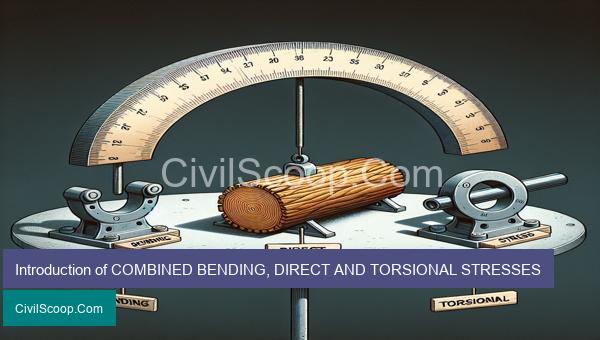
When designing structures and mechanical components, it is crucial to consider the different types of stresses that they may experience. Among these, combined bending, direct and torsional stresses are some of the most complex and challenging to analyze. These types of stresses can occur simultaneously when a load is applied to a structure, and they can greatly affect its strength and stability. In this article, we will provide an overview of this combined stress phenomenon and discuss its effects on different materials. We will also explore the methods used to analyze and design structures under such conditions. Understanding combined bending, direct and torsional stresses is essential for engineers and designers to ensure the safety and efficiency of various structures and components.
Table of Contents
COMBINED BENDING, DIRECT AND TORSIONAL STRESSES
Combined bending, direct and torsional stresses refer to the various types of forces that act on a structural member simultaneously. These forces include bending, direct (axial) and torsional (twisting) stresses, and their combination can significantly affect the design and stability of a structure.
Bending stress is caused by a force or moment that causes a structural member to bend or flex. This type of stress is characterized by tension on one side of the member and compression on the other. Bending stresses are commonly seen in beams and columns, where the weight of the structure or loads acting on it cause the member to bend.
Direct stress, also known as axial stress, is caused by a force that acts along the length of a structural member. It is distributed equally throughout the cross-section of the member, resulting in tension or compression along its length. This type of stress is commonly seen in columns and compression members.
Torsional stress is caused by a twisting force acting on a structural member. This type of stress is characterized by shearing and compressive stresses in different parts of the member. Torsional stresses are commonly seen in structures such as bridges, transmission towers and shafts.
In most cases, structural members are subjected to a combination of these three types of stresses. This means that a beam or column may experience bending, direct and torsional stresses simultaneously. In such cases, it is essential to consider the combined effect of these stresses for accurate structural analysis and design.
The combined effect of these stresses on a structural member can lead to failure or deformation if not properly accounted for. For instance, the combination of bending and direct stresses can cause a beam to buckle or deform, especially if the load is applied near its ends. Similarly, the combination of bending and torsional stresses can cause a member to twist or fail, especially if it has a variable cross-section.
To account for the combined stresses, engineers use various methods such as the superposition principle, which involves calculating individual stresses and then combining them using mathematical equations. Another approach is to use design codes and standards, which provide guidelines and equations for calculating the combined stress limits for different types of structural members.
In conclusion, combined bending, direct and torsional stresses are critical factors to consider in structural engineering. These stresses can significantly affect the behavior and stability of a structure and must be carefully taken into account during the design process. By accurately evaluating and considering all types of stresses, engineers can ensure the safety and stability of structures for their intended use.
Conclusion
In conclusion, the introduction of combined bending, direct, and torsional stresses has revolutionized the field of structural engineering. This new approach allows for a more accurate and comprehensive analysis of structures subjected to multiple types of stresses, ensuring their safety and durability. The incorporation of this concept into design codes and standards has greatly improved the overall understanding and management of stress in structures. As the demand for more complex and efficient structures increases, the application of combined stress analysis will continue to play a crucial role in ensuring their stability and performance. It is vital for structural engineers to have a thorough understanding of these stresses and their effects in order to develop innovative and resilient designs. The future of structure design and analysis relies heavily on the continued development and implementation of combined stress analysis