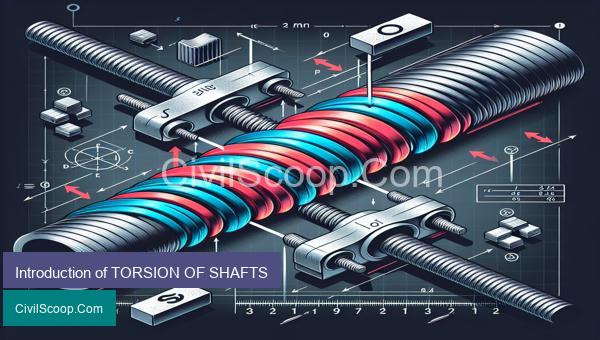
Torsion is the twisting or rotational force experienced by a structure when a torque is applied to it. In engineering, torsion is a critical factor to consider, especially in the design and analysis of shafts. The study of torsion of shafts is crucial for ensuring the safe and efficient operation of various mechanical systems such as engines, turbines, and pumps. In this article, we will explore the concept of torsion and its effects on shafts, as well as discuss the methods used to analyze and design shafts to withstand torsional forces. A deeper understanding of torsion of shafts is essential for any engineer or designer involved in developing strong and reliable mechanical systems.
Table of Contents
TORSION OF SHAFTS
Torsion of shafts is a common structural phenomenon in civil engineering that occurs when a shaft is subjected to twisting forces. This twisting action results in shear stresses and deformation in the shaft, which can have significant consequences on the structural integrity and stability of a building or structure.
Shafts are commonly used in civil engineering constructions, such as bridges, buildings, and machinery, to transmit rotational forces between different components. These forces, which are applied at one end of the shaft, create a torsional moment that is transmitted along the shaft’s length. This moment causes the shaft to twist, leading to shear stresses and deformations.
The amount of shear stress and deformation in a shaft depends on several factors, including the magnitude of the applied torque, the geometry and dimensions of the shaft, and the material properties. As torsional forces are applied to a shaft, they create shear stresses that are maximum at the outer surface of the shaft and decrease towards the center. This phenomenon is known as the shearing stress distribution and is represented by the shearing stress equation τ = T*r/J, where τ is the shear stress, T is the applied torque, r is the radial distance from the shaft’s center, and J is the polar moment of inertia.
Torsional forces can cause significant deformations in a shaft, known as torsional deformation. This deformation can result in significant changes in the cross-sectional shape of the shaft, which can ultimately lead to failure if not properly considered in the design phase. The amount of torsional deformation in a shaft is given by the torsion equation θ = TL/GJ, where θ is the torsional deformation, T is the applied torque, L is the length of the shaft, G is the shear modulus of the material, and J is the polar moment of inertia.
In design, engineers use safety factors to ensure that the shaft can withstand the expected torsional forces and will not fail. The critical shear stress, which is the maximum stress that a material can withstand before failure, is typically used to determine the safety factor required in the design of the shaft.
In addition to the safety factor, engineers also consider the material properties and cross-sectional shape of the shaft to minimize torsional stresses and deformations. For example, using a hollow cross-sectional shape for the shaft can help distribute the torsional stresses more evenly and reduce deformations.
In conclusion, understanding torsion of shafts is critical in civil engineering design to ensure the structural stability and integrity of constructions. By considering the applied torque, shaft geometry, and material properties, engineers can design shafts that can safely transmit rotational forces without causing significant shear stresses and deformations.
Conclusion
In conclusion, torsion of shafts is a fundamental concept in engineering that plays a crucial role in understanding the behavior of rotating structures. It involves the twisting and deformation of a shaft caused by a torque or twisting force. The introduction of torsion of shafts has revolutionized the design and analysis of various mechanical systems, from simple machines to complex industrial structures. With an understanding of torsion, engineers are able to ensure the safety, efficiency, and reliability of shafts and rotating components. As technology continues to advance, the study of torsion will remain essential in the design and development of new and innovative machinery. It is a fundamental concept that will continue to shape the future of engineering.