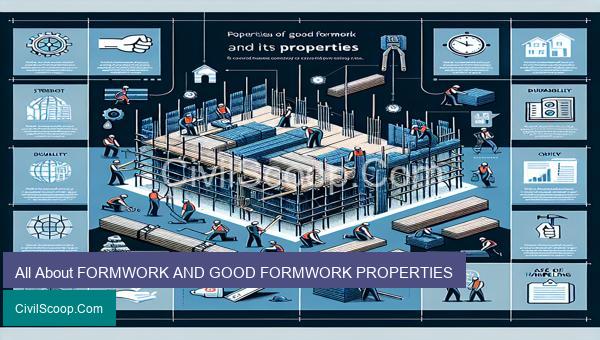
Formwork plays a crucial role in the construction industry as it provides the necessary support, mold, and structure to create concrete elements such as beams, columns, walls, and slabs. Good formwork properties are essential in ensuring the structural integrity and quality of the final concrete product. In this article, we will delve into the world of formwork and explore its various types, uses, and the important qualities that make for good formwork. Understanding the fundamentals of formwork is crucial for any construction project, and with the right knowledge, contractors and engineers can make informed decisions and achieve successful results.
Table of Contents
FORMWORK AND GOOD FORMWORK PROPERTIES
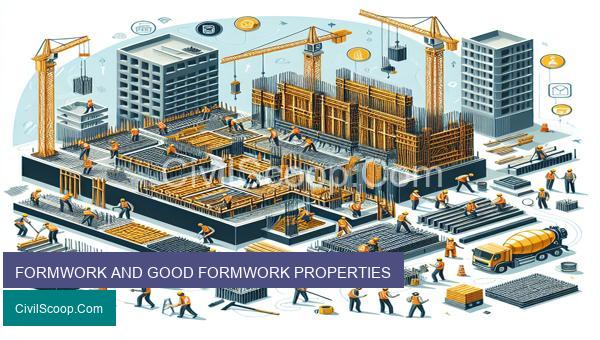
Formwork is a temporary structure used in construction projects to support the weight of the concrete and other construction materials during the casting and curing process. It also provides the required shape and surface finish of the concrete element. Good formwork needs to possess certain properties to ensure the structural integrity and safety of the construction.
1. Strength and Durability:
The formwork must have adequate strength and durability to safely withstand the loads and forces imposed by the weight of the concrete and construction materials. It should also be able to withstand the impact of construction activities such as pouring, vibrating, and finishing the concrete.
2. Stability:
The formwork should be stable and rigid to resist the lateral forces exerted by the concrete and wind loads. It must also be able to support itself and the additional loads during construction.
3. Ease of Assembly and Dismantling:
Good formwork should be easy to assemble and dismantle, enabling efficient use of time and labor. Reusable formwork systems are preferred to minimize waste and reduce costs.
4. Dimensional Accuracy:
Formwork must have precise dimensions to ensure that the finished concrete element is also accurate. Any inaccuracies in the formwork can result in a defective concrete structure.
5. Surface Finish:
The formwork should provide a smooth and even surface to achieve a desirable finish on the concrete element. The joints between the formwork panels should be tight to avoid any leakage of the concrete and to produce a neat appearance.
6. Water Resistance:
Water can adversely affect the formwork, leading to swelling, warping, and other forms of damage. A good formwork material must have high water resistance to maintain its structural integrity.
7. Reusability:
Using reusable formwork not only saves costs but also reduces the amount of waste generated during construction. It also minimizes the impact on the environment.
8. Fire Resistance:
Formwork material should have a high level of fire resistance to ensure the safety of the structure and the workers on-site. Fire-resistant materials like steel, aluminum, and some types of plywood are commonly used in formwork.
9. Adequate Ventilation:
Proper ventilation is essential to prevent the build-up of air pockets and ensure the even distribution of concrete. Good formwork should have adequate vents to allow trapped air to escape.
10. Compatibility with Construction Materials:
The formwork must be compatible with the construction materials used, such as concrete, reinforcement, and anchors. This ensures that the formwork can support the loads and forces imposed by these materials without any compatibility issues.
In conclusion, good formwork should possess the above-mentioned properties to ensure the safety, stability, and accuracy of the finished concrete structure. The selection of formwork material and design should be carefully considered to meet the specific requirements of each construction project.
Conclusion
In conclusion, formwork plays a crucial role in the construction industry by providing support and shape to the concrete during the casting process. Understanding the different types of formwork and their properties is essential for ensuring the strength, stability, and quality of a structure. Choosing the right formwork system can greatly impact construction efficiency, cost, and safety. The continuous advancement and innovation in formwork technology have allowed for the development of more efficient and durable formwork systems, making construction processes more efficient and sustainable. It is crucial for construction professionals to have a solid understanding of formwork and its properties to ensure the successful completion of a project. With the proper knowledge and utilization of good formwork properties, we can create safe, durable, and high-quality structures for