
Trial and error method has long been used in various fields and industries to find the most effective and efficient solution to a problem. In the world of concrete mix design, this method has also been a go-to approach for many engineers and construction professionals. It involves experimenting with different combinations of materials and adjusting the ratios until the desired strength and characteristics of the concrete are achieved. In this article, we will delve deeper into the concept of trial and error in concrete mix design, exploring its history, advantages and drawbacks, and how it continues to play a crucial role in the construction industry today.
Table of Contents
TRIAL AND ERROR METHOD OF CONCRETE MIX DESIGN
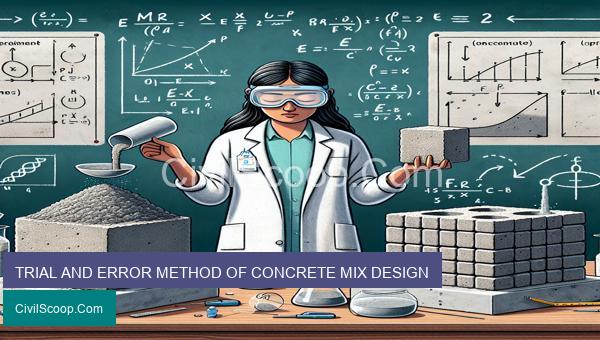
Concrete mix design is a crucial process in the construction of any structure that involves the use of concrete. It involves determining the right proportions of various materials such as cement, water, aggregates, and admixtures, to achieve the desired strength, durability, and workability of the final concrete product. There are several methods of concrete mix design, one of which is the trial and error method. In this article, we will discuss the trial and error method of concrete mix design, its advantages, and limitations.
The trial and error method is a simple and widely used method of concrete mix design, especially in smaller projects where the requirement for accuracy is not critical. This method involves using trial mixtures of concrete and adjusting the proportions of materials until the desired properties are achieved. The process of trial and error continues until the final mix meets the desired specifications.
The first step in the trial and error method is to determine the target strength of concrete required for the project. The target strength is usually specified by the structural engineer or based on the design requirements. Once the target strength is determined, the next step is to select the appropriate materials and their proportions.
In the trial and error method, the initial mix proportion of cement, water, aggregates, and admixtures is based on past experience, standard guidelines, or any other source of reference. The initial mix is then tested for its compressive strength, workability, and other properties as per the relevant standards.
Once the initial mix is tested, adjustments are made to the mix proportions based on the results obtained. If the compressive strength is lower than the target strength, the cement content is increased, and if it is higher, the cement content is reduced. Similarly, the water-cement ratio is also adjusted based on the workability of the concrete. This process of adjusting the proportions and testing the mix continues until the desired strength and workability are achieved.
One of the significant advantages of the trial and error method is that it is a simple and straightforward approach that does not require any complex calculations or computer programs. It is also a cost-effective method, as it does not involve extensive laboratory experiments. Moreover, this method also considers the variability of materials used, as each batch of materials may have different properties, thereby providing a more accurate mix design.
However, the trial and error method has its limitations. It is time-consuming, as it involves multiple trials to achieve the desired mix proportions. The quality of the concrete produced may also vary due to human error in measurement and mixing of materials. This method also does not take into account the long-term durability of the concrete, as it focuses only on the strength and workability.
In conclusion, the trial and error method of concrete mix design is a simple and effective method that helps in determining the right proportions of materials to achieve a desired concrete mix. However, it should only be used for smaller projects where precision is not crucial. For larger or critical projects, other methods such as the ACI method and the British Method are preferred, as they provide more accurate and consistent results. Nevertheless, the trial and error method remains a vital tool for civil engineers in the field of concrete mix design.
Conclusion
In conclusion, trial and error method of concrete mix design is a crucial aspect in the construction industry. It allows engineers and contractors to fine-tune the concrete mix to meet the specific requirements of a project. While it may seem like a time-consuming process, the ultimate goal is to achieve the desired strength, workability, and durability of the concrete. By following the steps outlined in this article, engineers can effectively utilize the trial and error method to create a successful concrete mix. It is important to note that this method should be used in conjunction with other mix design methods to ensure the best results. With continuous improvements in technology and techniques, the trial and error method will continue to play a vital role in creating efficient and long-lasting concrete structures.