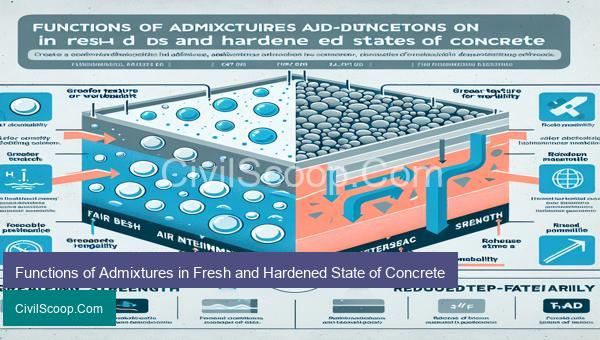
Concrete is one of the most widely used construction materials in the world due to its strength, durability, and versatility. However, the properties of concrete can be further enhanced by the addition of admixtures. Admixtures are chemical or mineral substances that are added to concrete in small quantities during the mixing process to alter its fresh and hardened state. These admixtures have a significant impact on the workability, setting time, strength, and durability of concrete. In this article, we will discuss the various functions of admixtures in both the fresh and hardened state of concrete, shedding light on their importance in the construction industry.
Table of Contents
Functions of Admixtures to Modify Fresh Concrete, Mortar, or Grout Properties
Admixtures are a type of chemical additive that is used in concrete, mortar, and grout to modify their fresh properties. These substances are added in small amounts to the mix to enhance certain properties, making it easier to work with, more durable, and able to achieve specific project requirements. Here are some of the main functions of admixtures in modifying fresh concrete, mortar, or grout properties:
1. Improved Workability: One of the most common functions of admixtures is to improve the workability of the fresh concrete or mortar. Workability refers to the ease of handling and placing the mix without any segregation or bleeding. Admixtures like plasticizers and superplasticizers help to increase the fluidity of the mix, making it easier to pump, place, and finish.
2. Water Reduction: Admixtures can also be used to reduce the water content in the mix, without compromising its workability. Water-reducing admixtures, also known as plasticizers, help to disperse the cement particles in the mix, reducing the amount of water needed for proper hydration. This not only makes the mix stronger but also helps to decrease the permeability and shrinkage of concrete.
3. Acceleration: In some cases, concrete or mortar may need to set and gain strength at a faster rate. Admixtures such as accelerators can be added to the mix to speed up the curing process. This can be beneficial in cold weather conditions, where the low temperatures can delay the setting of the mix.
4. Retardation: On the other hand, in hot weather conditions, the setting of concrete or mortar can be too fast, making it difficult to work with. Admixtures called retarders are used to slow down the curing process, allowing more time for placing, leveling, and finishing the mix.
5. Air Entrainment: Concrete, mortar, and grout are prone to cracking due to freeze-thaw cycles and exposure to harsh weather conditions. Air-entraining admixtures are used to create microscopic air bubbles in the mix, which act as a cushion against the expansion and contraction of the mix. This improves the durability and resistance of the mix to cracking and other weather-related damage.
6. Color Modification: Admixtures can also be used to modify the color of the mix, without affecting its strength or durability. Pigments are added to achieve a specific shade or hue, making it suitable for decorative purposes or to match existing structures.
7. Shrinkage Control: When concrete shrinks as it dries, cracks can form, compromising its strength and durability. Shrinkage-reducing admixtures are used to minimize the amount of shrinkage in the mix, thereby reducing the risk of cracking.
In conclusion, admixtures play a crucial role in modifying the fresh properties of concrete, mortar, and grout. By fulfilling various functions, they make the mix more workable, durable, and able to meet specific project requirements. It is important to consult with a qualified engineer or supplier when selecting and dosing admixtures to ensure the mix’s desired properties are achieved.
Functions of Admixtures to Modify Hardened Concrete Properties
Admixtures are chemical or mineral substances that are added to concrete during or after mixing to modify its fresh or hardened properties. They are used to enhance the performance of concrete in various ways, including improving workability, strength, durability, and appearance. Admixtures have become an essential component in modern concrete technology, as they allow for more precise and efficient construction, and the modification of hardened concrete properties plays a crucial role in enhancing the overall quality of concrete structures. In this article, we will discuss the functions of admixtures in modifying hardened concrete properties.
1. Increase in Strength and Durability:
Admixtures such as pozzolans, silica fume, fly ash, and slag are used to increase the strength and durability of concrete. These materials react with calcium hydroxide present in Portland cement, resulting in the formation of additional cementitious compounds. This leads to the densification of the concrete matrix, making it more impermeable and resistant to chemical attacks, thereby increasing its strength and durability.
2. Control of Setting Time:
The setting time of concrete is controlled by the amount and type of admixture added. This is particularly useful in large construction projects where the delivery and placement of concrete must be coordinated. For example, delaying the setting time of concrete can allow more time for placement and consolidation, while accelerating the setting time can be useful for cold weather concreting.
3. Improves Workability:
Admixtures such as plasticizers and superplasticizers are commonly used to improve the workability of concrete. These admixtures reduce the water-cement ratio, allowing for higher workability without compromising on strength. This is particularly useful for concrete with a low water content, as it can be difficult to achieve satisfactory workability without the use of admixtures.
4. Enhances Pumpability:
Concrete containing a high amount of fines, such as fly ash or silica fume, can become sticky and difficult to pump. To improve the pumpability of such concrete, air-entraining admixtures are often used. These admixtures create microscopic air bubbles in the mix, reducing the surface tension and allowing for easier pumping.
5. Improves Color and Aesthetics:
Admixtures such as pigments and colored aggregates are used to modify the appearance of concrete. They can be added to enhance the natural color of the aggregates or create a custom color to match the desired aesthetic of the structure. This is particularly useful for architectural concrete, where appearance is as important as strength and durability.
6. Reduces Shrinkage and Cracking:
Shrinkage and cracking are common issues in concrete, and admixtures such as shrinkage reducers and fibers can help address these problems. Shrinkage reducers reduce the drying shrinkage of concrete, while fibers act as reinforcement, reducing the width and length of cracks. These admixtures are especially beneficial for large concrete structures such as bridges and dams, where shrinkage and cracking can have severe consequences.
In conclusion, admixtures play a critical role in modifying hardened concrete properties, allowing for the production of high-quality and durable structures. By enhancing strength, durability, workability, pumpability, and aesthetics, these chemical substances have revolutionized the concrete industry, making it possible to construct complex and robust structures that were once considered impossible. A thorough understanding of the functions of admixtures is essential for professionals in the construction industry to make informed decisions in the selection and application of these materials in concrete
Conclusion
Admixtures are an essential component in the production of concrete. They have a significant impact on both the fresh and hardened state of concrete, playing a crucial role in improving its performance and durability.
In the fresh state, admixtures provide numerous benefits such as increasing workability, reducing the water-cement ratio, and improving the cohesion and pumpability of concrete. They also offer solutions to challenges such as early stiffening, segregation, and bleeding, thereby ensuring a more efficient and economical construction process.
This is especially important in today’s fast-paced construction industry, where time is of the essence and high-quality concrete is in demand. Admixtures allow for faster and more consistent placement and finishing of concrete, leading to increased productivity and cost savings.
Furthermore