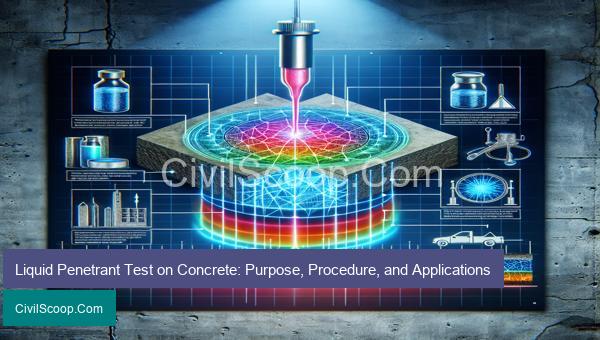
Liquid penetrant testing (PT) is an efficient and cost-effective method for detecting surface discontinuities, such as cracks, voids, and delaminations, in concrete structures. This non-destructive testing technique involves the use of liquid penetrants that are able to seep into the smallest surface openings, making it an ideal method for concrete applications where traditional visual inspections are not sufficient. In this article, we will explore the purpose, procedure, and applications of the liquid penetrant test on concrete, providing a comprehensive understanding of this valuable testing method in the field of construction and engineering.
Table of Contents
Purpose of the Test on Concrete
The purpose of testing concrete is to ensure its strength, durability, and other properties meet the required standards for the intended use. Concrete is a widely used construction material and it is crucial to ensure its quality for the safety and longevity of structures. The main purpose of testing concrete can be summarized as follows:
1. To determine the compressive strength: Concrete is primarily designed to withstand compressive forces, such as the weight of a structure. The compressive strength test is the most common and important test conducted on concrete, which measures the ability of concrete to resist compression and bear loads. This test is crucial in determining the adequacy of concrete for structural applications.
2. To assess the workability: Workability refers to the ease with which freshly mixed concrete can be handled and placed. The slump test is used to measure workability, which is an important property of concrete that affects its placement, consolidation, and finishing. Proper workability of concrete is necessary to ensure good quality and strong structures.
3. To evaluate durability: Durability is the ability of concrete to withstand various external factors, such as weathering, chemical attack, and abrasion. Concrete that is exposed to harsh conditions or chemical environments needs to be tested to ensure its durability. Tests such as the water absorption, chloride permeability, and sulfate resistance tests are commonly performed to assess the durability of concrete.
4. To check for quality control: Testing concrete is also important for quality control during the construction phase. By performing regular tests, any potential issues or problems with the concrete can be identified and addressed before it is used in the structure. This ensures that only high-quality concrete is used in construction, leading to a more durable and safe structure.
5. To monitor construction procedures: Testing concrete also helps in monitoring the construction procedures. For example, the concrete slump test can indicate if the concrete mix is too dry or too wet, and adjustments can be made accordingly. This helps in maintaining consistency and quality in the construction process.
6. To detect flaws and defects: Concrete testing also helps to identify any flaws or defects in the concrete, such as honeycombing, cracking, or delamination. These defects can reduce the strength and durability of the concrete and can be detected through various tests such as ultrasonic testing, rebound hammer test, and core tests. This allows for early detection and repair, saving time and money in the long run.
In conclusion, the purpose of testing concrete is to ensure its quality and performance for safe and durable construction. Proper testing of concrete helps to meet the required standards and ensures that the concrete is suitable for its intended use. It also helps in maintaining quality control during the construction phase and detecting any issues that may compromise the quality of the structure. As a result, testing concrete is an essential aspect of civil engineering and plays a significant role in building strong and reliable structures.
Procedures of Liquid Penetrant Test on Concrete
The Liquid Penetrant Test (LPT) is a non-destructive testing method commonly used in the construction industry to detect surface defects on concrete structures. This test involves the application of a penetrant material on the surface of the concrete and the subsequent examination of the surface for any indications of defects. The following are the general procedures for conducting a Liquid Penetrant Test on concrete.
1. Surface Preparation:
Before performing the test, the surface of the concrete should be cleaned thoroughly to remove any dirt, debris, or surface contaminants that can affect the test results. The surface can be cleaned using water, detergent, or a solvent depending on the type of contaminants present. The surface should then be allowed to dry completely before proceeding with the test.
2. Penetrant Application:
The penetrant material is applied on the clean and dry concrete surface. The most commonly used penetrant materials are red dye, fluorescent dye, or visible dye. The penetrant is usually sprayed or brushed onto the surface, and care should be taken to ensure a uniform and consistent coverage. The penetrant is then allowed to dwell for a specific period, depending on the manufacturer’s recommendations.
3. Dwell time:
The dwell time is the time allowed for the penetrant to penetrate any surface defects on the concrete. The recommended dwell time varies depending on the type and thickness of the penetrant used. During this time, the penetrant is absorbed by any existing defects on the surface.
4. Developer Application:
After the recommended dwell time, the excess penetrant material is removed from the surface, and a developer is applied. The developer is usually a white, powdery material that helps to draw out the penetrant from the defects onto the surface. The developer is applied in a thin and even layer, usually by spraying or dusting.
5. Development time:
The development time is the period given for the developer to draw out the penetrant from the surface defects onto the developer layer. This time can vary depending on the type and thickness of the developer used. The developer should be allowed enough time to dry completely before examining the surface for any indications of defects.
6. Examination:
Once the development time is complete, the surface is examined visually for any indications of defects. The indications may vary in color, size, and shape and are usually a result of the penetrant material being drawn out by the developer from the surface defects. The inspector should have proper lighting and should be trained to identify and interpret the indications accurately.
7. Cleaning:
After the examination, the developer layer and the remaining penetrant material should be thoroughly cleaned from the surface. Any residue left on the surface can interfere with the next test or compromise the concrete’s surface integrity.
8. Reporting:
The results of the test should be recorded and reported accurately. The report should include a detailed description of any indications found, the location, and size. The report should also include any relevant documentation, such as photographs and the test procedure followed.
In conclusion, the Liquid Penetrant Test on concrete is a simple and effective method of detecting surface defects. However, it requires proper preparation, application, and interpretation to ensure accurate results. It is essential to follow the recommended procedures and have trained personnel conduct the test to obtain reliable and informative results.
Advantages of Liquid Penetrant Test on Concrete
Liquid Penetrant Test (LPT) is a non-destructive testing method commonly used in civil engineering to assess the integrity of concrete structures. It involves the application of a colored dye, called penetrant, on the surface of concrete and then using a developer to draw out any defects or cracks present. This test has numerous advantages, some of which are discussed below.
1. Detection of Surface Defects: LPT is highly effective in detecting surface defects such as hairline cracks, pores, voids, and delamination in concrete. These defects can lead to water ingress, corrosion of reinforcing steel, and eventually structural failure. By identifying these defects at an early stage, appropriate repairs or maintenance can be carried out, ensuring the long-term durability of the structure.
2. Non-Destructive: Unlike destructive testing methods, LPT does not require any sample to be extracted from the structure, making it non-destructive. This means that the integrity of the structure remains unaffected, and the test can be performed without disrupting the structure’s use or function.
3. Cost-Effective: LPT is a relatively low-cost testing method compared to other non-destructive tests like ultrasonic testing or ground-penetrating radar. This makes it an attractive option for assessing large concrete structures, such as bridges or buildings, where extensive testing is required.
4. Easy to Perform: LPT is a simple and easy-to-use test that can be performed by trained technicians. The procedure involves applying the penetrant, waiting for a specific time, and then cleaning off the excess dye. The use of color contrast makes it easier to identify any defects, making LPT a user-friendly test method.
5. Versatility: LPT can be used on a variety of concrete surfaces, including horizontal, vertical, and overhead surfaces. It is also applicable to different types of concrete structures, such as beams, slabs, columns, and walls. This versatility makes LPT a widely used method in civil engineering.
6. Quick Results: LPT provides immediate results, making it a time-efficient test method. This means that the structure can be assessed quickly, and any necessary repairs or maintenance can be carried out promptly, minimizing downtime and disruption.
7. Assessing Repair Effectiveness: LPT can also be used to evaluate the effectiveness of repairs carried out on concrete structures. After repairing the defects, the structures can be retested to ensure that the repairs were successful in improving its integrity.
In conclusion, the use of Liquid Penetrant Test on concrete offers several advantages, making it a popular method for assessing the integrity of concrete structures. Its non-destructive nature, cost-effectiveness, ease of use, and quick results make it a preferred choice for civil engineers in maintaining the safety and durability of concrete structures.
Disadvantages of Liquid Penetrant Test on Concrete
Liquid Penetrant Test (LPT) is a widely used non-destructive testing method to detect surface discontinuities in concrete structures. It involves the application of a liquid dye onto the concrete surface and the subsequent removal of excess dye to reveal any defects. While LPT has its benefits, it also has several disadvantages that engineers need to be aware of.
1. Limited Depth of Penetration:
The primary disadvantage of LPT on concrete is its limited depth of penetration. The dye can only penetrate up to 3mm into the concrete surface, which means that any defects deeper than that will not be detected. This makes LPT ineffective for detecting hidden defects in the inner layers of the concrete structure.
2. High Surface Preparation Requirement:
For LPT to be effective, the concrete surface must be dry, clean, and free of any paints, coatings, or other surface treatments. This requirement makes the testing process time-consuming and costly, especially in cases where the concrete structure is large or complex.
3. Susceptible to Human Error:
LPT relies heavily on the skill and experience of the operator. Any mistake in the application and removal of the dye can lead to false results. The operator’s subjective judgment can also influence the test, making it less reliable.
4. Limited Detectability of Certain Defects:
Not all types of defects can be detected using LPT. For instance, surface voids, honeycombs, and cracks that are smaller than the penetration depth of the dye may go unnoticed. This limitation can pose safety risks, as critical defects can remain undetected.
5. Cannot Determine Root Cause of Defects:
LPT can identify the location and extent of defects, but it cannot determine the root cause of the problem. This limitation hinders engineers from addressing the underlying issue and implementing a long-term solution.
6. Limited Applicable Conditions:
LPT is not suitable for all types of concrete structures. It requires a smooth and non-porous surface to work effectively, which may not be the case for some rough or porous concrete surfaces. This limitation reduces the applicability of LPT in certain situations.
In conclusion, while Liquid Penetrant Test is a useful non-destructive testing method, it has its limitations and disadvantages. Engineers should carefully consider these factors and assess the suitability of LPT for a specific concrete structure before conducting the test. Depending solely on LPT for detecting defects in concrete can lead to inaccurate results and potential safety hazards.
Applications of Liquid Penetrant Test on Concrete
Liquid penetrant test is a widely used non-destructive testing method in the field of civil engineering. It is a simple and cost-effective technique for detecting surface cracks, defects or discontinuities in concrete structures. The method works on the principle of capillary action to identify flaws in the concrete surface by using a colored or fluorescent dye. This technique has various applications in the construction and maintenance of concrete structures.
1. Quality control and inspection during construction: Liquid penetrant test is widely used during the construction of concrete structures. It helps to detect surface cracks, voids, and other defects that may have occurred during the pouring, curing or finishing of concrete. This ensures that the quality of the concrete is maintained, and any flaws are identified and corrected before the structure is put into service.
2. Inspection of bridges and highways: Bridges and highways are vital components of our infrastructure, and it is important to ensure their safety and integrity. Liquid penetrant testing is used to inspect bridge decks, slabs, and joints for any signs of cracks or corrosion. It helps in detecting hidden flaws that are not visible to the naked eye, thus preventing any potential accidents or failures.
3. Maintenance and repair of concrete structures: As concrete structures are subject to environmental factors, they undergo wear and tear over time. Liquid penetrant testing is used to assess the condition of existing structures and identify any surface cracks, spalls or other defects that need repair. This method is also useful for inspecting the repaired areas to ensure that they are free from defects and meet the required standards.
4. Assessment of aging and deteriorating concrete structures: Many concrete structures have a long service life, and it is important to regularly inspect them to detect any signs of aging or deterioration. Liquid penetrant test is a valuable tool for assessing the condition of aging structures and identifying any flaws or defects that may have developed over time. This helps in the timely repair and rehabilitation of the structure.
5. Non-destructive testing of concrete pipes and tanks: Concrete pipes and tanks used for water and wastewater management are subjected to extreme environmental and chemical conditions. Liquid penetrant testing is used to detect surface cracks and defects in these structures and ensure their longevity.
6. Assessment of structural strengthening: Liquid penetrant test is also beneficial in assessing the effectiveness of structural strengthening methods such as jacketing or external bonding of reinforcement. It helps in identifying any flaws or defects in the strengthened area and ensures its structural integrity.
In conclusion, liquid penetrant test is a crucial tool for assessing the quality, safety, and integrity of concrete structures. It is a cost-effective and non-destructive method that can be applied to both new and existing structures. Regular application of this technique can help in maintaining the structural integrity of concrete structures and preventing potential accidents or failures.
Conclusion
In conclusion, the liquid penetrant test is a widely used and effective method for testing concrete structures. It serves the purpose of identifying surface cracks and defects that are invisible to the naked eye and can compromise the structural integrity of concrete. The procedure involves cleaning, applying penetrant, and developing and interpreting the results. This non-destructive testing technique can be used in a variety of applications such as construction, bridge inspection, and maintenance of infrastructure. It is important to conduct regular liquid penetrant tests on concrete structures to ensure their safety and longevity. With advancements in technology, the process has become more efficient and reliable, making it an essential tool for engineers and technicians in the concrete industry.