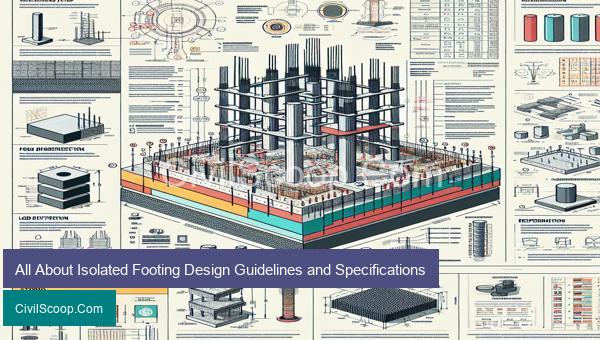
When constructing a building, one of the most critical elements is the foundation, specifically the isolated footing. Isolated footings are structures that support the load of a column or a pillar by distributing it to the soil beneath. It is essential to design isolated footings according to specific guidelines and specifications to ensure the stability and safety of the building. In this article, we will delve into all the important factors to consider when designing isolated footings, including load calculation, soil properties, reinforcement, and other critical aspects. By following these guidelines and specifications, engineers can guarantee the reliability and durability of isolated footings, providing a strong foundation for any construction project.
Table of Contents
Isolated Footing Design Guidelines and Specifications as per IS 456: 2000
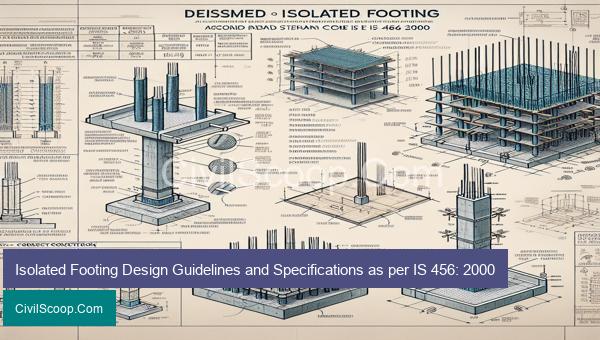
Isolated footings are structural members that support and transfer the load of a single column or a pile to the ground. These types of footings are usually used in non-load bearing structures such as residential buildings, storage tanks, and flagpoles. The design of isolated footings is governed by the guidelines and specifications as per IS 456: 2000, which is the Indian Standard code of practice for plain and reinforced concrete.
The following are the key guidelines and specifications for isolated footing design as per IS 456: 2000:
1. Material properties: The first step in designing an isolated footing is to determine the properties of the materials used, i.e. concrete and steel. The grade of concrete should be at least M20 and the steel used should be of Fe 415 or Fe 500 grade.
2. Load calculation: The next step is to calculate the load from the column or pile that will be transferred to the footing. This includes the dead load, live load, and any imposed load such as wind or earthquake.
3. Bearing capacity of soil: The soil on which the footing will rest should have adequate bearing capacity to support the load. This can be determined by conducting a soil test and using the results to calculate the safe bearing capacity as per IS 6403: 1981.
4. Dimensions of footing: The dimensions of the footing should be such that it can safely transfer the load to the soil without causing excessive settlement or shear failure. The footing should be designed as a square or rectangular slab with a minimum thickness of 150mm.
5. Reinforcement detailing: The footing should be reinforced with steel bars in both directions to resist bending, shear, and tension forces. The reinforcement detailing should be in accordance with IS 456: 2000, and the minimum reinforcement percentage should be 0.15% for mild steel and 0.12% for high strength deformed bars.
6. Shear and moment calculations: The shear and moment forces acting on the footing can be determined by using the column load and the dimensions of the footing. These forces should be checked against the design strength of the footing to ensure structural stability.
7. Minimum depth of footing: The minimum depth of the footing below ground level should be 1m for normal soil conditions and can be reduced to 0.5m for hard soil or rock.
8. Construction joints: In the case of large footings, construction joints may be required to facilitate placement and curing of concrete. These joints should be located at points of minimum shear and bending moment and should be detailed as per IS 456: 2000.
9. Quality control: The design and construction of isolated footings should be carried out under strict quality control measures to ensure the durability and strength of the structure. This includes proper compaction of the soil, adequate cover to reinforcement, and testing of concrete strength.
10. Waterproofing: Isolated footings should be waterproofed to prevent the entry of water and moisture into the structure. This can be achieved by providing a damp proof course or a waterproofing membrane.
In conclusion, isolated footing design as per IS 456: 2000 is a comprehensive process that takes into account the properties of materials, load calculation, soil conditions, reinforcement design, and construction guidelines. Following these specifications and guidelines will result in a safe and structurally sound isolated footing for any type of structure.
Conclusion
In conclusion, isolated footings play a crucial role in providing stable and safe foundations for various structures. Therefore, it is essential to follow the guidelines and specifications set forth by building codes and engineering standards to ensure proper design and construction of isolated footings. By understanding the process of designing isolated footings and the factors that influence it, engineers can make informed decisions and create robust and durable footings that can withstand various loads and environmental conditions. Additionally, continuous advancements in technology and research have led to the development of new design methods and specifications, making isolated footing design a constantly evolving field. Ultimately, following these guidelines and specifications is crucial in creating stable and safe structures that can withstand the test of time.