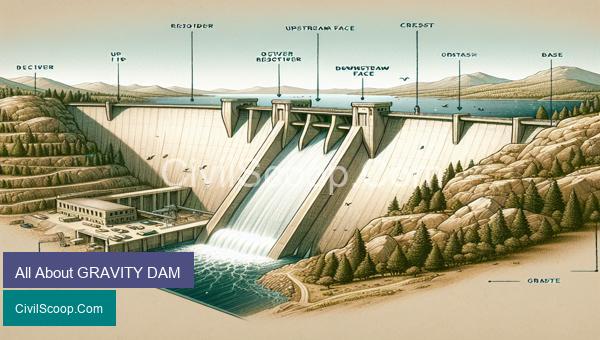
Gravity dams are one of the oldest and most commonly used types of dams, playing a crucial role in humanity’s continual quest to manage water resources for various purposes. These massive structures are created by utilizing the powerful force of gravity to resist the natural pressure of water, carefully designed and meticulously constructed to ensure their stability and durability. In this article, we will delve into the intricate details of gravity dams, exploring their purpose, design, construction, and the various factors that make them a vital part of our modern world. From ancient civilizations to modern engineering marvels, this all-encompassing guide will provide a comprehensive overview of everything you need to know about gravity dams.
Table of Contents
ANALYSIS OF GRAVITY DAM
A gravity dam is a type of dam that relies on its own weight and the force of gravity to hold back water. It is a common type of dam used for storing water, creating hydroelectric power, and controlling floods. In this article, we will analyze various aspects of gravity dam and understand its design, construction, behavior, and failure mechanisms.
Design of Gravity Dam:
The design of a gravity dam involves several important considerations including the height of the dam, the width of the base, and the type of materials used. The height of the dam needs to be carefully calculated as it affects the stability of the structure. A taller dam exerts more pressure on its base and therefore requires a wider base to resist this pressure.
The materials used in gravity dams are usually concrete or stone masonry. Careful selection of materials and proper mix design is essential for the strength and longevity of the dam. The type of materials used also affects the appearance and cost of the dam.
Construction of Gravity Dam:
The construction of a gravity dam involves laying down successive layers of concrete or masonry in a pre-planned sequence. The foundation of the dam is excavated and leveled to create a solid base. Then, the base of the dam is built, followed by the sides and the top. Special care is taken to ensure that each layer is properly bonded with the previous one to create a monolithic structure.
Cracks and joints are potential weak points in gravity dams, hence they should be carefully designed and constructed. Expansion joints are also incorporated to allow for thermal expansion and contraction of the dam.
Behavior of Gravity Dam:
The behavior of a gravity dam under different loading conditions is critical to its performance. The most important loading is the weight of water pushing against the dam. Other loads such as wind, earthquake, and temperature changes also have an impact on the behavior of a gravity dam. Proper analysis of these loads is essential to ensure the stability of the structure.
During an earthquake, a gravity dam may experience a phenomenon called “liquefaction” where the soil beneath the dam becomes soft and unstable, leading to failure. Thus, careful design and construction are required to mitigate this phenomenon.
Failure Mechanisms of Gravity Dam:
The failure of a gravity dam can have catastrophic consequences. The most common reason for failure is a failure in the foundation, due to poor soil conditions or erosion. Overflow or spillway failure can also lead to the collapse of a gravity dam. Failure due to seismic activity can also occur if the dam is not designed and constructed to withstand these forces.
Maintenance and regular inspections are critical in detecting and preventing potential failures. It is important to monitor the behavior of a gravity dam over time to detect any changes or signs of distress, and take necessary measures to prevent failure.
In conclusion, proper design, construction, and maintenance are essential for the performance and safety of a gravity dam. It is a complex structure that requires meticulous planning, analysis, and execution to ensure its stability and longevity.
Conclusion
In conclusion, gravity dams are a vital engineering structure that have been used for centuries to control water flow, generate hydropower, and prevent floods. These dams rely on their own weight to counteract the force of water, making them one of the most stable and reliable types of dams. While they do require careful planning and construction, the benefits they provide make them a valuable asset for managing water resources. With ongoing advancements in technology and techniques, gravity dams continue to play a critical role in meeting our ever-growing demand for water and energy. As we continue to learn more about their design and function, we can ensure these structures are built to withstand the test of time and continue to serve us for generations to come.