
Forecasts play a crucial role in the construction industry as they provide critical information about the timeline and duration of a project. Accurate forecasting of construction duration is essential for project planning, budgeting, and resource allocation. However, it is a complex and challenging process, influenced by a variety of factors such as weather, labor availability, material delays, and unexpected obstacles. In this article, we will dive into the world of forecasting construction duration and explore the various techniques, tools, and considerations involved in making reliable predictions for successful project management.
Table of Contents
FORECASTING CONSTRUCTION DURATION

Forecasting construction duration is a vital aspect of the planning and management of construction projects. It involves estimating the amount of time it will take to complete a construction project based on various factors such as project scope, available resources, technology, construction methods, and potential risks.
Forecasting construction duration is important for several reasons. It allows construction companies to manage their resources effectively, plan project schedules, and provide accurate estimates to clients. It also helps in identifying potential delays and taking proactive measures to mitigate them, thereby ensuring timely project completion.
The following are the essential steps involved in forecasting construction duration:
1. Understanding Project Scope: The first step in forecasting construction duration is to thoroughly understand the scope of the project. This includes detailed knowledge of the project specifications, design plans, and any potential changes that may occur during the construction process.
2. Breakdown of Activities: The next step is to break down the project into smaller and manageable activities. This allows for a more accurate estimation of the time required for each task.
3. Identify Resource Requirements: Resource requirement for a construction project includes labor, equipment, materials, and subcontractors. Accurate estimation of the resources required for each activity is crucial for forecasting construction duration.
4. Historical Data Analysis: It is essential to analyze historical data of similar projects to get an idea about the average duration of similar construction activities. This data can be used as a benchmark for forecasting the duration of the current project.
5. Utilization of Technology: With the advancements in technology, construction companies can use tools and software to aid in forecasting construction duration. Construction scheduling software like Primavera P6, Microsoft Project, and Oracle’s Primavera Suretrak, can help in creating detailed schedules with accurate time estimates.
6. Consideration of External Factors: Construction projects are often affected by external factors such as weather conditions, availability of materials, and labor strikes. It is crucial to consider these factors while forecasting construction duration and make necessary adjustments in the project schedule.
7. Risk Assessment: Identifying potential risks that may cause delays in the project and having contingency plans in place is crucial in forecasting construction duration. This helps in mitigating risks and minimizing the impact on the project schedule.
8. Regular Monitoring and Updating: Construction projects are dynamic, and it is essential to regularly monitor the progress and update the project schedule accordingly. This allows for a more accurate forecasting of construction duration based on the current progress.
In conclusion, forecasting construction duration requires a systematic approach, proper understanding of the project, and utilization of technology and historical data. It is an essential process to ensure timely and efficient completion of construction projects.
Definitions of FORECASTING CONSTRUCTION DURATION

Forecasting construction duration is the process of predicting the amount of time required to complete a construction project based on various factors such as scope, resources, and constraints. It is an essential aspect of construction project management as it helps in planning and scheduling activities, estimating costs, and monitoring progress.
There are several definitions of forecasting construction duration, and they include:
1. The American Society of Civil Engineers (ASCE) defines forecasting construction duration as “the process of predicting the time required to complete all activities of a construction project from start to finish, considering all known constraints.”
2. The International Project Management Association (IPMA) states that forecasting construction duration is “the process of estimating the time required to complete the project based on the scope, resources, and risks involved.”
3. According to the Construction Industry Institute (CII), “forecasting construction duration is the process of determining the total amount of time required to complete a construction project with a given scope, set of resources, and schedule constraints.”
4. The Project Management Institute (PMI) describes forecasting construction duration as “the process of evaluating a series of potential outcomes to estimate the time required for the project to reach completion.”
In simpler terms, forecasting construction duration is about making a realistic estimation of the time required to complete a construction project. It involves analyzing and considering various factors that can impact the project timeline and using sound judgment to arrive at a reasonable estimate.
Some of the key factors that are considered when forecasting construction duration include project scope, availability of resources, project complexity, site conditions, weather, and risks. For instance, a project involving a complex design, limited resources, and adverse weather conditions may have a longer duration than a relatively simpler project with ample resources and favorable weather.
Different techniques can be used for forecasting construction duration, such as milestone estimation, expert judgment, analogous estimation, and three-point estimation. These techniques use historical data, expert knowledge, and mathematical models to arrive at the duration estimate.
In conclusion, forecasting construction duration is a critical aspect of project planning and management. It helps in setting realistic project timelines, managing expectations, and ensuring the successful completion of construction projects within the allocated time and budget.
Scheduling and Schedulers of FORECASTING CONSTRUCTION DURATION

Construction projects are complex endeavors involving a multitude of activities and resources. Scheduling plays a crucial role in the successful execution of a construction project as it allows for the efficient coordination of these activities and resources. One important aspect of scheduling in construction is forecasting construction duration, which involves predicting the length of time it will take to complete a project. This forecast is crucial for budgeting, resource allocation, and overall project planning.
In order to effectively forecast construction duration, project managers rely on schedulers. These are professionals who specialize in creating and managing schedules for construction projects. Their main role is to develop a detailed timeline for the project based on the project scope, site conditions, resources available, and other factors.
There are several types of schedulers that may be involved in forecasting construction duration, depending on the size and complexity of the project. These include master schedulers, project schedulers, and construction schedulers.
Master schedulers oversee the entire project schedule and are responsible for its overall accuracy and coordination. They work closely with project managers and contractors to develop a high-level timeline for the project, considering factors such as project milestones, critical paths, and resource constraints.
Project schedulers, on the other hand, are responsible for developing and maintaining the detailed schedule for a specific phase or portion of the project. They work closely with the project team to identify the sequence of activities, allocate resources, and monitor progress to ensure that the project stays on track.
Construction schedulers are responsible for creating and managing schedules for the construction phase of the project. They work closely with the project team to ensure that the construction timeline is aligned with the overall project schedule. They also work closely with subcontractors and suppliers to coordinate their activities and ensure that materials and equipment are available when needed.
Schedulers utilize specialized software programs to assist in the scheduling process. These software programs, such as Primavera P6 or Microsoft Project, allow schedulers to create and update schedules, assign resources, and track progress in real-time. This enables schedulers to quickly identify delays or potential bottlenecks and make necessary adjustments to keep the project on schedule.
In addition to creating and managing schedules, schedulers also play a crucial role in communication and coordination. They act as a bridge between project managers, contractors, and other stakeholders, ensuring that everyone is aware of important timelines and deadlines. They also facilitate meetings and discussions to resolve scheduling conflicts and develop solutions for any delays that may arise.
In conclusion, scheduling and schedulers are critical for the successful forecasting of construction duration. By utilizing their expertise and specialized software programs, schedulers can develop detailed and accurate schedules that are essential for the planning and execution of construction projects. Their role in coordination and communication also helps to keep projects on track and ensure timely completion.
Forecasting Construction Duration of FORECASTING CONSTRUCTION DURATION

Forecasting construction duration is an essential aspect of project management in the construction industry. It involves predicting the timeline for completing a construction project and is crucial for ensuring its successful execution. Accurate forecasting of construction duration helps project managers to plan resources, manpower, and budget effectively, ultimately leading to timely project completion.
There are several methods used for forecasting construction duration, each with its advantages and limitations. Let’s take a look at some of the commonly used techniques.
1. Experience-based Forecasting:
This method relies on the experience and judgment of the project team. It involves estimating the duration based on past projects with similar scope, size, and complexity. The advantage of this method is its simplicity and ease of use. However, it may not be accurate if the previous projects had different circumstances or conditions.
2. Schedule Comparison:
In this method, the project schedule is compared with similar projects from the past, taking into account factors such as project size, resources, and team experience. This method provides a more detailed analysis than experience-based forecasting and gives a better understanding of the project’s critical path. However, it is time-consuming and requires a detailed schedule of previous projects, which may not always be available.
3. Parametric Forecasting:
This method uses mathematical models and statistical analysis to forecast construction duration. It involves identifying the critical tasks and using historical data to develop an estimation formula. Parametric forecasting is more accurate than experience-based and schedule comparison methods, but it has a higher degree of complexity and requires historical data to be collected and analyzed accurately.
4. Analytic Hierarchy Process (AHP):
AHP is a multi-criteria decision-making technique that combines both quantitative and qualitative aspects. It involves breaking down a project into smaller tasks and evaluating them based on multiple criteria such as cost, resources, and complexity. AHP is effective in providing a comprehensive analysis of the project, but it requires a significant amount of time and effort to gather and evaluate data.
5. Monte Carlo Simulation:
This method uses computer software to simulate different scenarios and determine the probability of achieving a specific duration. It considers various factors such as resource availability, weather conditions, and unexpected delays. Monte Carlo Simulation provides more accurate results than the other methods, but it requires specialized software and expertise to use effectively.
In conclusion, accurate forecasting of construction duration is crucial for timely project completion. Project managers need to select the most appropriate method based on the project’s scope, complexity, and available resources. It is also essential to continuously monitor and update the forecast during the project’s execution to account for any changes or unexpected events. A well-planned and executed forecasting process can help reduce project delays and keep projects on track for successful completion.
Some Methods for Project Scheduling of FORECASTING CONSTRUCTION DURATION
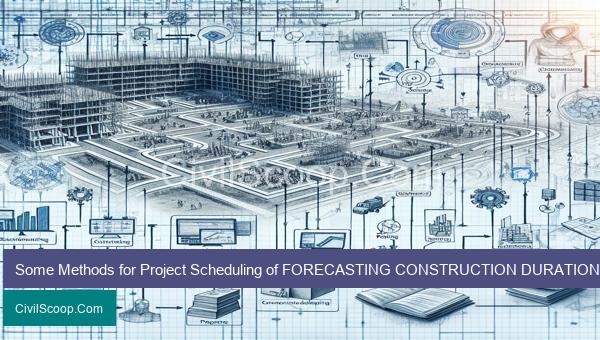
There are several methods that can be used for project scheduling and forecasting construction duration. These methods help in determining the most efficient and effective way to complete a construction project within the given time frame. Some of the commonly used methods for project scheduling of forecasting construction duration are:
1. Critical Path Method (CPM):
This is the most commonly used method for project scheduling and duration forecasting. CPM involves creating a network diagram depicting all the activities and their interdependencies. The longest path in this network, which is known as the critical path, represents the timeline for the entire project. By identifying the critical path, project managers can focus their efforts on the most important activities to ensure timely completion of the project.
2. Program Evaluation and Review Technique (PERT):
PERT is a statistical method used for project scheduling and duration forecasting. It utilizes three-time estimates for each activity: optimistic, most likely, and pessimistic. Based on these estimates, the expected duration of the project is calculated, taking into consideration the uncertainties and risks associated with different activities. PERT is particularly useful for complex projects where there is a high level of uncertainty.
3. Gantt Charts:
Gantt charts are visual representations of project schedules that provide a graphical illustration of tasks, their durations, and dependencies. Gantt charts also allow project managers to track the progress of each task against the planned schedule. These charts are easy to create and understand, making them popular among project managers.
4. Line of Balance (LOB):
LOB is a scheduling technique that is commonly used in projects involving repetitive activities. It involves organizing activities in a sequential order and assigning them to designated teams or resources. This method helps in efficient resource allocation, particularly in projects where resources are limited.
5. Resource Leveling:
Resource leveling is a method used to manage resource allocation in a project. It ensures that resources are not overutilized or underutilized, thereby avoiding delays and cost overruns. This method is particularly useful in projects where resources are limited, and several activities are dependent on the availability of resources.
6. Monte Carlo Simulation:
Monte Carlo simulation is a probabilistic method used for forecasting construction duration. It involves simulating different scenarios to assess the probability of project completion within a given time frame. This method takes into consideration the uncertainties and risks associated with each activity, providing a more realistic estimate of the project duration.
In conclusion, project scheduling and forecasting construction duration are crucial aspects of construction project management. By using one or a combination of these methods, project managers can effectively plan and manage resources to ensure the timely completion of projects. It is essential to consider the project’s unique characteristics and the availability of resources when deciding on the most appropriate method for project scheduling.
Factor Affecting Construction Duration of FORECASTING CONSTRUCTION DURATION

Construction duration refers to the estimated amount of time it takes to complete a construction project from start to finish. Accurately forecasting the construction duration is crucial for project planning, budgeting, resource allocation and overall project success. There are several factors that can affect the construction duration of a project. These factors can be broadly categorized into four main categories: project-specific factors, environmental factors, manpower and equipment factors, and external factors.
1. Project-specific Factors:
a. Scope of work: The scope of work defined for a construction project can significantly impact its duration. A project with a large and complex scope of work will take longer to complete compared to a simple project.
b. Design changes: Changes in the design or scope of work during the construction phase can lead to delays and impact the overall duration of the project.
c. Material availability: The availability of building materials and their timely delivery to the project site can affect the pace of construction and lead to delays.
d. Site conditions: Unforeseen site conditions such as soil stability, topography, and weather conditions can significantly impact the construction duration. Remediation of these conditions can cause project delays.
e. Project management: Effective project management is crucial for completing a project within the estimated duration. Poor management, lack of communication, and inadequate planning can lead to delays and increase project duration.
2. Environmental Factors:
a. Weather: Adverse weather conditions such as heavy rain, snow, or extreme heat can cause delays in construction activities and affect the overall duration of a project.
b. Natural disasters: Construction projects located in areas prone to natural disasters such as earthquakes, hurricanes, or floods may face unexpected delays due to damage to the site, equipment or materials.
c. Environmental regulations: Projects that require environmental permits or approvals may face delays if there are changes in regulations or if compliance issues arise.
3. Manpower and Equipment Factors:
a. Skilled labor availability: Availability of skilled labor is crucial for the timely completion of a construction project. The shortage of skilled labor can lead to a delay in completing certain tasks and ultimately affect the project schedule.
b. Equipment availability: Timely availability and proper functioning of construction equipment are critical for the progress of activities on a construction site. Any equipment breakdown or delay in procurement can cause project delays.
c. Workforce productivity: Productivity of the construction workforce can affect the pace of construction and the overall duration of the project. Factors such as work fatigue, safety concerns, and disruption of work can result in lower productivity and delays in project completion.
4. External Factors:
a. Permits and approvals: Any delay in obtaining necessary permits and approvals from local authorities can result in project delays.
b. Political and social changes: Political and social issues such as protests, strikes, or changes in government policies can impact the timeline of a construction project.
c. Supply chain disruptions: Any disruptions in the supply chain, such as shortages of materials or price fluctuations, can cause delays in project completion.
In conclusion, accurate forecasting of construction duration is essential for successful project completion. However, various factors can affect the project duration, and project managers must carefully consider and plan for these factors to minimize delays and ensure timely completion of the project. Proper project management, effective communication, and contingency plans can help mitigate these factors and keep the construction duration on track.
Project Delays and their Causes: of FORECASTING CONSTRUCTION DURATION

Project delays are a common and major issue in the construction industry. They not only result in increased costs but also impact the overall progress and success of a project. Delays in construction projects can be caused by many factors, and understanding these causes is crucial to effectively forecast the construction duration of a project.
1. Design Changes:
One of the most significant causes of delays in a construction project is design changes. Changes in construction plans and specifications can occur due to various reasons, such as client preferences, errors in drawings, or changes in building regulations. These design changes can cause a domino effect on the project and lead to delays in procurement, material selection, and construction activities.
2. Inadequate Planning:
Poor planning is another common cause of project delays. This can include insufficient resources, poor scheduling, and lack of coordination between different parties involved in the project. Inadequate planning can lead to rescheduling of activities, rework, and budget overruns, resulting in delays.
3. Weather:
The weather is a significant factor that can cause delays in a construction project, particularly for outdoor activities. Extreme weather conditions such as heavy rain, snow, or high winds can make it impossible to carry out construction work, resulting in delays. It is essential to consider weather patterns in the project’s location and plan accordingly to reduce the impact of weather-related delays.
4. Labor Shortages:
Construction projects require skilled labor to complete tasks effectively and efficiently. However, labor shortages can occur due to various reasons, including the unavailability of skilled workers, immigration policies, or labor strikes. These labor shortages can delay the progress of a project and significantly impact the construction duration.
5. Material Shortages:
Delays in the delivery of materials can also cause project delays. This can happen due to various reasons, such as a strike at the manufacturing plant, transportation issues, or inadequate inventory. Material shortages can lead to a standstill in construction activities, resulting in extended project duration.
6. Legal and Permitting Issues:
Obtaining necessary permits and approvals from authorities is a crucial aspect of a construction project. Delays in obtaining these approvals can significantly impact the project timeline. Legal issues such as disputes between parties involved in the project can also result in project delays.
To forecast the construction duration accurately, project managers need to identify and evaluate potential causes of delays. This includes conducting a thorough analysis of the project’s scope, identifying critical project activities, and understanding the potential risks associated with each activity. Proper planning and mitigation strategies should also be in place to minimize the impact of delays on the project.
In conclusion, project delays can be caused by various factors, including design changes, inadequate planning, weather, labor and material shortages, and legal and permitting issues. Understanding these causes and implementing effective mitigation strategies is crucial for accurate forecasting of construction duration and successful project completion.
Relationship between Cost and Time: of FORECASTING CONSTRUCTION DURATION
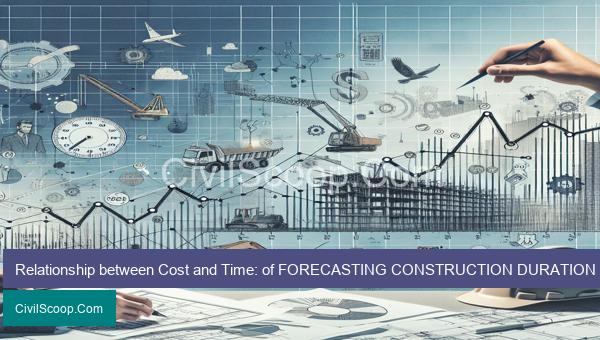
The relationship between cost and time in forecasting construction duration is a crucial aspect that all civil engineers must consider during the planning and execution of any construction project. Cost and time are two of the most significant factors that directly impact the success of a construction project. Proper forecasting of construction duration is essential for project managers to ensure that the project is completed within the specified time frame and allocated budget.
Cost and time are interdependent factors in the construction industry. Any change in the duration of a project will have a direct impact on the cost, and similarly, any changes in the assigned budget will affect the project’s timeline. Therefore, it is vital to establish a strong relationship between cost and time during the forecasting of construction duration to ensure project success.
One of the most critical factors to consider when forecasting construction duration is the availability of resources. The availability of resources directly affects the project’s timeline and cost. If there is a shortage of resources, the construction schedule will be delayed, resulting in an increased project duration and increased costs due to the need for additional labor and materials. Similarly, if there is an excess of resources, the project’s timeline may be shortened, but the cost will increase due to idle resources.
Weather conditions also play a significant role in the relationship between cost and time during the forecasting of construction duration. Adverse weather conditions can significantly impact the cost and timeline of a project. For example, heavy rains or snowfall can delay construction, resulting in additional costs for rescheduling and overtime pay for workers. Similarly, extreme heat can also cause delays and extra costs for providing adequate cooling systems for workers and equipment.
Project delays, due to unforeseen circumstances or poor planning, can also have a significant impact on the cost and time of a construction project. Delays can result in increased material and labor costs, as well as potential penalties for not meeting the project’s deadline. Therefore, accurate forecasting of construction duration is crucial to minimize potential delays and their impact on both cost and time.
Furthermore, the relationship between cost and time during the forecasting of construction duration is also affected by project management strategies and techniques. An experienced project manager will be able to identify potential risks and challenges in advance and formulate a plan to mitigate them. This proactive approach can help in minimizing project delays and controlling costs.
In conclusion, the relationship between cost and time in forecasting construction duration is a complex and critical aspect that must be carefully managed by civil engineers. Accurate forecasting of construction duration is essential to ensure that the project is completed within the allocated budget and timeline. Factors such as resource availability, weather conditions, project delays, and project management strategies all contribute to the cost and time relationship in construction duration forecasting. By considering these factors, civil engineers can effectively plan and execute successful construction projects.
Pre-design Estimating of Project Duration:
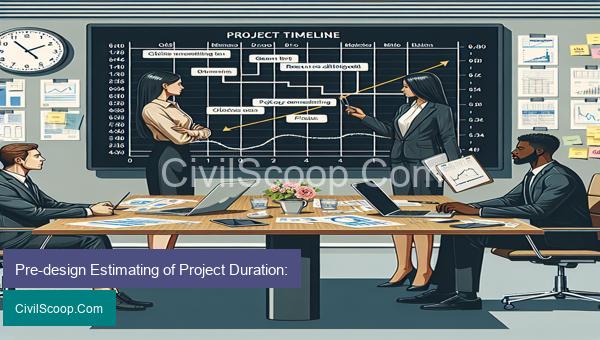
Pre-design estimating of project duration is an important process in the field of civil engineering as it helps in determining the time required to complete a construction project. It involves forecasting the total duration of a project from its initiation to its completion, taking into account various factors such as scope, resources, and constraints.
The first step in pre-design estimating of project duration is to gather all the necessary information about the project. This includes the project scope, budget, and timelines. The scope of the project should be clearly defined, and any constraints such as site conditions, weather, and availability of resources should be identified.
Next, the team involved in the project should analyze the scope of work and break it down into smaller work packages. This will help in creating a detailed schedule and identifying milestones for the project. It is essential to involve all the stakeholders and teams in this process to get a realistic idea of the project duration.
Once the work packages and milestones are identified, the team can then estimate the time required to complete each task. This can be done by using historical data from similar projects, expert judgment, and past performance of resources. It is important to consider the availability and capability of resources while estimating the duration of each task.
Another important aspect to consider in pre-design estimating of project duration is the critical path method (CPM). This is a technique used to determine the longest path of sequential activities that must be completed on time for the project to be completed within the desired duration. Any delay in tasks on the critical path can result in a delay in the overall project duration.
In addition to the critical path method, the team can also use other tools and techniques such as Gantt charts, PERT charts, and project management software to aid in pre-design estimating of project duration. These tools help in visualizing the project timeline, identifying dependencies, and tracking progress.
It is important to note that pre-design estimating of project duration is not an exact science, and the estimated duration may change as the project progresses. Therefore, it is crucial to regularly review and update the project schedule to account for any changes or delays.
In conclusion, pre-design estimating of project duration is a vital step in the construction process. It helps in setting realistic timelines, identifying potential delays, and ensuring the project is completed on time. By involving all stakeholders, using appropriate tools and techniques, and regularly reviewing the schedule, the project team can ensure an accurate and achievable project duration.
Summary of FORECASTING CONSTRUCTION DURATION
Forecasting construction duration is a vital aspect of project management in the construction industry. It involves predicting the time it will take to complete a construction project based on various factors and data. This process helps project managers to plan and allocate resources, schedule tasks, and evaluate progress accurately.
The following is a summary of the key elements involved in forecasting construction duration:
1. Project Scope: The first step in forecasting construction duration is to define the project scope. This includes identifying the project objectives, constraints, and deliverables. It also involves assessing the project complexity, site conditions, and potential risks that could affect the duration.
2. Work Breakdown Structure (WBS): The WBS is a hierarchical representation of the project scope, and it helps to break down the project into smaller and manageable activities. This helps in estimating the time required for each task and determining the critical path for the project.
3. Historical Data: Historical data from previous similar projects is a valuable resource in forecasting construction duration. It provides insights into the potential challenges and how long it took to overcome them, helping to estimate the duration accurately.
4. Estimating Techniques: Several techniques are used to determine the duration of different activities, including three-point estimation, analogous estimation, and parametric estimation. These methods use data such as the project scope, resource availability, and similar projects’ performance to calculate the duration.
5. Resource Planning: Resource planning is a critical component of construction duration forecasting. It involves identifying the resources required for each activity and determining their availability. This helps project managers to allocate resources effectively and avoid delays due to resource shortages.
6. Scheduling: Once the duration of each activity is estimated, the next step is to create a project schedule. The schedule includes the start and end date for each activity, dependencies, and milestones. It helps to visualize the project’s timeline and identify any potential delays.
7. Contingency Planning: Despite careful planning and forecasting, unexpected delays may still occur during construction projects. Therefore, it is essential to have contingency plans in place to mitigate risks and keep the project on track.
In conclusion, forecasting construction duration is a complex process that involves considering various factors, such as project scope, historical data, estimating techniques, resource planning, scheduling, and contingency planning. It requires a rigorous analysis and a deep understanding of the project and its environment. With accurate forecasting, project managers can ensure that construction projects are completed on time and within budget.
Conclusion
In conclusion, forecasting construction duration is a crucial aspect of project management in the construction industry. It involves analyzing various factors and using tools and techniques to estimate the time needed to complete a project. Accurate forecasting can help project managers make informed decisions, manage resources effectively, and meet project deadlines. Thus, it is imperative for construction professionals to have a thorough understanding of forecasting methods and continuously track and update their projections throughout the project’s lifecycle. By employing advanced technologies and strategies, construction duration forecasting can significantly improve efficiency and productivity in the construction industry.