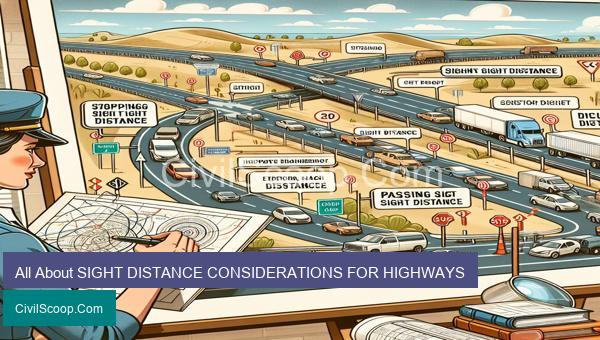
Highways are essential for efficient transportation and play a crucial role in connecting people and goods from one place to another. As the demand for highways continues to increase, it is imperative to ensure the safety of all road users. One critical factor in ensuring safe highway design is sight distance. This refers to the distance that a driver can see ahead on the road while maintaining a safe speed. Adequate sight distance allows drivers to detect and respond to potential hazards, reducing the chances of accidents. In this article, we will explore the various elements of sight distance considerations for highways and their significant impact on road safety.
Table of Contents
SIGHT DISTANCE CONSIDERATIONS FOR HIGHWAYS
Sight distance is a critical factor in designing safe and efficient highways. It refers to the distance a driver can see ahead while travelling on a highway. Adequate sight distance is essential for drivers to anticipate and react to potential hazards on the road, such as other vehicles, pedestrians, and obstacles. Here are some important considerations for designing sight distance on highways.
1. Stopping Sight Distance (SSD): This is the minimum distance required for a driver to bring their vehicle to a stop from a given speed. The recommended stopping sight distance for highways is 12 seconds for passenger cars and 15 seconds for heavy vehicles. This distance is determined based on the driver’s reaction time and the braking capabilities of the vehicle. Adequate SSD ensures that drivers have enough time to see and react to potential dangers on the road.
2. Decision Sight Distance (DSD): This is the distance required for a driver to safely make a decision, such as changing lanes, passing another vehicle, or making a turn. DSD is usually greater than SSD and is influenced by factors such as road curvature, gradient, and speed of the vehicle. Insufficient DSD can lead to risky and abrupt maneuvers, ultimately increasing the risk of accidents.
3. Intersection Sight Distance (ISD): Intersections are high-risk areas on highways and require special consideration for sight distance. ISD is the minimum distance required for a driver at one approach to see a vehicle approaching from the other approach. It is critical for safe decision-making at intersections to prevent collisions. The recommended ISD for urban intersections is 70-120 meters, while for rural intersections, it is 200-300 meters.
4. Obstruction Sight Distance (OSD): It is the distance required for a driver to see and pass an obstruction on the road, such as a tree, pole, or parked vehicle. The recommended OSD is 1.5 times the height of the obstruction, with an additional 90 meters of clear sight distance. Adequate OSD is necessary to avoid last-minute swerving or collisions.
5. Design Speed: The design speed of a highway has a significant impact on sight distance. Higher design speeds require greater sight distances to provide drivers with enough time to react to potential hazards. Designing highways with lower design speeds can help reduce the required sight distance, making it easier to meet sight distance requirements in challenging topographic and land use conditions.
6. Terrain and Road Alignment: The terrain and road alignment play a crucial role in determining the sight distance on highways. Crests and sags in the road, sharp curves, and steep gradients can significantly reduce sight distance, posing a risk to drivers. Engineers must carefully consider the topography and design the highway layout to provide adequate sight distance for safe driving.
In conclusion, sight distance is a critical factor in ensuring safety on highways. Adequate sight distance requires careful consideration of various factors, such as stopping distance, decision-making distance, intersections, obstructions, and road design speed. Engineers must conduct thorough sight distance analysis and design highways to provide drivers with the necessary visual information to make safe and timely decisions on the road.
What is Sight Distance in Highway Engineering?
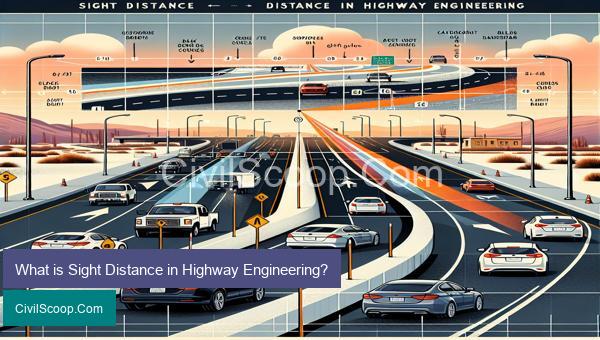
Sight distance is a crucial concept in highway engineering that refers to the maximum distance a driver can see ahead on a road. It is a critical consideration in the design and construction of highways as it directly impacts the safety and efficiency of the road.
There are three types of sight distance that engineers must take into account when designing a highway – stopping sight distance (SSD), decision sight distance (DSD), and passing sight distance (PSD). Each of these types has a specific purpose and calculation method that helps engineers determine the appropriate road geometry for a safe and efficient highway.
Stopping sight distance (SSD) is the distance required for a driver to perceive an object in their path and bring the vehicle to a complete stop before colliding with it. It takes into account the driver’s reaction time, which is typically around 2.5 seconds, and the vehicle’s braking distance, which depends on its speed and deceleration rate. Engineers use mathematical formulas to calculate the minimum SSD needed for different road conditions, such as curves, gradients, and obstructions.
Decision sight distance (DSD) is the distance required for a driver to safely make a decision, such as changing lanes or merging onto a highway. It considers the driver’s reaction time, the speed of the vehicles on the road, and the time needed to complete the maneuver safely. DSD is particularly crucial in areas with heavy traffic or complex road configurations, where drivers need enough time to assess the situation and make a safe decision.
Similarly, passing sight distance (PSD) is the distance required for a driver to safely overtake and pass another vehicle on a two-lane highway. It takes into account the speed of the passing vehicle, the speed of the oncoming vehicle, and the time and distance needed to complete the maneuver without causing a collision. PSD is particularly important in areas with high traffic or uneven road surfaces.
Engineers must also take into account the design speed of the highway when calculating sight distance. A higher design speed will require more significant sight distance, as drivers will have less time to react and maneuver their vehicles at higher speeds.
In addition to calculating the required sight distance, engineers must also ensure that the road geometry, such as the alignment, width, and grade of the highway, provides adequate sight distance for drivers. This includes maintaining clear and unobstructed sight lines and avoiding sharp curves or steep grades that can limit sight distance.
In conclusion, sight distance is a crucial factor in highway engineering that ensures the safety and efficiency of the road for all drivers. It requires careful consideration and calculation during the design and construction phase to provide adequate sight lines for drivers to make timely and safe decisions while traveling on the highway.
Conclusion
In conclusion, ensuring adequate sight distance for highways is crucial for the safety of drivers, pedestrians, and other road users. By considering various factors such as vehicle speed, roadside design, and geometric design, engineers can minimize the risk of accidents and improve overall highway safety. As technology advances, it is important to continuously evaluate and update sight distance standards to keep up with the growing demands of modern transportation. By implementing proper sight distance considerations, we can create a safer and more efficient highway system for everyone. Let us continue to prioritize sight distance in highway design and maintenance to ensure safer journeys for all.