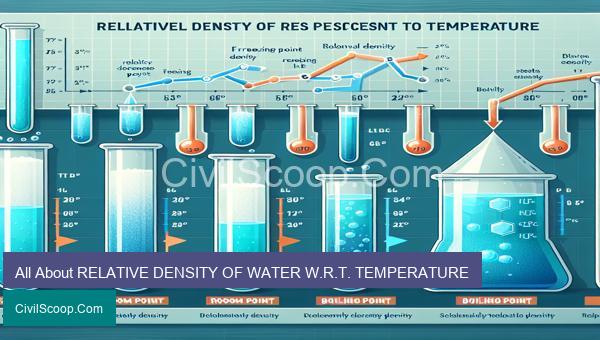
Water plays a critical role in our daily lives, from essential hydration to various industrial and scientific applications. One property of water that greatly affects its behavior and uses is its relative density, which is a measure of how dense water is compared to other substances. However, relative density of water is not a fixed value and is highly influenced by temperature. In this article, we will explore the concept of relative density of water in relation to temperature and its significance in various fields. We will delve into the principles and calculations involved, as well as the practical applications and implications of this important physical property. So, let’s dive in and learn all about the relative density of water W.R.T. temperature.
Table of Contents
RELATIVE DENSITY OF WATER W.R.T. TEMPERATURE
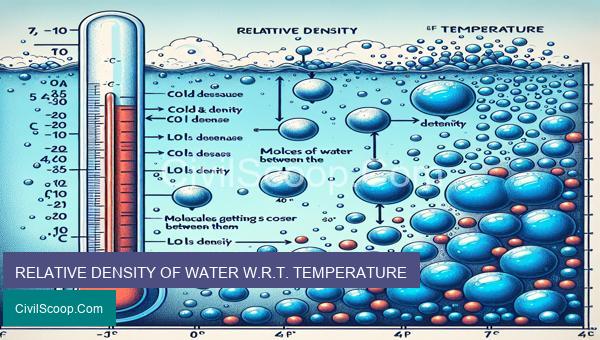
Relative density, also known as specific gravity, is a measure of the density of a substance compared to the density of water at a specific temperature and pressure. In civil engineering, the relative density of water is an important factor to consider in various design and construction projects, especially when dealing with fluids and soil mechanics.
Water is a unique substance because its density changes with temperature. This is due to the fact that as water is heated, the molecules gain energy and begin to move faster, causing the space between them to increase. This results in a decrease in density. On the other hand, when water is cooled, the molecules slow down and become more compact, causing an increase in density.
The relationship between the density of water and temperature is non-linear and can be best described by a curve known as the density-temperature curve. At a temperature of 4 degrees Celsius (39.2 degrees Fahrenheit), water reaches its maximum density of 1.000 g/cm3. This means that at this temperature, the mass of 1 cm3 of water is exactly 1 gram.
As the temperature of water increases from 4 degrees Celsius, its density decreases and the same volume of water weighs less. For example, at 15 degrees Celsius (59 degrees Fahrenheit), the density of water is 0.9991 g/cm3, and at 25 degrees Celsius (77 degrees Fahrenheit) it is 0.9971 g/cm3. Similarly, as the temperature drops below 4 degrees Celsius, the density of water increases.
In civil engineering, the relative density of water is commonly used in materials testing and design calculations. It is particularly important in soil mechanics, where it is used to determine the compaction of soils. As temperature affects the density of water in soil pores, it is crucial to account for this change when measuring the density of the soil.
In fluid mechanics, the relative density of water is used to determine the buoyancy of objects in water. Objects with a higher relative density than water will sink, while those with a lower relative density will float. This principle is utilized in the design and construction of ships, boats, and other floating structures.
In conclusion, the relative density of water with respect to temperature is an important concept in civil engineering. The density of water varies with temperature, which has significant implications in various design and construction projects. By understanding and accounting for this change, engineers can ensure the accuracy and safety of their designs.
Conclusion
In conclusion, the relative density of water with respect to temperature is an important concept to understand in the field of physics and chemistry. It refers to the tendency of water to expand or contract with changes in temperature, which has significant effects on industries such as shipping, food production, and weather forecasting. Through the study of this topic, we can gain a deeper understanding of the properties of water and its behavior under different conditions. Furthermore, the relationship between temperature and relative density of water also highlights the importance of accurate measurements and precise calculations in scientific research. Overall, relative density of water with respect to temperature is a fascinating topic that continues to be studied and utilized in various industries, further enhancing our understanding of this crucial element.