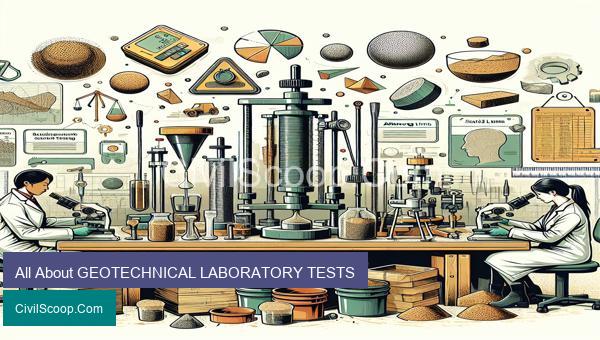
Geotechnical laboratory tests are an essential part of engineering and construction projects. These tests provide valuable information about the physical properties and behavior of soil and rock materials, which are crucial for designing and constructing safe and stable structures. Whether it is a high-rise building, a bridge, or a road, geotechnical laboratory tests play a significant role in determining the feasibility and success of a project. In this article, we will delve into the world of geotechnical laboratory tests, their types, and their importance in the construction industry. We will explore their purpose, procedures, and how the results obtained from these tests are interpreted and utilized in engineering design. So, let’s dive in and learn all about geotechnical laboratory tests.
Table of Contents
GEOTECHNICAL LABORATORY TESTS

Geotechnical laboratory tests are essential for engineers and geologists to better understand the properties of soil and rock materials. These tests provide valuable information for designing structures such as buildings, bridges, roadways, and other infrastructure projects.
The following are some common geotechnical laboratory tests that are frequently conducted:
1. Grain Size Analysis: This test is used to determine the distribution of particle sizes within a soil sample. It is performed by passing the sample through a series of sieves with varying mesh sizes. The results are then used to classify the soil and determine its suitability for different engineering purposes.
2. Atterberg Limits: This test measures the moisture content at which soil changes from one state to another, such as from a liquid to a plastic state or from a plastic to a solid state. The results of this test help in classifying soils as clay, silt, or sand, which have different engineering properties.
3. Soil Compaction Test: This test is performed to determine the maximum dry density and optimum moisture content of a soil sample. It is done by compacting a soil sample in a standard mold under controlled conditions, and then measuring its density and moisture content.
4. Proctor Test: The Proctor test is a modified version of the compaction test and is used to determine the maximum dry density and optimum moisture content of a soil sample. It is commonly used for design purposes in earthwork and road construction projects.
5. Shear Strength Test: This test determines the shear strength properties of soil, which is crucial for stability analysis of slopes, retaining walls, and other earth structures. It involves applying a certain amount of stress to a soil sample and measuring its deformation or resistance to deformation.
6. California Bearing Ratio (CBR) Test: The CBR test is used to evaluate the load-bearing capacity of a soil sample and its suitability as a subgrade material for road construction. It involves measuring the penetration resistance of a soil sample under controlled conditions.
7. Permeability Test: This test measures the ability of a soil sample to allow water to flow through it. It is essential for evaluating the suitability of a soil material for drainage and seepage control in engineering projects.
8. Consolidation Test: The consolidation test is used to determine the compression and settlement characteristics of a soil sample subjected to an applied load over time. The results of this test are used to calculate the settlement of soil under various loading conditions.
Geotechnical laboratory tests are crucial for obtaining important data regarding the strength, stiffness, and durability of soil materials. This information is then used in the design process to ensure the safety and reliability of construction projects. It is essential for engineers to carefully select and perform the appropriate laboratory tests to obtain accurate and reliable results.
Conclusion
In conclusion, geotechnical laboratory tests play a crucial role in understanding the properties and characteristics of soil and rock formations. These tests provide valuable information for the design and construction of various structures such as buildings, roads, and bridges. By conducting these tests, engineers and geologists can assess potential risks and ensure the safety and reliability of a project. With advancements in technology and techniques, geotechnical laboratory testing continues to evolve, providing more accurate and efficient results. As such, it is essential for all construction projects to include comprehensive geotechnical laboratory testing to ensure optimal performance and longevity.