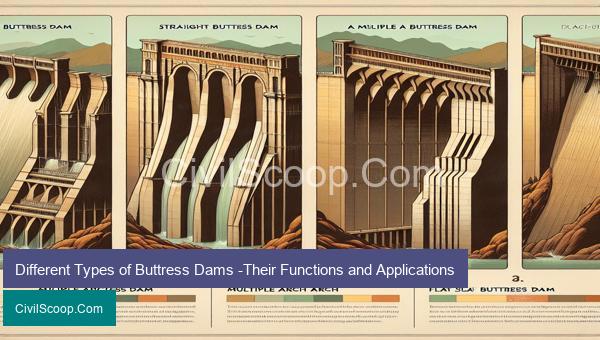
Buttress dams are one of the most common types of dams in the world, providing vital infrastructure for water management, hydropower generation, and flood control. These dams are known for their distinctive trapezoidal shape, which allows them to effectively withstand the pressures of water and provide stability. However, there are several different types of buttress dams, each with their own unique design and function. In this article, we will explore the various types of buttress dams and their specific functions and applications, providing a deeper understanding of these essential structures. Whether you are a dam engineer, a student of engineering, or simply curious about these impressive feats of engineering, this article will offer valuable insights into the different types of buttress dams and how
Table of Contents
What is a Buttress Dam?
A buttress dam, also known as an arch-gravity dam, is a type of structure used in civil engineering to resist the pressure of water against it. It is an effective solution for creating large and stable dams in areas with narrow gorges or deep canyons.
The design of a buttress dam is based on the principle of arches and the use of counterforts, which are heavy concrete walls built on the downstream side of the dam. These counterforts extend into the dam and provide additional support against the water pressure. The dam’s base is typically wider than its top, creating a triangular shape that helps distribute the water pressure evenly.
Buttress dams are generally constructed in mountains, with their walls connected to the surrounding rock, making them extremely strong and stable. The upstream face of the dam is curved to reduce the water pressure, while the downstream face is built straight to resist the compression forces of the water.
The construction of a buttress dam typically requires excavating the bedrock or rock foundation of the canyon to create a solid base. The foundation is then covered with a layer of non-porous material, such as concrete, to prevent seepage. The dam is then built on top of the foundation, using multiple layers of reinforced concrete.
One of the main advantages of a buttress dam is its spectacular resistance to water pressure. The counterforts and the arch effect of the dam combine to create a strong barrier against water movement. This enables buttress dams to withstand high water levels, making them ideal for use in high-risk areas.
Another significant benefit of buttress dams is their low construction cost. Compared to other types of dams, buttress dams require less material, meaning they are less expensive to build. They also have a relatively small footprint, making them suitable for areas with limited space.
However, buttress dams do have some drawbacks. One of the main disadvantages is their aesthetic appearance. Unlike gravity and embankment dams, which blend with the surrounding natural landscape, buttress dams can be visually unappealing.
Additionally, the construction process of a buttress dam is complex and requires skilled workers and specialized equipment. Therefore, the construction timeframe for buttress dams is longer than that of other types of dams.
In conclusion, buttress dams are an essential engineering solution for creating large and stable dams in mountainous regions. Their unique design and strong resistance to water pressure make them an ideal choice for flood control, irrigation, and hydropower generation. While they do have some drawbacks, their benefits outweigh them, making them a valuable asset in the field of civil engineering.
Types of Buttress Dams
A buttress dam is a type of dam that is designed to resist the lateral force of water pressure by utilizing a series of buttresses or supports. It is one of the most common types of dams, used for a variety of purposes such as water storage, irrigation, flood control, and hydropower generation.
There are several different types of buttress dams, each with its own unique features and design considerations. In this article, we will discuss four main types of buttress dams: multiple arch buttress dams, single arch buttress dams, single-angle buttress dams, and multiple-angle buttress dams.
1. Multiple Arch Buttress Dams
Multiple arch buttress dams, also known as multiple dome buttress dams, are generally used for medium to large-sized reservoirs. As the name suggests, this type of dam has multiple arches that work together to support the weight of the water in the reservoir. The arches are connected by a concrete slab or deck, creating a series of domes that distribute the water pressure to the buttresses and foundation.
The main advantage of multiple arch buttress dams is their ability to withstand high water pressure. They can also be constructed in a curved alignment, making them suitable for narrow valleys.
2. Single Arch Buttress Dams
Single arch buttress dams, also known as dome buttress dams, have only one arch that supports the weight of the reservoir. This type of dam is often used for smaller reservoirs with a low water head. The arch is typically supported by several buttresses, which transfer the water pressure to the foundation.
Single arch buttress dams are relatively easy to construct and are suitable for narrow valleys. However, they are not as stable as multiple arch buttress dams and are not recommended for high water pressure.
3. Single-Angle Buttress Dams
Single-angle buttress dams are similar to single arch buttress dams, but they have an inclined or sloping face that is designed to resist the water pressure. This type of dam is commonly used in narrow, steep valleys, where a curved alignment for multiple arch buttress dams is not feasible.
Single-angle buttress dams are cost-effective and relatively easy to construct. However, they require extensive excavation and are not suitable for high water heads.
4. Multiple-Angle Buttress Dams
Multiple-angle buttress dams are a combination of single arch buttress dams and single-angle buttress dams. They have multiple arches that are supported by inclined buttresses, which distribute the water pressure to the foundation. This type of dam is suitable for narrow valleys and can withstand high water pressure.
Multiple-angle buttress dams are more stable than single-angle buttress dams and can be constructed in a curved alignment. However, they are more complex and expensive to construct.
In conclusion, the selection of a specific type of buttress dam depends on several factors such as the height, water head, and site conditions. It is essential to carefully consider all these factors to ensure the safety and stability of the dam. Proper construction and maintenance of buttress dams are crucial to ensure their long-term performance and protection of surrounding communities and infrastructure.
Conclusion
In conclusion, buttress dams are an essential component of water resource management, providing stability and controlled water flow. The different types of buttress dams, including multiple, hollow, and solid buttress, serve specific purposes and are used in various applications depending on the topographical and geological features of the dam site. Their functions, such as providing support to the main dam body and distributing water pressure, are crucial in ensuring the safety and efficiency of the dams. As technology and engineering continue to advance, the design and construction of buttress dams are constantly evolving, allowing for more effective and sustainable solutions. From irrigation to hydroelectric power generation, buttress dams play a fundamental role in various industries, making them a vital element in modern-day infrastructure.