Lightweight concrete, also known as cellular or aerated concrete, is a revolutionary building material that has gained popularity in recent years due to its many benefits. It offers a lighter and more versatile alternative to traditional concrete, making it a top choice for construction projects of all kinds. From high-rise buildings to residential homes, lightweight concrete has proven to be a durable and cost-effective solution. In this article, we will delve into all aspects of lightweight concrete, including its composition, production process, and advantages over conventional concrete. So, whether you’re a construction professional or simply interested in learning more about innovative building materials, keep reading to discover all there is to know about lightweight concrete.
Table of Contents
What is Lightweight Concrete?
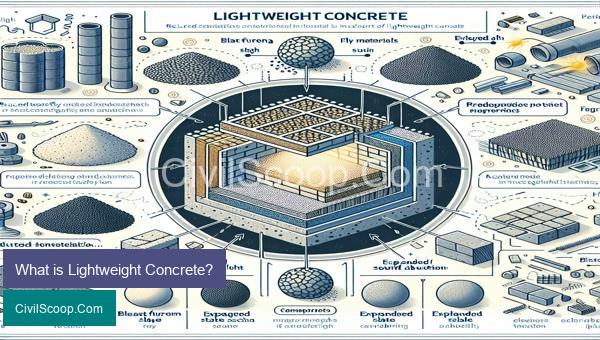
Lightweight concrete, also known as lightweight aggregate concrete, is a type of concrete that is made by replacing some of the traditional aggregates (such as gravel, crushed stone, or sand) with lightweight aggregates. These lightweight aggregates can include materials such as expanded clay, shale, or slate, perlite, vermiculite, or pumice.
The density of lightweight concrete can range from 300 kg/m3 to 1800 kg/m3, making it significantly lighter than traditional concrete which has a density of around 2400 kg/m3. This reduction in weight is achieved by using lightweight aggregates that are porous and have a lower specific gravity.
There are two types of lightweight aggregates used in lightweight concrete – natural and artificial. Natural lightweight aggregates are made from natural materials such as volcanic pumice, scoria, and tuff, while artificial lightweight aggregates are produced by heating and expanding natural materials such as clay, shale, or slate in a rotary kiln.
Lightweight concrete has various benefits that make it a popular choice in the construction industry. The lightweight nature of the concrete makes it easier to handle, transport, and place, which reduces labor and equipment costs. It also allows for faster construction as less structural support is needed.
Another advantage of lightweight concrete is its superior thermal properties. Due to the air voids created by the lightweight aggregates, this type of concrete has a lower thermal conductivity, making it an excellent choice for insulating buildings. It can also help in reducing energy costs by keeping buildings cooler in the summer and warmer in the winter.
Additionally, lightweight concrete has a higher fire rating than traditional concrete, thanks to the use of natural and inorganic lightweight aggregates. This makes it a safer option for building structures, especially in fire-prone areas.
While lightweight concrete has many benefits, it also has some limitations. It has a lower compressive strength compared to traditional concrete, which means it may not be suitable for structures that require high strength, such as bridges or high-rise buildings. Additionally, it can be more expensive than traditional concrete due to the cost of lightweight aggregates.
In conclusion, lightweight concrete is a type of concrete made by replacing some or all of the traditional aggregates with lightweight aggregates. It has several benefits such as reduced weight, better thermal properties, and higher fire resistance. However, it may not be suitable for all construction projects due to its lower strength and higher cost.
Classification of Lightweight Concrete
Lightweight concrete (LWC) is a type of concrete that has a lower density and a higher strength compared to traditional concrete. It is made by reducing the weight of the aggregate, either by using lightweight aggregates such as expanded clay, shale, or slate, or by using air voids within the mixture.
Lightweight concrete has several advantages over standard concrete, including reduced dead load on structures, improved thermal insulation, increased fire resistance, and less environmental impact due to the use of recycled materials. As a result, it has become a popular choice in the construction industry, particularly for the development of high-rise buildings, where weight is a critical factor.
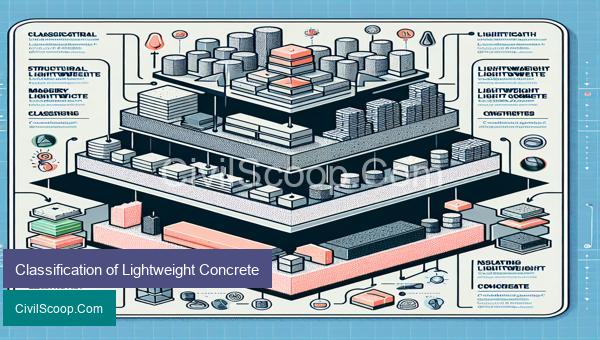
Based on the level of density and strength, LWC can be classified into three types: structural, insulating, and high-strength lightweight concrete.
1. Structural Lightweight Concrete
Structural lightweight concrete (SLWC) has a density ranging between 1400-1900 kg/m3 and a compressive strength of about 17-28 MPa. This type of concrete is used in the construction of high-rise buildings, bridges, and other structures where weight is a critical factor. The most commonly used aggregates in SLWC are expanded clay, shale, and slate. However, lightweight pumice and scoria aggregates are also used in some cases. SLWC provides good thermal insulation and fire resistance, making it suitable for both load-bearing and non-load bearing structures.
2. Insulating Lightweight Concrete
Insulating lightweight concrete (ILWC) has a density ranging between 250-1000 kg/m3 and a compressive strength of about 1-6 MPa. It is primarily used for thermal insulation purposes, such as in the construction of walls, roofs, and floors. The most commonly used aggregate in ILWC is expanded polystyrene (EPS) beads, which are mixed with cement, water, and a foaming agent. ILWC has excellent thermal insulation properties and is lightweight, making it an ideal choice for energy-efficient buildings.
3. High-Strength Lightweight Concrete
High-strength lightweight concrete (HSLWC) has a density ranging between 800-2000 kg/m3 and a compressive strength of 28-69MPa. This type of concrete is produced by using lightweight aggregates such as expanded clay, pumice, and slag. HSLWC is primarily used in applications where a higher strength is required, such as in precast concrete elements, hydropower structures, and tunnel linings. It offers the combined benefits of reduced weight and higher strength, making it a suitable choice for a wide range of construction projects.
In addition to these types, lightweight concrete can also be classified based on the method of production, namely pumped lightweight concrete, foamed concrete, and autoclaved aerated concrete (AAC). Pumped lightweight concrete is produced by using a pump to inject air into the mixture, creating a lightweight and high-strength product. Foamed concrete is produced by mixing a foaming agent, such as synthetic detergents, with the cement mix, resulting in a mix with a high volume of air voids. AAC is produced using a chemical reaction, resulting in concrete with a porous structure and a low density.
In conclusion, the classification of lightweight concrete is determined by its density, strength, and production method. Each type offers unique properties and advantages, making it suitable for different construction projects. As a civil engineer, understanding these classifications is crucial in selecting the right type
Types of Lightweight Concrete
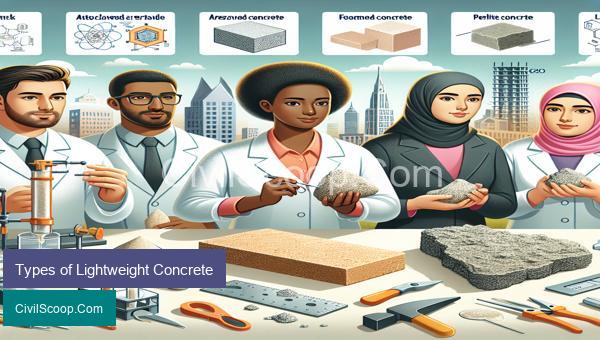
Lightweight concrete, also known as cellular or aerated concrete, is a type of concrete that has a lower density than traditional concrete. This is achieved by using aggregate materials that are lighter in weight, such as expanded clay, shale, or slate. Lightweight concrete offers several advantages over traditional concrete, such as improved thermal insulation, reduced dead load on structures, and increased fire resistance. In this article, we will discuss the various types of lightweight concrete.
1. Aerated Concrete:
Aerated concrete, also known as gas concrete, is a type of lightweight concrete that is produced by introducing air bubbles into a cement-based mixture. This is achieved by adding a foaming agent to the mixture, which creates tiny air bubbles that increase the volume of the mixture. The resulting concrete has a density of 450-900 kg/m³, making it 50-75% lighter than traditional concrete. Aerated concrete is commonly used in the construction of walls, partitions, and roofs.
2. Lightweight Aggregate Concrete:
Lightweight aggregate concrete is produced by replacing traditional aggregates such as crushed stone or gravel with lightweight aggregates, such as expanded clay, shale, or slate. These materials are lightweight and have a porous structure, making them ideal for use in concrete. The lightweight aggregates are mixed with cement and water to form a concrete mixture with a density of 800-1600 kg/m³. This type of lightweight concrete is commonly used in floor and roof slabs, precast elements, and in the construction of lightweight structures.
3. Foam Concrete:
Foam concrete, also known as cellular concrete, is a lightweight concrete that is produced by mixing a foaming agent with a cement-based mixture. The foaming agent creates air bubbles within the mixture, which results in a concrete with a density of 300-1600 kg/m³. Foam concrete is commonly used in filling voids, insulation, and in the construction of lightweight structures such as bridges, roads, and housing.
4. Cement-Bonded Particle Board:
This type of lightweight concrete is produced by bonding together medium density wood particles with cement. The resulting board has a density of 400-600 kg/m³ and is used in the construction of non-load bearing walls, partitions, and false ceilings. It offers thermal and sound insulation properties and is easy to handle and install.
5. Autoclaved Aerated Concrete (AAC):
AAC is a lightweight precast concrete that is made by mixing cement, fly ash, lime, and water. This mixture is then poured into molds and cured in an autoclave, which results in a strong and lightweight concrete with a density of 500-800 kg/m³. AAC is used in the construction of load-bearing walls, panels, and lintels in residential and commercial buildings.
In conclusion, lightweight concrete offers many advantages and can be produced using various methods and materials. The type of lightweight concrete chosen for a specific project will depend on its intended use, environmental conditions, and cost-effectiveness. It is important for engineers to carefully consider all factors before selecting the most suitable type of lightweight concrete for a particular construction project.
Types of Lightweight Concrete Based on Density and Strength
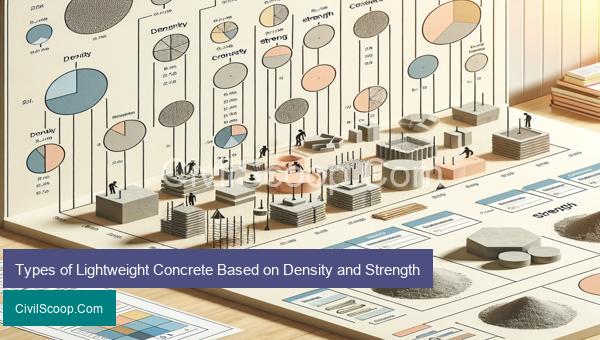
Lightweight concrete is a type of concrete that has a lower density compared to traditional concrete, making it lighter and easier to work with. It is commonly used in construction projects where weight is a major concern, such as high-rise buildings and bridges. Lightweight concrete can be classified into different types based on its density and strength. In this article, we will discuss the various types of lightweight concrete based on these properties.
1. Low-Density Lightweight Concrete
Low-density lightweight concrete (LWC) is a type of concrete with a density of less than 2,000 kg/m3. It is made by replacing the coarse aggregate with lightweight materials such as pumice, perlite, or expanded clay. LWC is commonly used for non-structural applications such as thermal insulation, filling voids, and soundproofing. It is also suitable for use in lightweight foundations and floor slabs.
2. Medium-Density Lightweight Concrete
Medium-density lightweight concrete (MDLC) has a density range of 2,000 kg/m3 to 2,500 kg/m3. It is made by replacing some of the coarse aggregate with lightweight materials, while the fine aggregate and cement remain the same. The most common lightweight materials used in MDLC are expanded shale, sand, and gravel. This type of concrete is suitable for structural applications such as load-bearing walls, partitions, and precast elements.
3. High-Strength Lightweight Concrete
High-strength lightweight concrete (HSLWC) is a type of concrete that has both high strength and low density. It is made by using lightweight aggregates, such as expanded clay, pumice, or shale, in combination with a high-strength cement and a low water-cement ratio. HSLWC has a density range of 2,000 kg/m3 to 1,500 kg/m3 and a compressive strength of over 50 MPa. This type of concrete is commonly used in high-rise buildings, bridge decks, and other structural applications where high strength and low weight are required.
4. Aerated Concrete
Aerated concrete, also known as cellular concrete, is a type of lightweight concrete that is produced by introducing air or gas bubbles into the concrete mixture. The air bubbles are created using a foaming agent or by incorporating aluminum powder into the mix. Aerated concrete has a density range of 300 kg/m3 to 1,200 kg/m3 and is used for both structural and non-structural applications. It is suitable for load-bearing walls, partition walls, and fire-resistant construction.
5. Lightweight Aggregate Concrete
Lightweight aggregate concrete (LWAC) is a type of concrete that is produced by replacing the natural coarse aggregate with lightweight materials such as expanded clay, pumice, or slag. LWAC has a density range of 1,500 kg/m3 to 1,700 kg/m3 and is commonly used in precast elements, structural lightweight concrete, and masonry blocks. It is also suitable for use in marine structures due to its high resistance to chloride ions.
In conclusion, lightweight concrete is a versatile material that offers a wide range of benefits, such as reduced weight, improved thermal insulation, and increased fire resistance. The type of lightweight concrete chosen for a specific construction project will depend on the required density and strength. It is important to carefully consider these factors to ensure the optimal performance of the concrete in the structure.
Uses of Lightweight Concrete
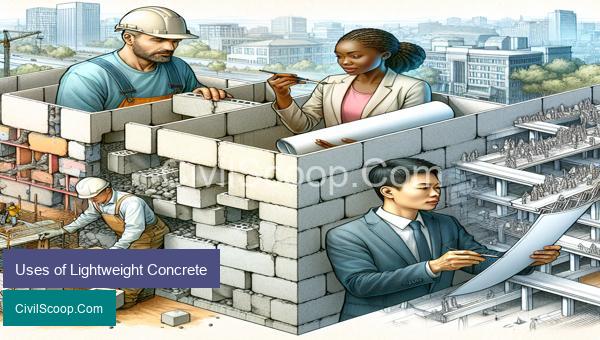
Lightweight concrete, also known as foamed concrete or aerated concrete, is a specialized type of concrete that has a significantly lower density than traditional concrete. It is made by mixing a lightweight aggregate material, such as expanded polystyrene beads or volcanic pumice, with a cement-based binder and water. This results in a concrete with a lower weight, enhanced thermal and acoustic insulation properties, and improved fire resistance.
Lightweight concrete has many uses in civil engineering due to its unique properties. Some of the common uses are listed below:
1. Building Construction:
Lightweight concrete is commonly used in the construction of buildings, especially in multi-story structures. Since it is significantly lighter than traditional concrete, it reduces the overall weight of the structure, thereby decreasing the load on the foundation and structural elements. This makes it a preferred choice for building tall and large structures.
2. Insulation:
The high thermal insulation properties of lightweight concrete make it an ideal material for insulation in buildings. It is commonly used in wall and roof panels to enhance the energy efficiency of a building. It helps in reducing the heating and cooling costs, making it a sustainable and cost-effective option.
3. Bridge Construction:
Lightweight concrete is also used in the construction of bridges, particularly in the deck slabs. The lower density of the concrete reduces the overall weight of the bridge, making it more efficient in withstanding the live load. It also has a higher ductility compared to traditional concrete, making it a better choice for seismic regions.
4. Road Construction:
In road construction, lightweight concrete is used as a base material for pavements. Its lower density makes it easier to transport and place, reducing the time and labor required for construction. It also has a high strength-to-weight ratio, making it a suitable option for high traffic areas.
5. Marine Applications:
Lightweight concrete is highly resistant to water, making it an ideal material for marine structures. It is used in the construction of dykes, breakwaters, and underwater structures. Its lower weight also helps in reducing the overall load on the structure, making it more stable and durable.
6. Roofing:
Lightweight concrete is commonly used in roofing applications due to its excellent thermal insulation and waterproofing properties. It is used in the form of precast panels or as a cast-in-place layer on a flat or sloping roof. This not only provides insulation but also helps in creating a level and smooth surface for roof finishes.
7. Geofoam:
Geofoam, which is a type of expanded polystyrene foam, is often used in lightweight concrete for geotechnical applications. It is used to fill voids, reduce lateral earth pressures, and provide lightweight backfills. Its low density and high compressive strength make it an ideal material for use in embankments, retaining walls, and roadways.
In conclusion, lightweight concrete has several uses in civil engineering, and its popularity is increasing due to its numerous advantages over traditional concrete. It offers a more sustainable and cost-effective solution for various construction projects. As research and technology continue to advance in this field, we can expect to see more innovative uses of lightweight concrete in the future.
Advantages of Lightweight Concrete
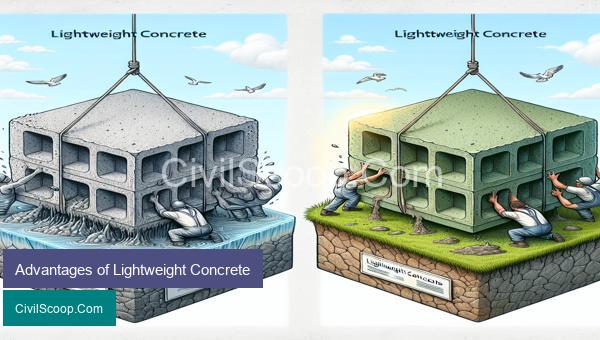
Lightweight concrete, also known as foam concrete, is a special type of concrete that contains less aggregate materials and more air pockets. This results in a lower density compared to traditional concrete, making it significantly lighter in weight. This type of concrete has gained popularity due to its various advantages over traditional concrete. Below are some of the main advantages of lightweight concrete.
1. Reduced Weight: As the name suggests, lightweight concrete is significantly lighter in weight compared to traditional concrete. It has a density of 300 to 1800 kg/m3, while traditional concrete has a density of around 2300 kg/m3. This makes it an ideal choice for structures that require a high strength-to-weight ratio, such as high-rise buildings, bridge decks, and parking garages. The lower weight of lightweight concrete also reduces the load on the foundation, leading to cost savings.
2. Improved Thermal Insulation: The air pockets in lightweight concrete act as insulators, providing better thermal insulation compared to traditional concrete. This makes it suitable for use in buildings in hot or cold climates, as it can help reduce energy consumption by maintaining a consistent indoor temperature.
3. Better Fire Resistance: Due to the presence of air pockets in lightweight concrete, it has a lower thermal conductivity, which means it takes longer for heat to transfer through it. This results in better fire resistance compared to traditional concrete. In case of a fire, the concrete will char on the surface, creating a protective barrier to the inner layers and preventing the structure from collapsing.
4. Increased Sound Insulation: Lightweight concrete has good sound absorption properties, making it an excellent choice for soundproofing walls and floors. The air pockets in the concrete trap sound waves, reducing noise transmission. This is beneficial in buildings such as hospitals, schools, and residential apartments, where noise control is crucial.
5. Ease of Handling and Placing: Due to its low weight, lightweight concrete is easier to handle and place compared to traditional concrete. This can result in faster construction, saving time and labor costs. It is also easier to cut, making it suitable for intricate constructions.
6. Improved Durability: The use of lightweight expands the life of concrete structures, as it reduces the load on the structure and minimizes the effects of shrinkage and thermal stress. It is also less prone to cracking and can withstand harsh environmental conditions.
7. Eco-friendly: The main ingredient in lightweight concrete is the use of fly ash, a by-product of coal-fired power plants. By utilizing fly ash, the carbon footprint of lightweight concrete is significantly reduced, making it more environmentally friendly than traditional concrete.
In conclusion, lightweight concrete offers several advantages, including reduced weight, improved thermal and sound insulation, better fire resistance, ease of handling, improved durability, and eco-friendliness. These benefits make it a cost-effective and sustainable option for a wide range of construction projects. As a civil engineer, understanding the advantages of lightweight concrete is essential to consider it as an alternative to traditional concrete and achieve improved structural performance.
Durability of Lightweight Concrete
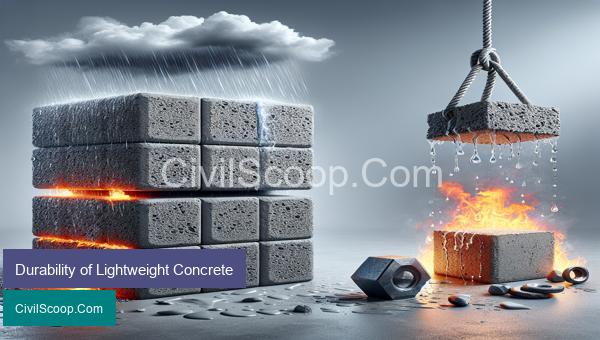
Lightweight concrete, also known as cellular or aerated concrete, is gaining popularity in the construction industry due to its numerous benefits such as reduced weight, improved thermal efficiency, and better sound insulation. However, one of the most important factors that determine the long-term performance of any concrete structure is its durability. Therefore, it is essential to understand and evaluate the durability of lightweight concrete.
Durability refers to the ability of a material to resist various environmental and chemical factors that can deteriorate its strength and structural integrity over time. In the case of lightweight concrete, the main factors that affect its durability are freeze-thaw cycles, chemical attacks, and carbonation.
Freeze-thaw cycles occur when water inside the concrete freezes due to low temperatures, causing expansion and damaging the concrete structure. The air voids and low water-cement ratio in lightweight concrete make it less prone to cracking during freeze-thaw cycles, making it more durable than traditional concrete. This is because the air voids provide space for the water to expand, preventing the pressure build-up that leads to cracking.
Chemical attacks can also significantly impact the durability of concrete. Lightweight concrete has a lower alkalinity than regular concrete, making it more vulnerable to chemical attacks. However, this can be mitigated by using additives and sealants to protect the concrete from harmful chemicals, making it more durable compared to traditional concrete.
Carbonation is a natural process in which carbon dioxide from the environment reacts with the calcium hydroxide in concrete, forming calcium carbonate. This process reduces the alkalinity of the concrete, resulting in the corrosion of embedded reinforcement and compromising the structural integrity of the concrete. As mentioned earlier, lightweight concrete has a lower alkalinity, making it more susceptible to carbonation. However, this can be prevented by using additives and sealants to protect the concrete from carbon dioxide penetration.
Another important aspect of durability is the long-term strength and structural performance of the concrete. Lightweight concrete has a lower density, which can cause concerns about its strength and load-bearing capacity. However, studies have shown that lightweight concrete can have equal or even higher compressive strength compared to regular concrete. This means that lightweight concrete is not only durable against environmental and chemical attacks but also strong enough to withstand the required loads and stresses.
In conclusion, durability is a crucial aspect of any concrete structure, and lightweight concrete has proven to be a durable material when used correctly. Its light weight, improved resistance to freeze-thaw cycles, and ability to withstand chemical attacks make it a robust choice for many construction projects. However, proper design and construction techniques, such as using additives and sealants, are essential in ensuring the long-term durability of lightweight concrete structures. As a civil engineer, it is crucial to carefully consider and evaluate the durability aspects of lightweight concrete in any construction project.
Conclusion
In conclusion, lightweight concrete is a versatile building material with numerous benefits. Its lightweight nature makes it ideal for use in various construction projects, from residential homes to commercial buildings. Its durability, insulation properties, and fire resistance also make it a practical choice for many applications. With ongoing research and advancements, lightweight concrete continues to evolve and improve, providing sustainable and cost-effective solutions for the construction industry. Whether it’s reducing the environmental impact of a project or enhancing its structural strength, lightweight concrete offers endless possibilities and solutions for the modern world. Therefore, it is evident that lightweight concrete is here to stay and will continue to revolutionize the construction industry for years to come.