Dynamic compaction is a ground improvement technique that has been used for many decades to improve the strength and stability of soil. It involves the repeated dropping of a heavy weight onto the ground surface, which creates powerful shock waves that consolidate and densify loose soil layers. This process has a range of advantages, including cost-effectiveness, speed of execution, and minimal disturbance to surrounding structures. In this article, we will explore the purposes and uses of dynamic compaction, highlighting its effectiveness in various applications and the benefits it provides to construction projects.
Table of Contents
Purpose of Dynamic Compaction
The purpose of dynamic compaction is to improve the load-bearing capacity and stability of soil or foundation materials by compacting them using controlled, high-energy impacts. This process is typically used for construction projects where soft or loose soils need to be strengthened to support heavy structures, such as buildings, roads, highways, or airports.
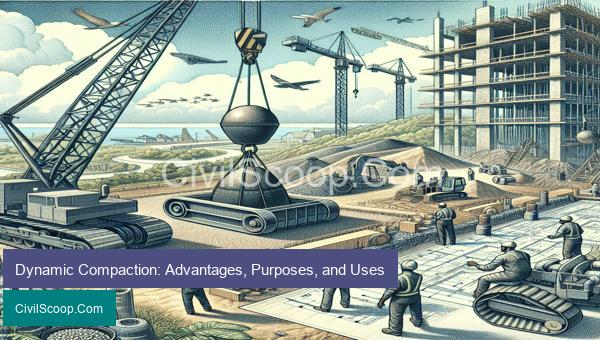
Dynamic compaction is also commonly referred to as dynamic consolidation or impact compaction. It involves the use of specialized heavy machinery, such as a crane or excavator-mounted tamper, to drop a heavy weight repeatedly onto the ground surface. The weight range can vary from 10 to 40 tons, and the height of the drop can range from 15 to 40 feet.
The impact of the weight creates a high-intensity energy pulse that drives the loose soil particles into a more compact state. The successive compaction impacts also cause the soil particles to rearrange and realign, resulting in a denser and more stable soil structure. This increase in density and improved interparticle contact leads to an increase in the soil’s shear strength, stiffness, and load-bearing capacity.
Dynamic compaction is often used on sites where the soil is too weak or has low bearing capacity to support the anticipated loads. It is also used in areas with loose fill or organic materials, such as sanitary landfills or dredged materials, where traditional compaction methods may not be efficient or feasible.
One of the primary advantages of dynamic compaction is its ability to improve the soil’s bearing capacity at greater depths than other compaction methods. The energy generated by the impact can penetrate up to 100 feet below the ground surface, making it suitable for deeper soils. It is also a cost-effective technique as it can compact large areas quickly, making it ideal for large-scale construction projects.
Additionally, dynamic compaction can also mitigate potential ground settlement issues that can occur due to construction activities. It can help to densify the soil layers, reducing the risk of future settlement or differential settlement, which can damage structures, roads, or other infrastructure.
In summary, the purpose of dynamic compaction is to strengthen, stabilize, and improve the soil or foundation materials’ load-bearing capacity by compacting them using high-energy impacts. It is a widely used and effective technique for improving the properties of soft or loose soils, making it an essential method in civil engineering and construction projects.
Dynamic Compaction Process
Dynamic compaction is a ground improvement method used in civil engineering to densify and strengthen the soil layers to increase their bearing capacity. It involves the use of heavy machinery to drop a heavy weight onto the ground surface repeatedly, causing a series of impacts that transmit energy into the soil layers, compacting and strengthening them.
The dynamic compaction process begins with a detailed site investigation to determine the underlying soil condition and the desired level of compaction. This information is used to design the optimum drop height, drop weight, and grid spacing for the compaction process.
The next step is to prepare the site for dynamic compaction. This involves clearing the area of any vegetation, debris, and loose materials to avoid any interference with the process. The site is also typically leveled to ensure a consistent drop height.
A specialized compactor, commonly known as a drop weight hammer, is used for the dynamic compaction process. This machine consists of a heavy weight (typically between 8-40 tons) and a drop height of 10-40 meters. The hammer is lifted by a crane and then released onto the ground surface at regular intervals, creating a series of impacts on the soil.
The impacts from the drop weight generate shock waves that spread outwards and downwards, resulting in intense vibrations and compaction of the soil layers. These vibrations cause the soil particles to rearrange and settle into a more compact state, increasing the overall density and strength of the soil.
The process is repeated on a grid pattern, typically with a spacing of 1.5 to 3 meters, depending on the soil conditions and desired level of compaction. The number of drops per grid point can vary depending on factors such as soil type, depth, and required level of compaction.
Dynamic compaction is most effective in coarse-grained soils such as gravel, sand, and silt, but can also be used in fine-grained soils with appropriate adjustments to the drop weight and height. The effectiveness of the process also depends on the soil moisture content, with dry soils achieving better compaction results.
One of the main advantages of dynamic compaction is its cost-effectiveness compared to other ground improvement methods. It can be completed relatively quickly, with large areas of land being treated in a short span of time. It is also a non-intrusive method, as it does not require excavation or significant disturbance of the ground.
However, there are some limitations to the use of dynamic compaction. It is not suitable for highly cohesive or organic soils, as they do not respond well to the dynamic impacts. There is also a risk of damage to nearby structures due to the intense vibrations, and as such, proper monitoring and safety measures should be put in place during the process.
In conclusion, dynamic compaction is an effective technique for ground improvement, particularly for compacting loose or weak soils. It is a reliable and cost-effective method to increase the bearing capacity of the ground and mitigate potential settlement issues. With proper planning and execution, it can provide long-term benefits for various civil engineering projects.
Advantages of Dynamic Compaction
Dynamic compaction is a technique used in the field of civil engineering to improve the strength and stability of soil. It involves the repeated dropping of heavy weights onto the soil surface, which causes dynamic loading and compaction. This process has several advantages, making it a popular and effective choice for soil improvement in construction projects. Some of the main advantages of dynamic compaction are listed below:
1. Suitable for a wide range of soil types:
Dynamic compaction is a versatile technique that can be used on various types of soils, including granular, cohesive, and mixed soils. This makes it an ideal choice for construction sites where the soil conditions may vary.
2. Cost-effective:
Dynamic compaction is a cost-effective method of improving soil strength and stability as it requires minimal equipment and labor compared to other conventional methods such as soil replacement or soil stabilization. This makes it an attractive option for construction projects with budget constraints.
3. Fast and efficient:
Dynamic compaction is a rapid and efficient process that can be completed in a relatively short period. The heavy weight drops create shock waves that penetrate deep into the ground, consolidating and strengthening the soil layers in a short time. This reduces construction time and allows for faster project completion.
4. Improved load-bearing capacity:
Dynamic compaction results in significant improvement in the load-bearing capacity of the soil. The repeated drop of weights creates denser and more compact soil layers, increasing their ability to support heavy structures and loads. This makes it an ideal method for improving the bearing capacity of the ground for foundations of buildings, bridges, roads, and other structures.
5. Minimal disturbance to the surrounding area:
One of the major advantages of dynamic compaction is that it causes minimal disturbance to the surrounding area. Unlike other soil improvement methods like soil replacement, there is no need for excavating and disposing of soil, thus reducing the impact on the environment. This makes it a sustainable option for construction projects.
6. Suitable for large scale projects:
Dynamic compaction is suitable for large scale projects as it can cover a considerable area in a short time. This makes it an ideal choice for construction sites with a vast area to be improved, as it is quicker and more efficient compared to other methods.
In conclusion, dynamic compaction is a cost-effective, fast, and efficient method of improving soil strength and stability. Its versatility, improved load-bearing capacity, and minimal disturbance to the surrounding area make it a popular choice for civil engineering projects.
Disadvantages of Dynamic Compaction
Dynamic compaction is a ground improvement technique that involves the use of heavy machinery to continuously drop large weights on the surface of the soil. This process helps to increase the density and strength of the soil, making it suitable for supporting the weight of buildings, roads, and other structures. While dynamic compaction has its advantages, it also has some disadvantages that engineers and contractors need to be aware of. In this article, I will discuss the main disadvantages of dynamic compaction.
1. Limited depth of improvement:
Dynamic compaction is only effective in improving the top layers of the soil. The energy from the impact of the weights decreases as it travels deeper into the soil. As a result, the improvement in soil density and strength is limited to a shallow depth. This can be a significant disadvantage if the structure being built requires a deeper level of support.
2. Soil type limitations:
Dynamic compaction is most effective on granular soils that have low moisture content. The impact of the weights can cause finer soils, such as clay, to compress and potentially cause settlements. This limits the use of dynamic compaction to specific soil types and conditions, making it less versatile compared to other ground improvement methods.
3. Ground disturbance and vibrations:
The impact of the heavy weights can cause significant ground vibrations, which can be disturbing to nearby properties and structures. These vibrations can also cause damage to nearby structures, especially if they are old or poorly designed. In addition, the compaction process can cause ground disturbance, leading to settlement and potential damage to underground utilities.
4. Cost:
The equipment and labor required for dynamic compaction can be expensive, making it a costly ground improvement method. The process involves the use of heavy machinery, which requires highly skilled operators and additional safety measures. This can significantly increase the overall cost of a project.
5. Time-consuming:
Dynamic compaction is a time-consuming process, particularly when dealing with large areas. The compaction process may need to be repeated several times in different areas, which can delay the project schedule. In addition, the significant amount of time required for assessment and planning can also delay the construction process.
6. Environmental concerns:
The use of heavy machinery and the disturbances caused by dynamic compaction can have adverse effects on the environment. The vibrations produced during the process can potentially harm nearby ecosystems, and the emissions from the machinery can contribute to air pollution.
In conclusion, dynamic compaction has some significant disadvantages that engineers and contractors must consider when choosing a ground improvement method. It is essential to thoroughly assess the site conditions and project requirements before deciding on the most suitable ground improvement method to use.
Applications of Dynamic Compaction
Dynamic compaction is a method commonly used in civil engineering for improving the load-bearing capacity of soils. It involves dropping heavy weights repeatedly on the surface of the ground to compact the soil and densify it. This technique has been used for several decades and has proven to be effective in a variety of applications. Here are some of the most common applications of dynamic compaction:
1. Foundation Improvement: Dynamic compaction is often used to improve the bearing capacity and stiffness of soils for building foundations. By compacting the soil, the technique can increase the soil’s ability to support the weight of the structure and reduce the settlement, therefore improving the overall stability of the building.
2. Road and Highway Construction: The use of dynamic compaction is widespread in the construction of roads and highways. This method is used to compact the soil and create a stable base for the pavement layers above. Dynamic compaction can also help to improve the resistance of the soil against the lateral forces generated by heavy traffic.
3. Landfill Construction: Landfills require a strong and stable base to support the weight of the waste they contain. Dynamic compaction is an effective technique to create a suitable foundation for landfills. It can help to reduce the settlement of the landfill and improve its overall stability.
4. Slope Stabilization: Dynamic compaction is also used for slope stabilization in hilly terrain. By compacting the soil and increasing its density, this method can improve the strength and stability of slopes, reducing the chances of landslides and soil erosion.
5. Airport Runways: Airports require stable and durable runways to handle the weight of aircraft during takeoff and landing. Dynamic compaction is used in the construction of airport runways to create a strong, compacted base layer that can withstand heavy aircraft loads and reduce settling.
6. Building Demolition: In cases where existing structures need to be demolished for redevelopment, dynamic compaction can be used to densify the soil underneath the building. This helps to reduce the potential for differential settlement of the new structure and creates a stable foundation for the new construction.
7. Site Preparation: Before any construction project, the site must be properly prepared. Dynamic compaction is a common technique used for site preparation, especially in areas with poor soil conditions. By compacting the soil, this method can improve the stability of the site, making it suitable for construction.
In conclusion, dynamic compaction has a wide range of applications in civil engineering, making it a valuable and versatile technique. It is a cost-effective method for improving the strength, stability, and load-bearing capacity of soils, making it an essential tool for many construction projects.
Conclusion
In conclusion, Dynamic Compaction is a highly effective technique used for improving the strength and stability of soil. This method offers several advantages over traditional compaction methods, such as speed, cost-effectiveness, and versatility. It can be used for a variety of purposes, from creating a solid foundation for buildings to preventing liquefaction in earthquake-prone areas. Additionally, Dynamic Compaction is a sustainable solution that minimizes soil settlement and long-term maintenance costs. With a proven track record of success, this technique continues to be a popular choice in the construction industry. Whether for large scale projects or smaller applications, Dynamic Compaction remains an invaluable tool for achieving optimal soil density and strength.